
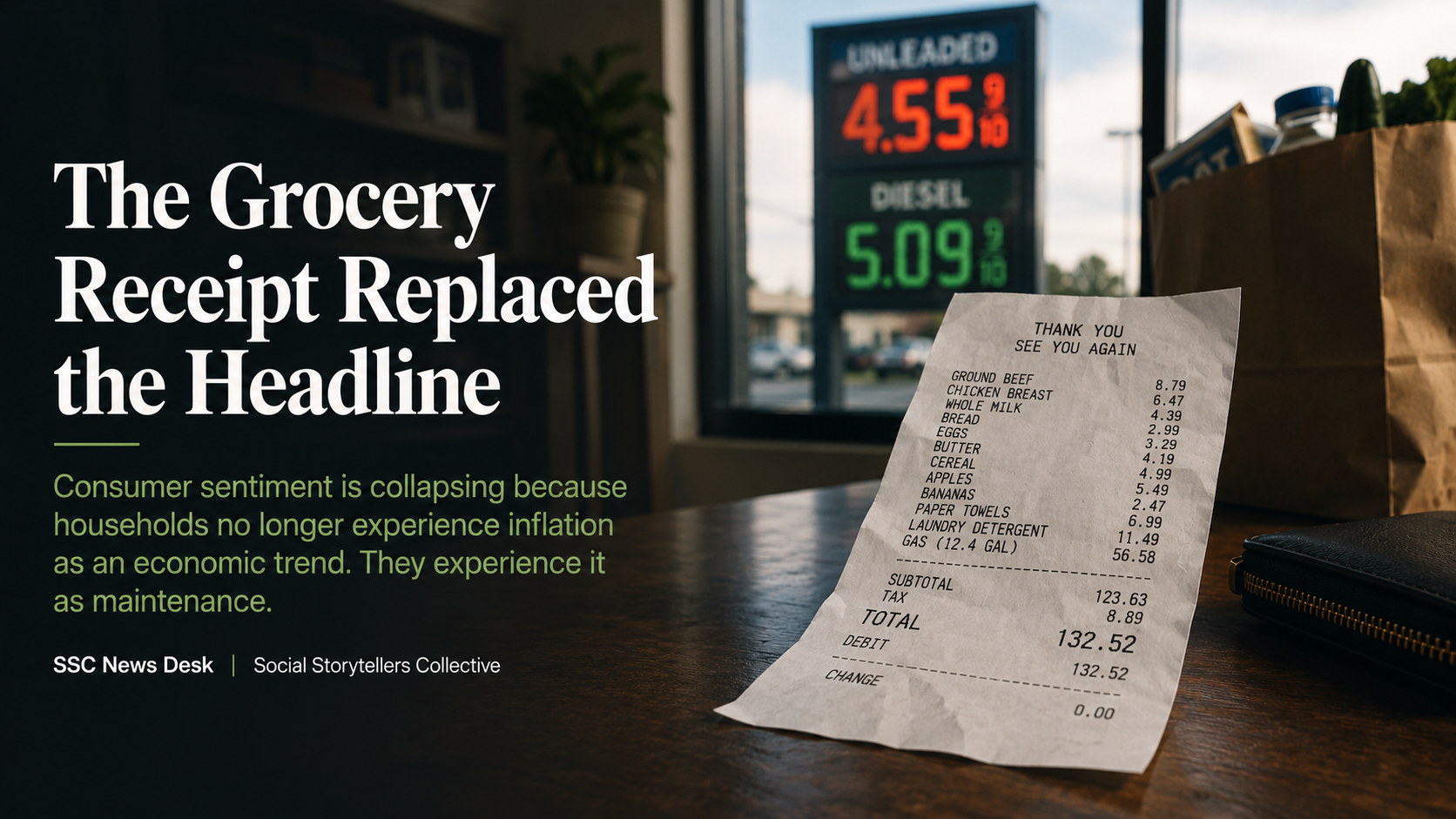
U.S. consumer sentiment fell to 44.8 in May, the lowest reading ever recorded by the University of Michigan survey, even as broader economic indicators continue to describe the labor market as relatively stable. The national average for gasoline climbed above $4.55 per gallon this week. Food prices remain elevated. Insurance costs continue rising. The economy is increasingly producing a split-screen reality where official resilience and personal depletion coexist at the same time.
What changed over the last year is not simply that things became more expensive. It is that the cumulative cost of maintaining ordinary life has started breaking through psychological thresholds for middle-income households. Inflation initially entered public conversation as a temporary macroeconomic disruption tied to supply chains and interest rates. Now it is showing up as exhaustion. Americans are spending more money simply to preserve the same routines they had two years ago, and increasingly they are failing to keep pace. The personal savings rate dropped to 3.6% this spring, near its lowest level since 2022. Credit card balances surpassed $1.2 trillion earlier this year. The household economy is no longer absorbing shocks quietly.
The contradiction inside the current economy is that many of the strongest financial indicators are disconnected from the emotional experience of participation. Markets remain relatively strong. Corporate earnings in sectors like travel, luxury retail, and AI continue climbing. But consumers do not experience the economy through stock performance. They experience it through recurring payments. A gallon of gas, a grocery cart, an insurance premium, a utility bill — these are the interfaces people actually interact with every day. The headline inflation rate declining matters far less when the baseline cost structure of ordinary life has permanently reset upward.
That reset is also changing behavior in visible ways. Americans are driving less, consolidating shopping trips, delaying travel, cutting restaurant visits, and increasingly moving toward discount retailers even in higher income brackets. Walmart executives said this week that more affluent consumers are continuing to migrate toward lower-cost purchasing patterns. Airlines and hospitality brands are simultaneously reporting softening domestic demand in lower-tier travel segments while premium experiences remain resilient. The result is an economy becoming more stratified not only by wealth, but by who still has the capacity to absorb volatility without altering their lifestyle.
SSC has been tracking this shift closely. In What Doesn’t Make It Into the Cart — part of our ongoing Access Shiftseries — we documented how food insecurity is no longer a condition defined by poverty alone. It is increasingly defined by the distance between what things cost and what paychecks can absorb. The 44.8 consumer sentiment reading is that distance becoming measurable.
The deeper structural issue is that inflation has evolved from a temporary disruption into an infrastructure problem. Housing, healthcare, transportation, and food costs are no longer fluctuating around a stable center. The center itself has moved. Wages have risen in some sectors, but not at the pace required to restore the purchasing power households lost over the last several years. Mainstream coverage still tends to frame inflation as something consumers are reacting to emotionally. Increasingly, the reaction is mathematical. The grocery receipt is not symbolic. It is operational.
This is why consumer sentiment matters even when unemployment remains relatively low. Confidence is not only about whether people currently have jobs. It is about whether they believe ordinary life is becoming more manageable or less manageable over time. Right now, the dominant feeling across much of the country is not collapse. It is compression. The economy still functions. People are still participating. But more households are quietly discovering that stability now requires a level of income that used to feel comfortably upper middle class.
The broader signal emerging is that Americans are entering a new relationship with consumption itself. Spending is becoming more defensive, more strategic, and more psychologically loaded. The post-pandemic economy promised normalization. What many households instead received was a permanent increase in the cost of remaining normal.