
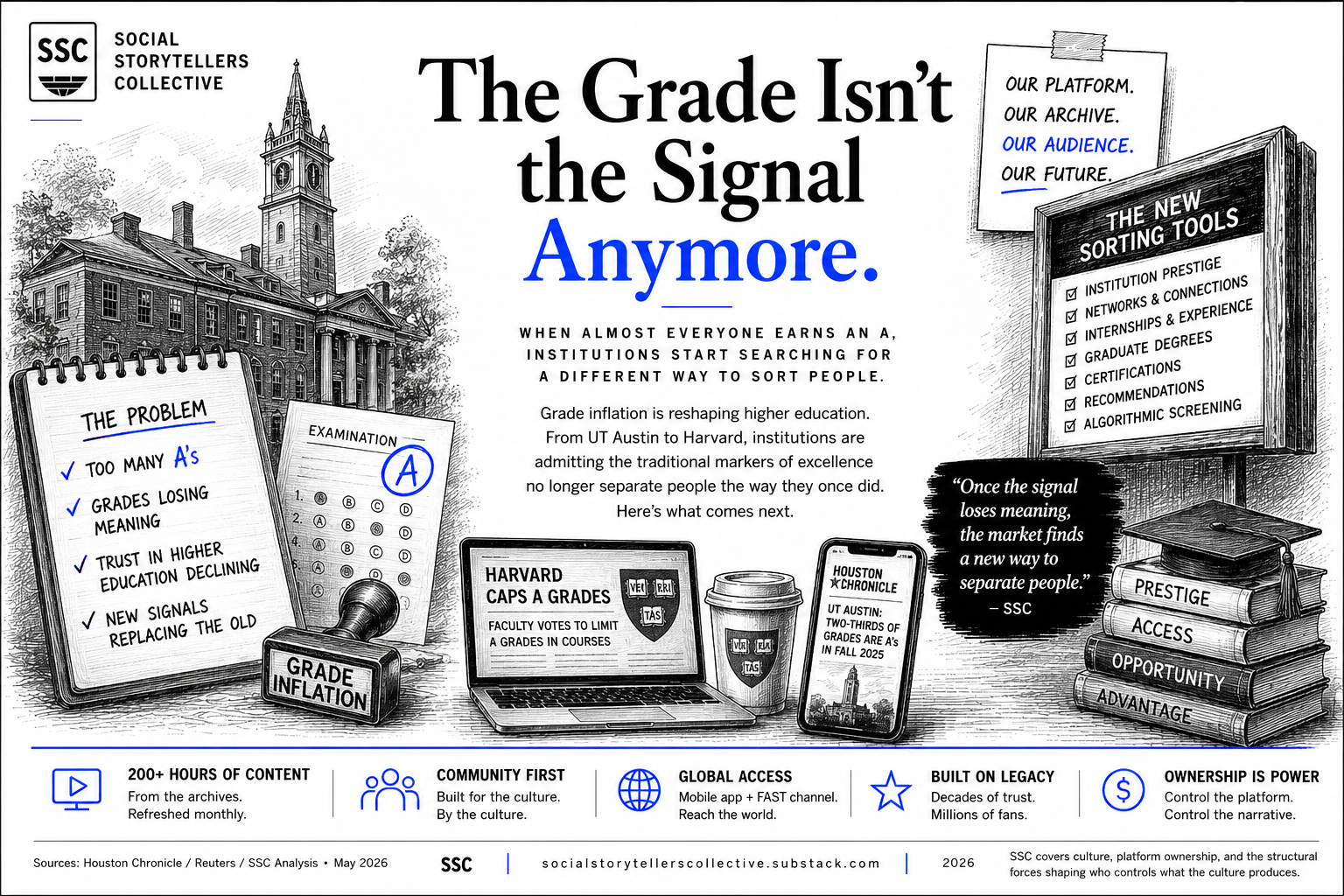
When almost everyone earns an A, institutions start searching for a different way to sort people.
Higher education is entering another legitimacy crisis — not because students are failing, but because too many are succeeding on paper in ways institutions no longer trust. A Houston Chronicle report this week found that roughly two-thirds of grades issued at UT Austin in fall 2025 were A’s, with 87% at B-minus or higher. The story lands amid broader national anxiety about whether grades still communicate mastery or distinction in the way universities once promised.
Elite institutions are beginning to admit it publicly. Harvard faculty recently voted to cap A grades after internal reports showed more than 60% of undergraduate grades were A’s — up dramatically from previous decades. The move was framed as an attempt to restore meaning to academic distinction after administrators warned the inflation was weakening academic culture itself. When nearly everyone is marked excellent, institutions and employers start searching for other ways to separate candidates.
The problem is what fills that vacuum. Grades were never just feedback — they were infrastructure. GPAs shaped scholarships, internships, graduate admissions, recruiting pipelines, and professional access. Once the signal inflates broadly enough, gatekeepers don’t stop sorting. They move to new filters: institutional prestige, social networks, unpaid experience, personality assessments, algorithmic screening. The replacement signal is rarely more equitable. Usually it’s less visible and harder to challenge.
Grade inflation is often framed as leniency or student entitlement. It’s also a market response to pressure. Universities compete simultaneously for tuition dollars, retention metrics, rankings, and graduation rates. Students increasingly see themselves as customers paying enormous sums for economic mobility in an unstable labor market. Professors face pressure from evaluations and administrative oversight. Under those conditions, harsher grading becomes institutionally expensive.
Employers are quietly signaling that the bachelor’s degree alone no longer resolves uncertainty — which helps explain why internships now function like prerequisite labor, why professional certifications keep expanding, and why elite firms increasingly recruit through narrower institutional pipelines even while publicly discussing access. Grade inflation doesn’t eliminate hierarchy. It intensifies the search for new hierarchy markers that are less transparent and more socially unequal than the GPA system they replace.
The political layer matters too. The Chronicle report noted that Texas A&M student government leaders joined calls for federal action on grade inflation — reflecting how academic rigor is becoming folded into larger debates about institutional trust. Higher education is already under pressure from lawmakers, donors, and federal officials over ideology, governance, and credibility. Grading is now part of that legitimacy fight: whether universities still function as engines of knowledge production or increasingly operate as expensive credential distributors struggling to hold public trust.
The larger signal isn’t that students are earning more A’s. It’s that institutions are admitting the traditional markers of excellence no longer do the work they once did. And once official signals weaken, informal sorting systems rush in. That shift rarely creates more equality. It just makes the hierarchy harder to see.
Related SSC analysis: Harvard’s Grade Inflation Debate Is About More Than Grades