
The research it dismisses as “dubious” has been peer-reviewed for decades. The pattern behind the investigation is the one worth watching.
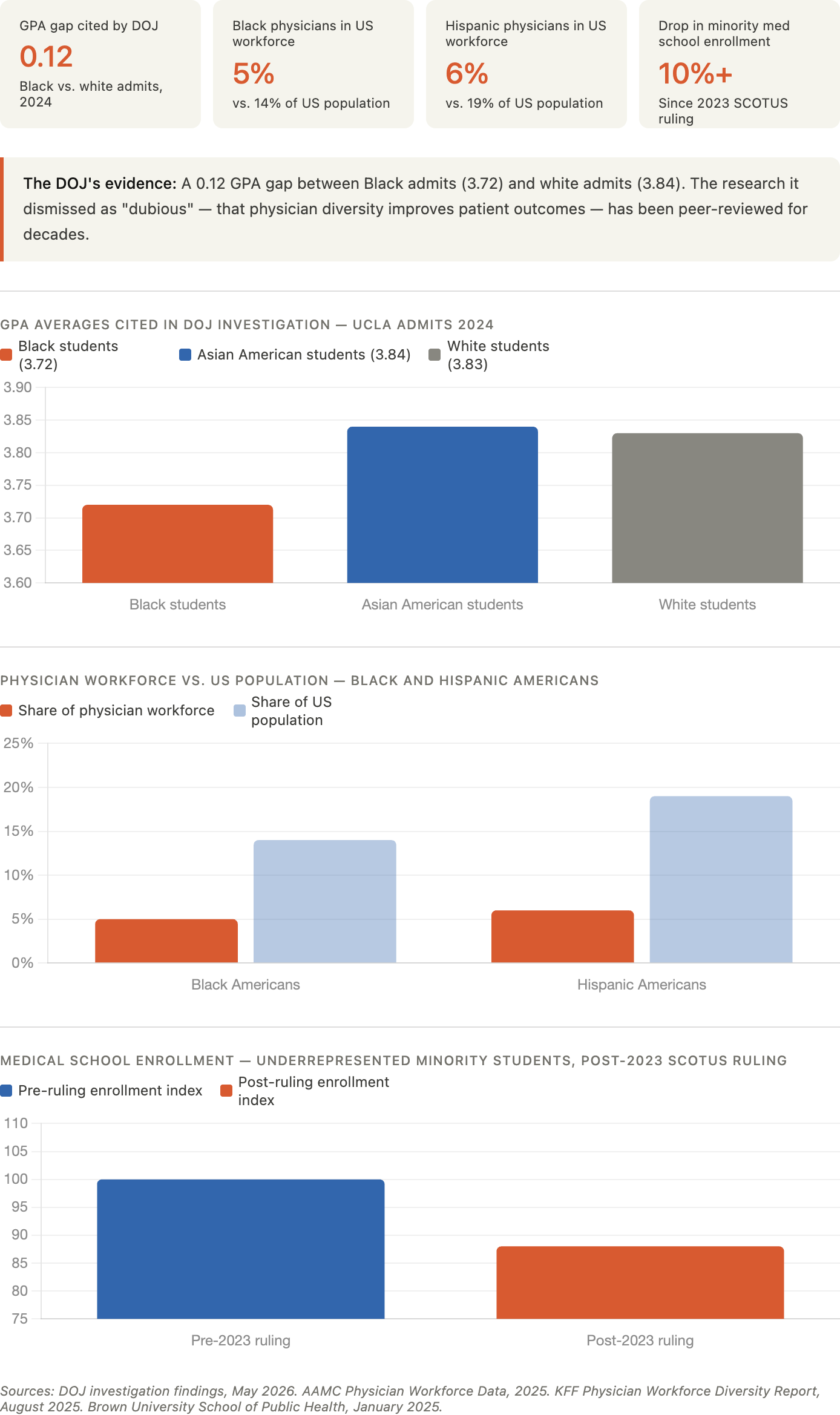
The Department of Justice announced this week that UCLA’s David Geffen School of Medicine illegally considered race in its admissions process, discriminating against white and Asian American applicants by favoring Black and Hispanic ones. As evidence, the DOJ cited a data point: Black students admitted in 2024 had an average GPA of 3.72, compared with 3.84 for Asian American students and 3.83 for white students.
That 0.12 difference is doing enormous work in this argument. It is worth examining carefully — because the DOJ is asking you to accept that a 0.12 GPA differential is proof of illegal discrimination, while simultaneously dismissing decades of peer-reviewed research on what actually produces better patient outcomes as a “dubious contention.”
That framing is not an accident. It is the argument.
What the research actually says
The DOJ specifically took issue with UCLA’s stated belief that patients receive better care when treated by a doctor of the same race. First Assistant U.S. Attorney Bill Essayli called this a “dubious contention.” He did not cite any evidence for that characterization. The research does not support it.
According to KFF analysis of the existing literature, greater representation of Black primary care physicians is associated with increased life expectancy and lower mortality among Black patients. Black, Hispanic, and Asian adults who have more health care visits with providers who share their racial or ethnic background more frequently report positive and respectful interactions — and are more likely to use preventive care, adhere to treatment plans, and avoid unnecessary emergency department visits.
A January 2025 study published in Health Affairs found that one in five Black and Hispanic individuals enrolled in Medicare Advantage plans had no access to a Black or Hispanic doctor in their network. Roughly four in ten counties lacked Black doctors in Medicare Advantage networks entirely. That is not a diversity statistic. That is a care access crisis.
Meanwhile, a Penn LDI study found that physicians are paid 8.8% less for visits with Black patients and 9.8% less for visits with Hispanic patients — meaning the doctors most likely to serve communities with the greatest health disparities face direct financial disincentives to do so. The system is structured to produce exactly the shortage it claims not to cause.
And yet the DOJ characterizes the medical rationale for physician diversity as dubious — without engaging any of this literature — while treating a 0.12 GPA gap as self-evident proof of discrimination.
What a 0.12 GPA gap actually tells you
Grade point averages and standardized test scores are not neutral measures of physician potential. They are metrics that have been extensively documented to reflect socioeconomic advantage, access to test preparation, undergraduate institutional resources, and the compounding effects of attending well-funded versus under-resourced schools — not innate ability or future clinical performance.
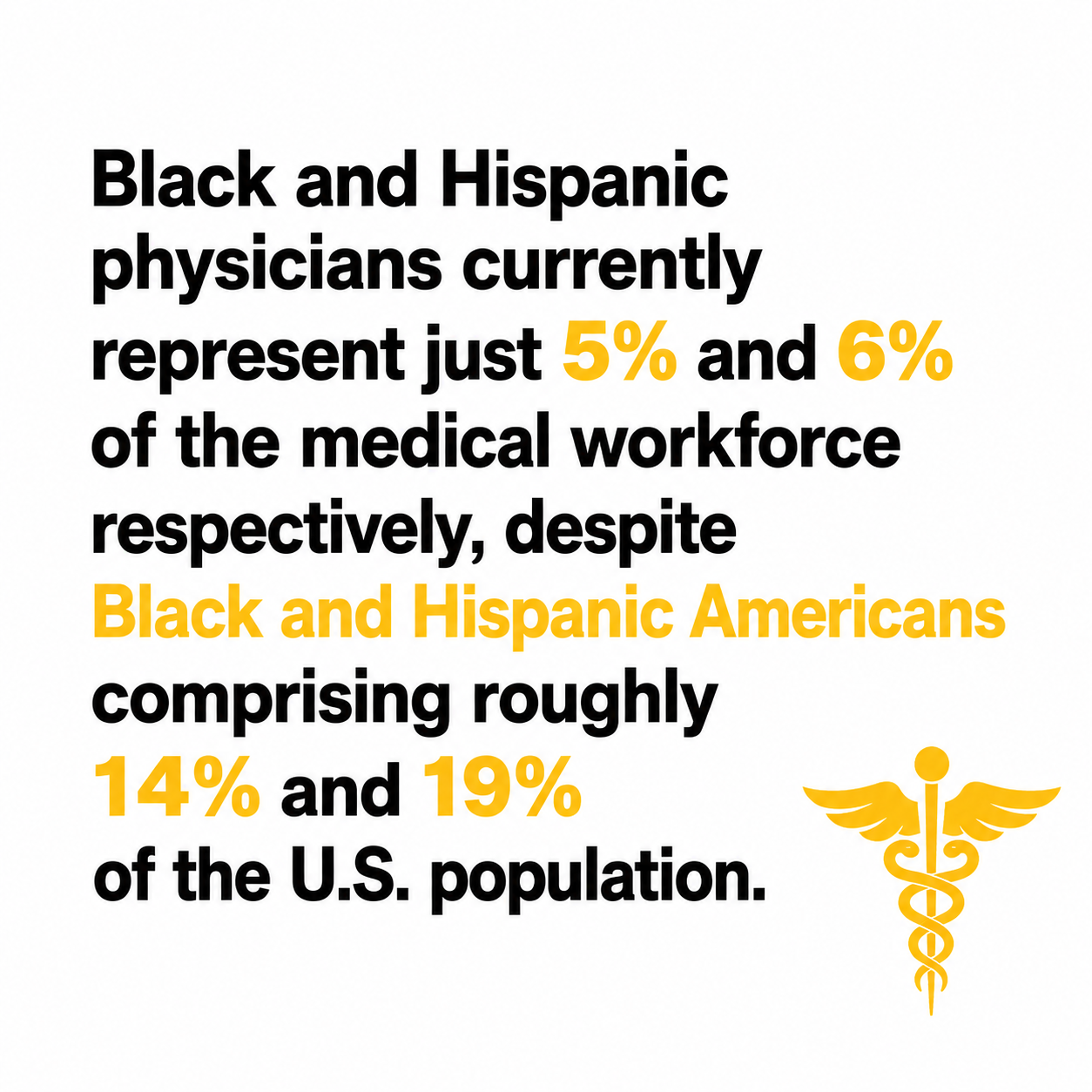
The AAMC projects a physician workforce deficit of between 37,800 and 124,000 doctors by 2034 — a shortage that falls disproportionately in underserved communities. Black and Hispanic physicians currently represent just 5% and 6% of the medical workforce respectively, despite Black and Hispanic Americans comprising roughly 14% and 19% of the U.S. population. Following the Supreme Court’s 2023 ruling banning race-conscious admissions, AAMC data show a double-digit drop in enrollment of Black, Hispanic, and Native American students at medical schools nationally.
The pipeline was already narrow. The DOJ investigation is now targeting the institutions that were still trying to widen it.
The pattern behind the investigation
The UCLA finding does not exist in isolation. In March, the DOJ opened investigations into possible race-based discrimination in medical school admissions at Stanford, Ohio State, and the University of California, San Diego. The Trump administration has simultaneously demanded that colleges collect data proving they are not considering race in admissions — data that then becomes the basis for investigations like this one.
This is the same strategic architecture visible in Tennessee’s redistricting session this week, in the passport revocation story, in the rollback of federal DEI contracting requirements that SSC documented in the Black unemployment piece earlier this week. The mechanism is different in each case. The direction is the same: systematically dismantle the institutional levers that produced any measurable racial equity, one investigation, one map, one policy at a time — while framing each individual action as a neutral application of law.
The Supreme Court’s 2023 Harvard ruling said colleges could continue to assess how applicants’ backgrounds speak to broader characteristics. The DOJ is now treating applicants’ personal statements about being part of a marginalized group as evidence of illegal intent. The window the Court left open is being closed from the inside.
What medicine loses
The Commonwealth Fund’s 2026 State Health Disparities Report found that policy changes made by Congress and the Trump administration in 2025 are likely to widen existing racial and ethnic disparities in access, affordability, and outcomes. Black and Hispanic children in all but eight states are already less likely to receive recommended preventive care than white children. Maternal mortality rates for Black women remain roughly three times higher than for white women. The communities carrying the greatest health burden are the ones most dependent on a diverse physician pipeline — and most exposed when that pipeline narrows.
The DOJ’s argument is that a 0.12 GPA differential constitutes illegal discrimination. The research it dismisses as dubious suggests that without deliberate intervention, the physician workforce will remain so racially homogenous that entire communities will continue going without doctors who understand their lives, speak their languages, and are willing to practice in their neighborhoods.
Both of those things cannot be equally true. The DOJ has chosen which one to act on.
UCLA said its admissions process “is based on merit and grounded in a rigorous, comprehensive review of each applicant” and that it is “confident in its practices.” The DOJ says it plans to sue. Penalties could include loss of federal funding.
The investigation is not really about GPA. It never was. It is about who gets to define merit, who benefits from that definition, and what happens to the communities left outside it when the institutions that challenged that definition are systematically dismantled.
Sources: KABC/ABC7 (Amy Powell, May 6, 2026). KFF Physician Workforce Diversity Report, August 2025. Health Affairs, January 2025. Penn LDI, December 2025. Commonwealth Fund 2026 State Health Disparities Report. JAMA Network Open, 2022 (Mora et al). Brown University School of Public Health, January 2025. Association of American Medical Colleges workforce data, 2025.