
Ozempic, Wegovy, Mounjaro, and Zepbound have moved fast enough and visibly enough that the market is treating GLP-1 adoption as a structural shift in American consumer behavior — and responding accordingly, at scale, before the majority of Americans who might benefit from these drugs have been able to access them. Food companies are reformulating products. Apparel brands are rethinking sizing strategies. Fitness and wellness companies are recalibrating around a consumer who is losing weight through medication rather than movement. Restaurants are adjusting portion sizes and menu offerings. Retail analysts are modeling reduced caloric consumption into long-term demand forecasts. The restructuring is real, it is accelerating, and it is being built around a consumer whose profile does not represent the population most in need of what these drugs actually do.
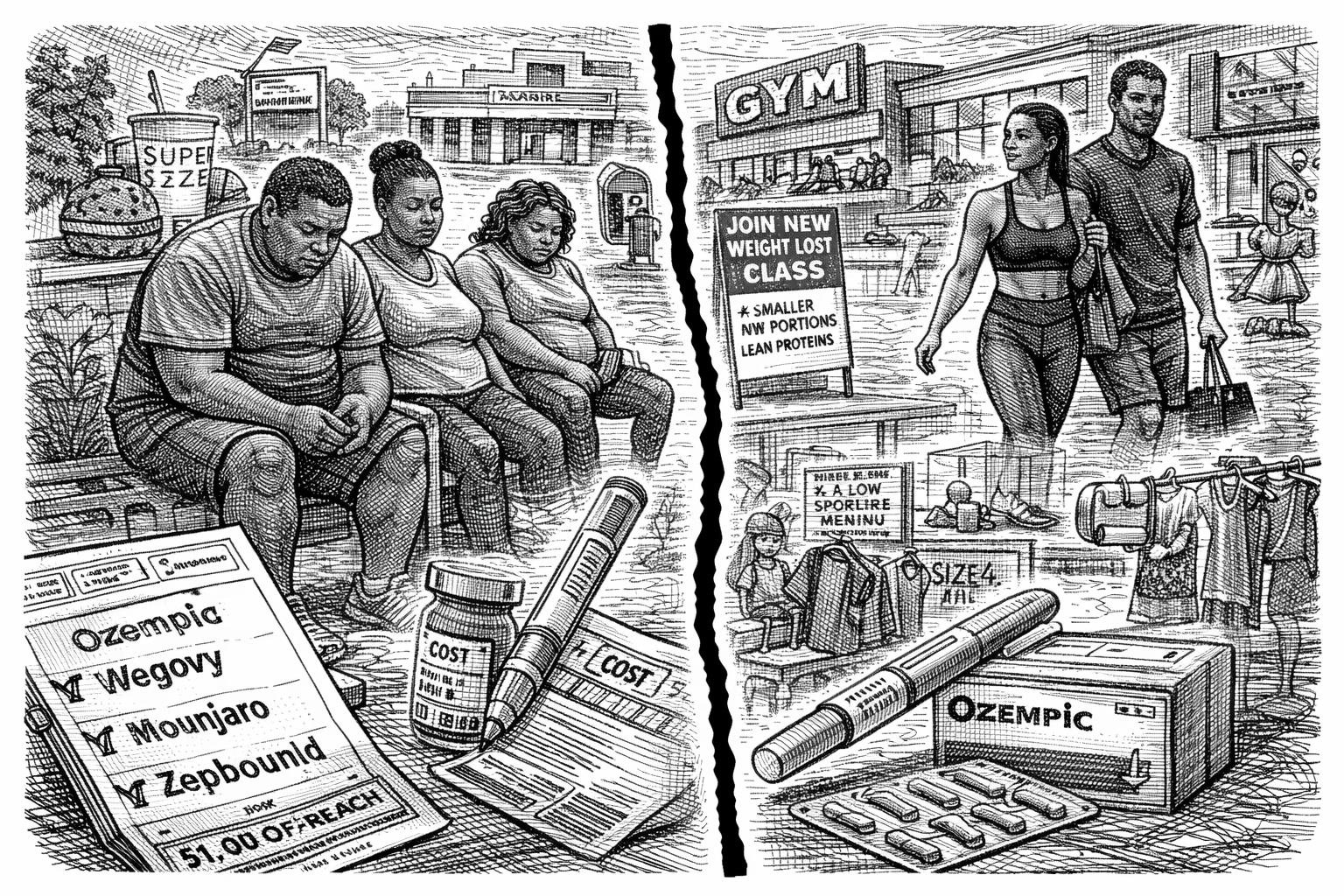
That sequencing is the story. The industries restructuring around GLP-1 adoption are doing so based on the behavior of a consumer cohort that skews white, higher-income, and privately insured — the population that has been able to access these medications at the price points and with the clinical support they require. The average monthly cost of Ozempic and Wegovy — the brand names that have become shorthand for the entire drug class — ranges from $900 to $1,300 without insurance coverage. Medicare only recently began covering GLP-1 drugs for obesity, and coverage remains inconsistent across Medicaid programs state by state. Employer insurance plans vary widely in whether they cover the drugs at all, and prior authorization requirements create additional barriers that disproportionately affect patients navigating complex insurance systems without administrative support. The result is a drug that is transforming American bodies and American markets simultaneously — but not equally, and not for everyone.
The communities most affected by obesity and its downstream health consequences — Black, Latino, and lower-income Americans — are the communities with the least reliable access to GLP-1 medications. Black Americans have higher rates of obesity, type 2 diabetes, and cardiovascular disease than white Americans, driven by the same structural conditions SSC tracks across every beat: food environments shaped by decades of disinvestment, healthcare systems with documented disparities in treatment quality and access, economic precarity that makes the cost of chronic disease management prohibitive, and a pharmaceutical industry that prices innovation for the market that can pay rather than the population that needs it most. The GLP-1 drugs that are being credited with reshaping American consumer behavior were developed in response to a health crisis that is most acute in communities that are now being asked to watch the market restructure around a solution they cannot access.
The food system dimension of this story deserves particular attention. If GLP-1 adoption continues to grow among higher-income consumers, food companies will increasingly optimize their products for reduced-appetite eating — smaller portions, lower caloric density, more protein-forward formulations — targeted at a market that has been medically recalibrated. The food environments in lower-income and majority-Black and Brown communities, which are already characterized by limited access to fresh produce, overrepresentation of ultra-processed foods, and the kind of caloric density that GLP-1 drugs are designed to counteract, are unlikely to be redesigned around the needs of a consumer cohort that the food industry does not see as the primary market for its reformulated products. The result is a bifurcating food system — one track optimized for the medicated consumer with access and purchasing power, another track unchanged for the communities most in need of the nutritional intervention the drugs are providing elsewhere. That bifurcation is not a side effect of the GLP-1 boom. It is its structural logic, operating exactly as consumer markets are designed to operate.
What gets built in the GLP-1 economy — which products get reformulated, which services get redesigned, which communities get counted in the consumer models driving those decisions — will be determined by who the market sees as its customer. The communities carrying the highest burden of the health conditions GLP-1 drugs treat are not, by and large, the communities the market is currently designing for. And if access to these medications does not expand significantly and equitably in the next several years, the GLP-1 economy will have succeeded in reshaping American consumer culture around a health intervention that deepened rather than closed the gap between who gets to be healthy and who gets to watch.