
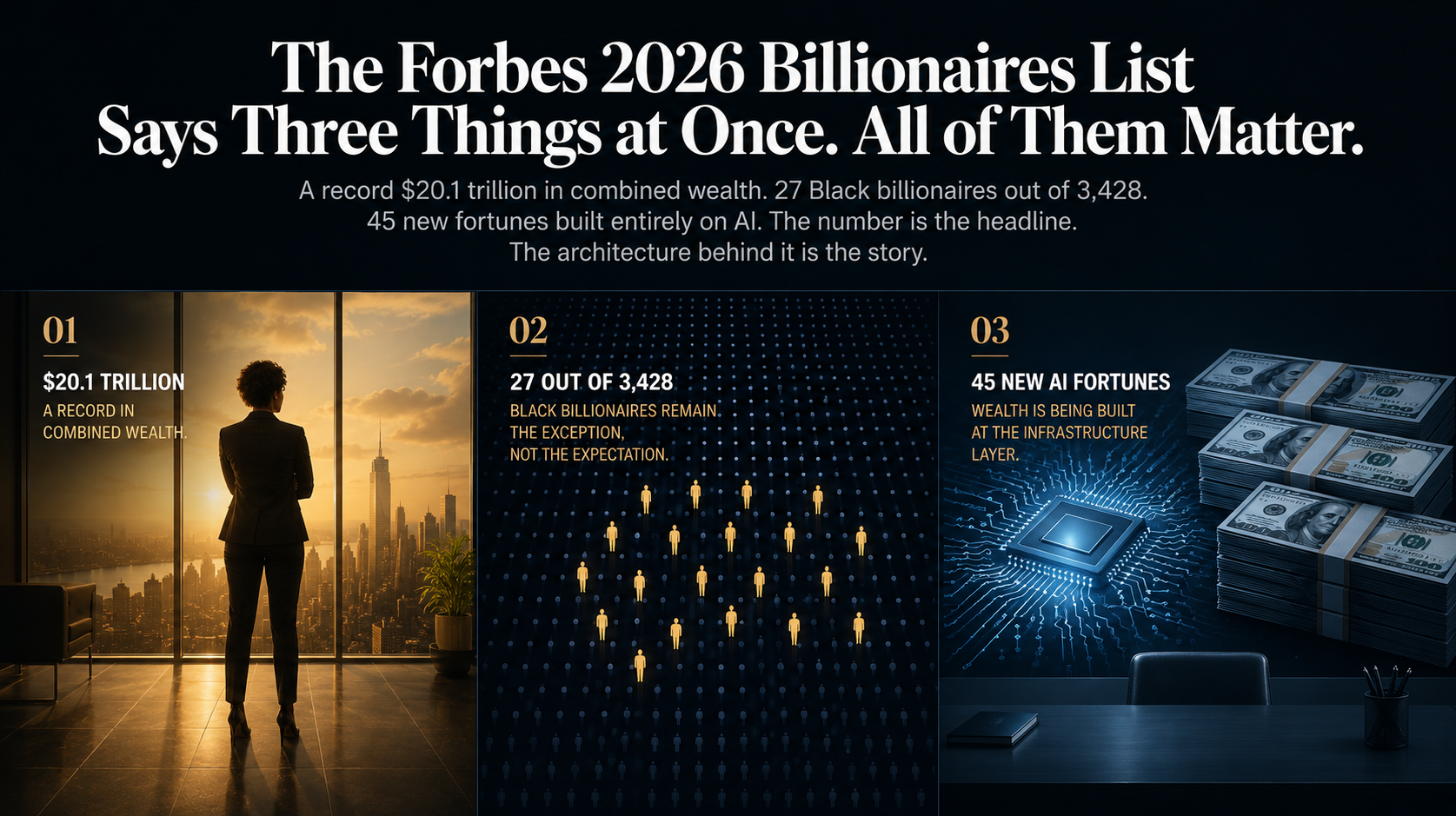
The Forbes 2026 World’s Billionaires List dropped in March with a headline that landed cleanly: a record 3,428billionaires, a combined net worth of $20.1 trillion — roughly equivalent to the GDP of the United States — and wealth that grew 25% in a single year. 309 new names. $4 trillion added to the pile since 2025.
Three stories live inside those numbers. They are related. They are not the same story.
The Beyoncé Story Is an Ownership Story
Beyoncé Knowles-Carter and Dr. Dre both crossed the billion-dollar threshold in 2026 as official Forbes newcomers. The coverage celebrated the milestone. SSC wants to be precise about what the milestone actually reflects.
Beyoncé’s billion was not built on streaming royalties or ticket revenue alone — though both contributed. It was built on a specific set of decisions made over nearly 30 years about what to own, what to control, and what not to give away. Her touring infrastructure. Her haircare line Cécred. Her Texas whiskey brand SirDavis. Her production company. Her masters. Her narrative. The billion is the outcome of an ownership architecture assembled piece by piece over three decades — in an industry that has historically extracted enormous value from Black artists while returning them the smallest possible share of what they generated.
Dr. Dre’s path follows the same logic from a different direction. His 2014 sale of Beats by Dre to Apple for more than $3 billion — a deal that included a significant equity stake — has continued to compound. New ventures including Gin & Juice with Snoop Dogg added to the total. He is now only the second rapper in history to appear on the Forbesbillionaires list, right behind Jay-Z, whose net worth sits at $2.8 billion.
Jay-Z, Rihanna, LeBron James, Tyler Perry, Oprah Winfrey — the pattern across every Black American on the list is consistent. The wealth was not built primarily through performance or celebrity. It was built through ownership. The cultural capital came first. The financial architecture was constructed deliberately on top of it. What The Grio noted this week is worth repeating plainly: for generations, Black labor — beginning with enslaved labor — built enormous wealth in this country that Black people were systematically excluded from accessing. The 27 names on the 2026 list represent what ownership looks like when the door finally opens. The door has not opened wide. But the names walking through it have understood exactly what was required to get there.
The 27 Number Is a Record. It Is Also Less Than 1%.
27 Black billionaires out of 3,428 total. That is 0.79% of the list representing a group that makes up roughly 14% of the U.S. population and a far larger share of the global population. The number is growing — up from 23 in 2025, with combined wealth rising from $96 billion to $121 billion in a single year. The growth is real. The ratio has not meaningfully changed.
Aliko Dangote holds the top spot for the 15th consecutive year — $28.5 billion, built on Dangote Cement, Africa’slargest cement producer, and a 650,000-barrel-per-day refinery in Lagos that pushed his fortune up $4.6 billion in the past year alone. He ranks 86th on the overall list. The richest Black man in America is Alexander Karp — co-founder and CEO of Palantir Technologies, with an estimated $13.4 billion — whose mother is African American. David Steward of World Wide Technology follows at $12.4 billion.
New to the list this year beyond Beyoncé and Dr. Dre: David Grain of Grain Management at $2.3 billion, Robert Johnson — co-founder of BET — returning to billionaire status, and Stefan Kaluzny of Sycamore Partners at $1.3 billion. Private equity and finance are producing new Black billionaires in ways entertainment and sports did not, which is its own structural argument about where generational wealth is being built in the current economy.
The 27 is worth celebrating. It is also worth holding next to the larger number. 3,428 billionaires. $20.1 trillion in combined wealth. Fewer than 30 of them are Black. The record is real. The ratio is what it is.
The AI Wealth Story Is the Economy Story
The 2026 list created 45 new billionaires whose fortunes were built entirely on artificial intelligence. Combined with existing AI-linked billionaires, there are now 86 people on the list whose wealth is directly tied to AI — as co-founders, senior executives, or major investors. Their combined wealth: $2.9 trillion.
That number requires context. SSC has spent the past week documenting how AI is being used to justify mass layoffs at JPMorgan, Meta, LinkedIn, and across the broader tech sector. The same technology generating $2.9 trillion in wealth for 86 people is being cited as the reason roughly 1,000 workers a day are losing their jobs in 2026. Both things are true. They are not unrelated.
The profile of the new AI billionaires is telling. The richest newcomer is Edwin Chen — a former Google and Metaengineer who founded Surge AI, a platform specializing in data labeling and annotation for neural network training, valued at $18 billion. The wealth was not built on building the model. It was built on building the data infrastructure the model depends on. The founders of ElevenLabs — voice platform Piotr Dabkowski and Mati Staniszewski — crossed the threshold this year. So did infrastructure-layer founders tied to data centers and the hardware running them: Peter Salanki of CoreWeave, Michael Hsing of Monolithic Power Systems. And at the application layer: the founders of Perplexity, Cursor, Lovable, Sierra, and Cognition — the companies building coding assistants and enterprise AI tools that are replacing the entry-level roles the credential economy was supposed to deliver.
The youngest self-made billionaire in Forbes history this year is Surya Midha — 22 years old, who co-founded AIrecruiting tool Mercor with two university friends. He is worth $2.2 billion. The tool his company built is used to screen and hire workers. The irony of a 22-year-old becoming a billionaire by building a platform that determines who gets jobs — in the same year that AI is being used to eliminate the jobs the people being screened were hoping to get — is not subtle.
6 of the 10 wealthiest people in the world have fortunes directly tied to AI investment. Elon Musk leads the list at $839 billion — more than double his 2025 fortune of $342 billion — driven in part by his investment in Grok and the continued growth of Tesla and SpaceX. The $100 billion club has a record 20 members. Five people own more than $200 billion each.
The companies cutting workers cite AI efficiency. The people who built the AI infrastructure are cashing out at a scale the list has never seen before. The workers being displaced are not in the $2.9 trillion. They are in the severance calculation.
What the List Actually Says
$20.1 trillion in combined billionaire wealth. A 25% increase in a single year. The top 20 centibillionaires — the $100 billion club — hold more wealth collectively than the bottom 2,000 billionaires on the list combined.
27 of the 3,428 names are Black. That is a record. It is also less than 1% of a list built significantly on industries — entertainment, sports, consumer goods — where Black labor, creativity, and cultural production have been foundational inputs for generations.
45 new fortunes built on AI in a single year. The same technology driving those fortunes is the primary justification being offered for the largest wave of white-collar job displacement in a generation.
The list tells three stories simultaneously. The Beyoncé story is about what ownership produces when Black artists and entrepreneurs refuse to let the industry extract the value without capturing a share of it. The 27 story is about how far that door has opened — and how much further it has to go. The AI story is about who is capturing the value of the most consequential technological transition of our lifetimes, and what is happening to everyone who isn’t.
All three are true. None of them are finished.