
Somewhere in a Long Island gymnasium this spring, twenty-one teenagers are going to walk across a stage wearing sashes that say Valedictorian 2026. They earned straight A-plusses in every class for four years. Before the ceremony was even scheduled, the internet had already decided what their achievement meant — and it wasn’t about them.
That’s the word doing work today. Not transformation this time. Fine print. It showed up in a credential whose ROI was eaten before anyone updated the brochure. It showed up in a platform that spent a decade calling participation free and is now sending you a bill. It showed up in a privacy promise running on a competitor’s engine. It showed up in a shoe brand that sold you a value system and found out value systems are discretionary spending. It showed up in a proxy war between a founder and the board of the company he built. And it showed up in twenty-one students whose achievement the internet converted into someone else’s argument before the graduation date was set.
The fine print was always there. This week it became the headline.
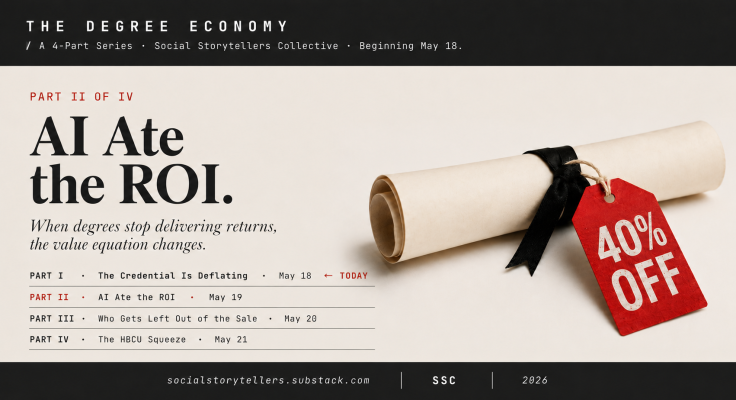
The Degree Economy: AI Ate the ROI
Part II of SSC’s four-part series
The MBA was a transaction. You paid — in time, money, and opportunity cost — and in return, McKinsey, Goldman, Bain, and BCG opened a door that was otherwise closed. The pyramid was the point. Thousands of entry-level analysts feeding work upward, billing hours, building the relationships that eventually made partners rich. You bought access to that pyramid. That was the deal.
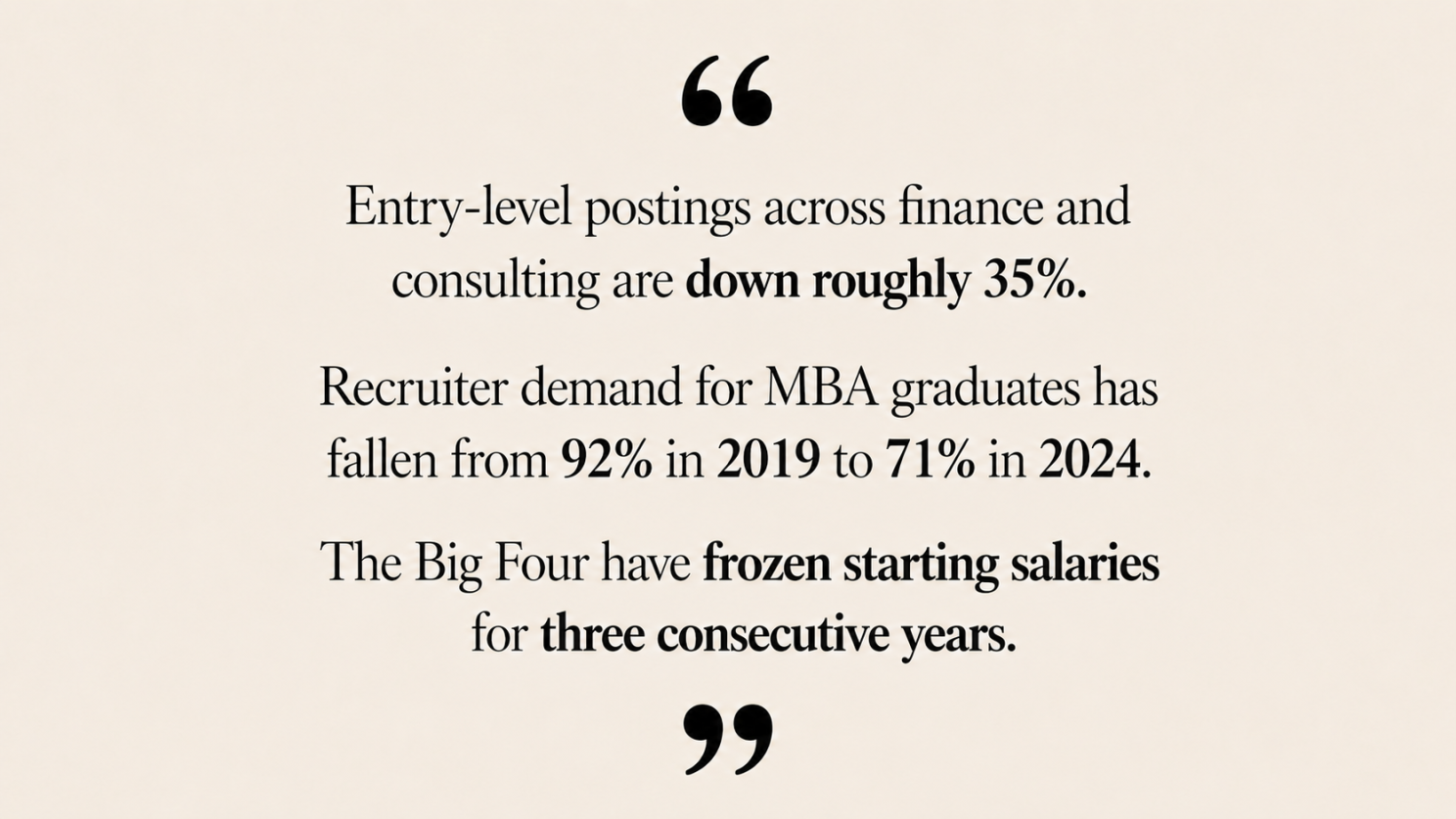
The pyramid is being dismantled. Entry-level postings across finance and consulting are down roughly 35%. Recruiter demand for MBA graduates has fallen from 92% in 2019 to 71% in 2024. The Big Four have frozen starting salaries for three consecutive years. Two senior executives estimated UK graduate recruitment would fall by roughly half in the coming year. McKinsey cut roughly 200 technology and support roles in late 2025, with further reductions signaled. BCG and Bain have followed parallel trajectories.
The schools’ response has been to add AI modules and cut tuition below the prestige line — UC Irvine, Purdue, Johns Hopkins all discounting. Not one top-20 program has touched their rates. The Harvard MBA still opens rooms the Purdue MBA doesn’t, regardless of what the entry-level market looks like underneath it.
The credential isn’t worthless. The job it was designed to fill is disappearing. That distinction matters enormously — especially for the workers who needed the non-Harvard version of this deal to work. Part III asks who was counting on it. And what happens to them now.
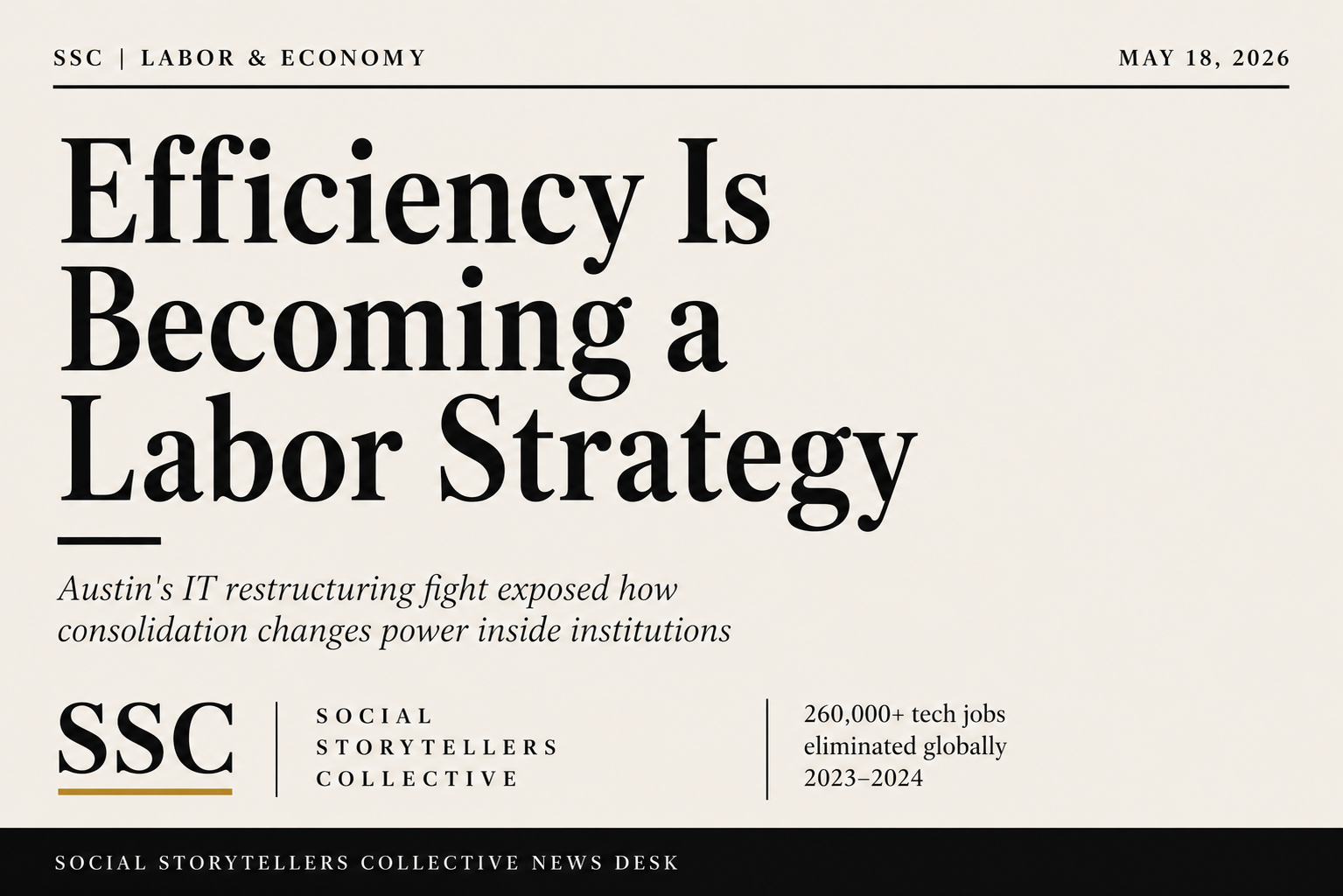
Austin officials scaled back the city’s proposed One ATS restructuring this week after municipal IT workers pushed back against a plan to consolidate more than 400 technology employees into a single centralized structure. The city called it modernization.
Workers have learned to read that word. “Efficiency” arrives in the paragraph before restructuring does. It reshapes who controls expertise inside the institution — and then how many humans that institution needs to hold that expertise at all.
Austin pushed back and the city blinked. Worth noting. Most don’t get the chance.
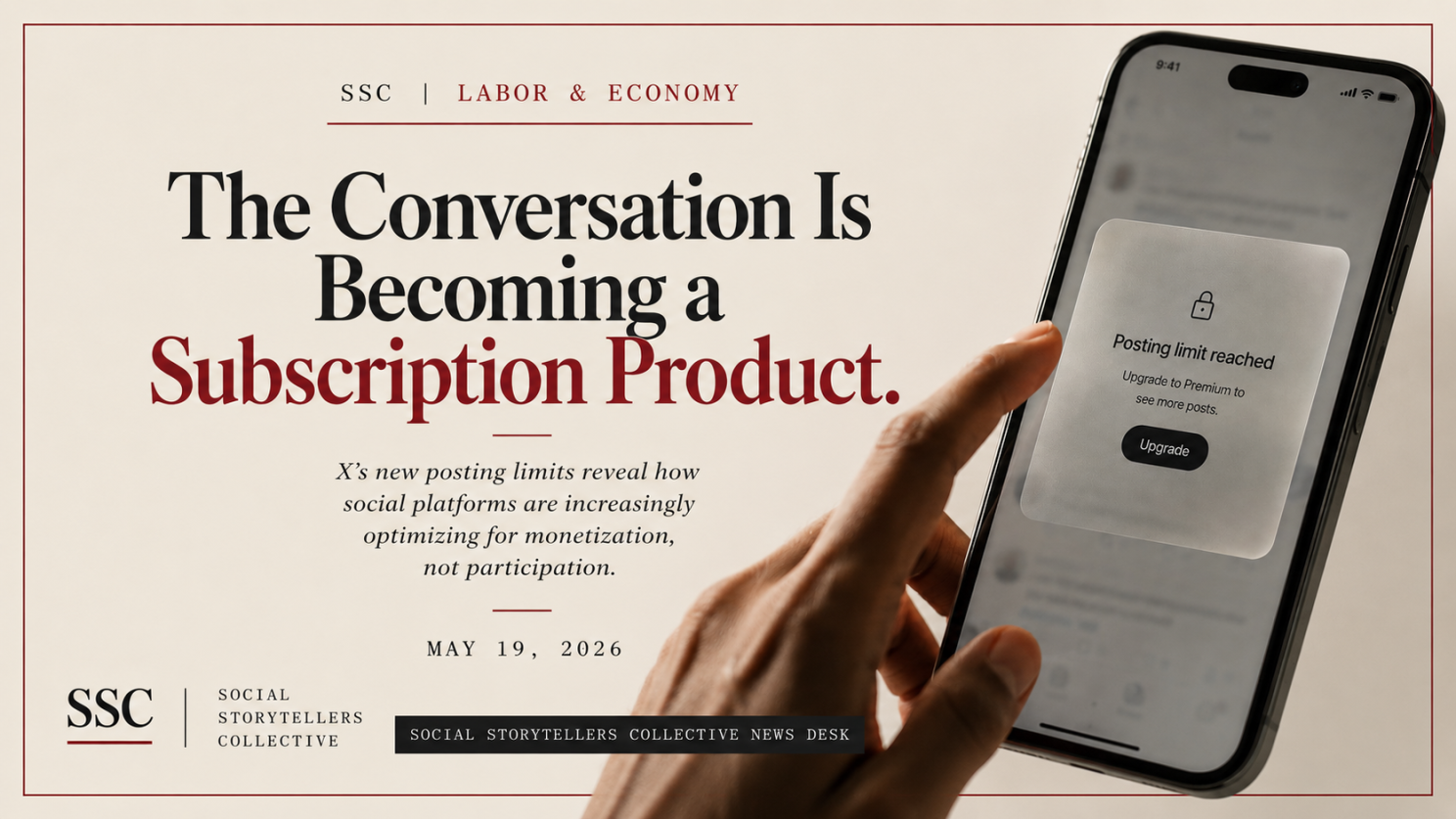
X’s new posting limits reveal how social platforms are increasingly optimizing for monetization, not participation.
X capped free users at 50 posts per day this week — tweets, reposts, quote posts — plus 200 replies, with a cooldown timer before you hit the wall. The platform that spent a decade optimizing for maximum engagement is now optimizing for maximum conversion.
The math is not complicated. X has approximately 14.2 million Premium subscribers against a total base of roughly 600 million monthly active users. The posting limits are a conversion mechanism: find the users who need this badly enough, then charge them to keep going. The communities that made X worth being on — journalists, Black Twitter, scientists, LGBTQ+ communities — were the first to leave when the environment became hostile enough to justify rebuilding elsewhere. Bluesky reached 42 million users. Threads surpassed 275 million monthly users.
The resentment and the reliance are not contradictions. They are the business model. Most of the people posting about leaving X are posting about it on X. The crowd is still the product. The free part is ending.
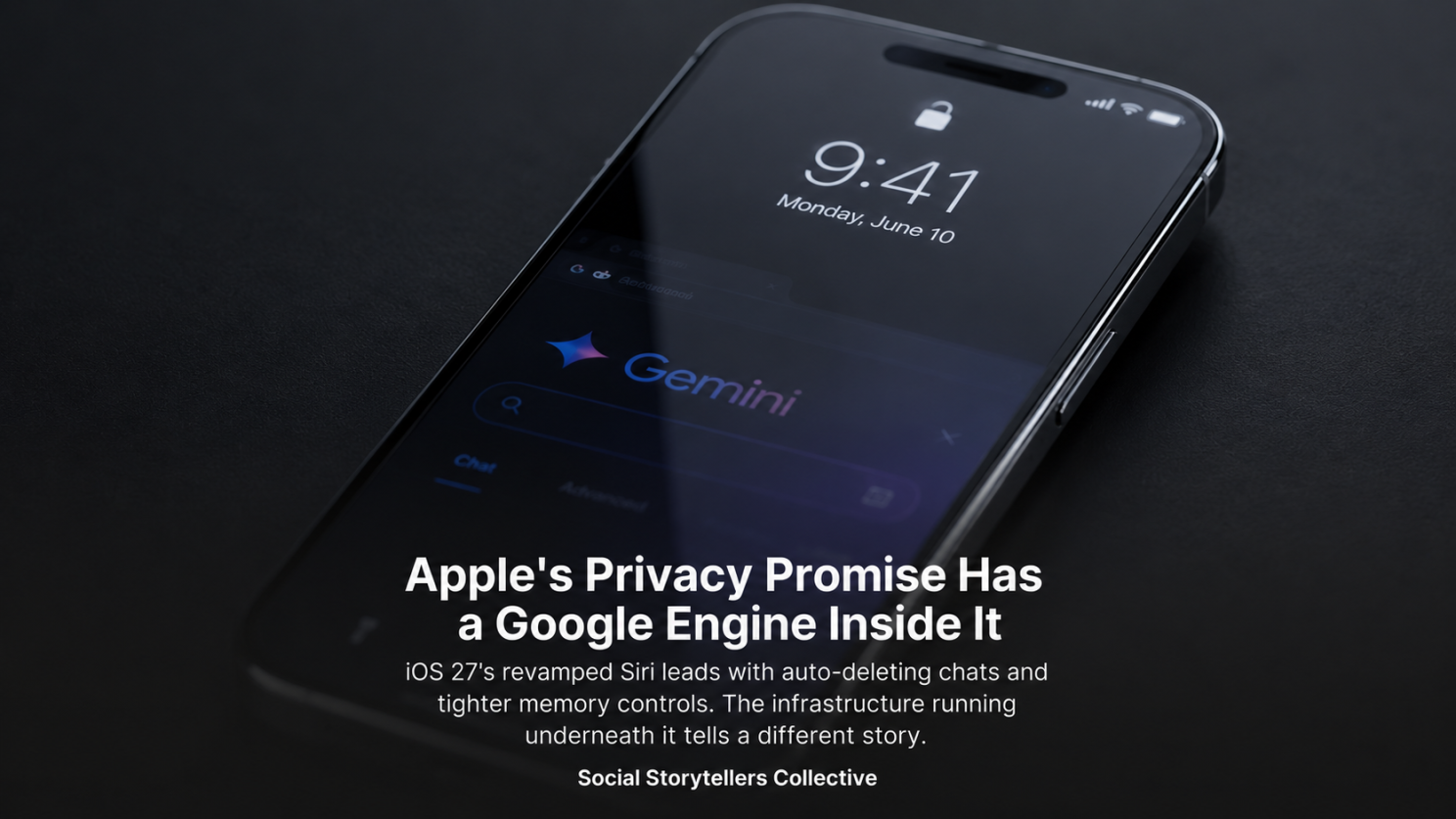
iOS 27’s revamped Siri leads with auto-deleting chats and tighter memory controls. The infrastructure running underneath it tells a different story.
Apple has spent more than a decade making privacy the centerpiece of its brand identity. Not as a feature. As a philosophy. The company that refused to unlock a terrorist’s iPhone for the FBI. The company that built App Tracking Transparency and watched the advertising industry scramble to adjust. The company whose billboards read “What happens on your iPhone, stays on your iPhone.” Privacy was not a selling point at Apple. It was the selling point.
iOS 27’s revamped Siri arrives this fall with auto-deleting chats, tighter memory controls, and a redesigned interface built around the premise that your AI conversations should belong to you. At this year’s Worldwide Developers Conference, Apple will position the new Siri as the privacy-forward alternative in an AI race moving in the opposite direction — toward data accumulation, behavioral modeling, and the kind of persistent memory that makes assistants more useful and more surveilled simultaneously.
Siri is running on Google’s Gemini underneath it.
The partnership is, in the language of the industry, entirely standard. Large language model infrastructure is expensive and dominated by a small number of players. But Apple is not a standard company in this context — it is the company that built a decade of brand premium on the argument that what happens inside its ecosystem stays there. That promise is the reason its customers pay more. It is the reason they trust it with their health data, their financial information, their location history, and now their AI conversations.
Privacy as a product feature and privacy as an architectural reality are not always the same thing. The auto-delete is real. The interface controls are real. What is harder to find in the marketing materials is a detailed explanation of what Google’s Gemini model processes, retains, or learns from the conversations Apple is routing through it. At WWDC, Apple will present the new Siri to a global audience that has already decided to trust it. What it probably will not include is the part that matters most.

When a $400 Swatch sells out in hours, it isn’t really a watch being sold. It’s access to a universe that normally starts at $20,000.
The lines outside Swatch stores this weekend did not look like luxury retail. They looked like sneaker drops and concert queues. Crowds gathered overnight in cities from New York to Dubai for the Audemars Piguet × Swatch “Royal Pop” collection. Stores closed early. Police intervened. Videos of crowd surges spread within hours.
A $400 Swatch sold out because it was never really a watch being sold. It was temporary access to a symbolic universe that normally starts at $20,000. Within hours, Royal Pop pieces were already listed on eBay for multiples of retail. The product cleared the retail stage and entered the cultural one before most stores had reopened.
The luxury industry spent decades protecting distance. The collaboration inverts that logic entirely — monetizing proximity instead. The unboxing is the event. The line is the marketing. The chaos was proof of purchase.
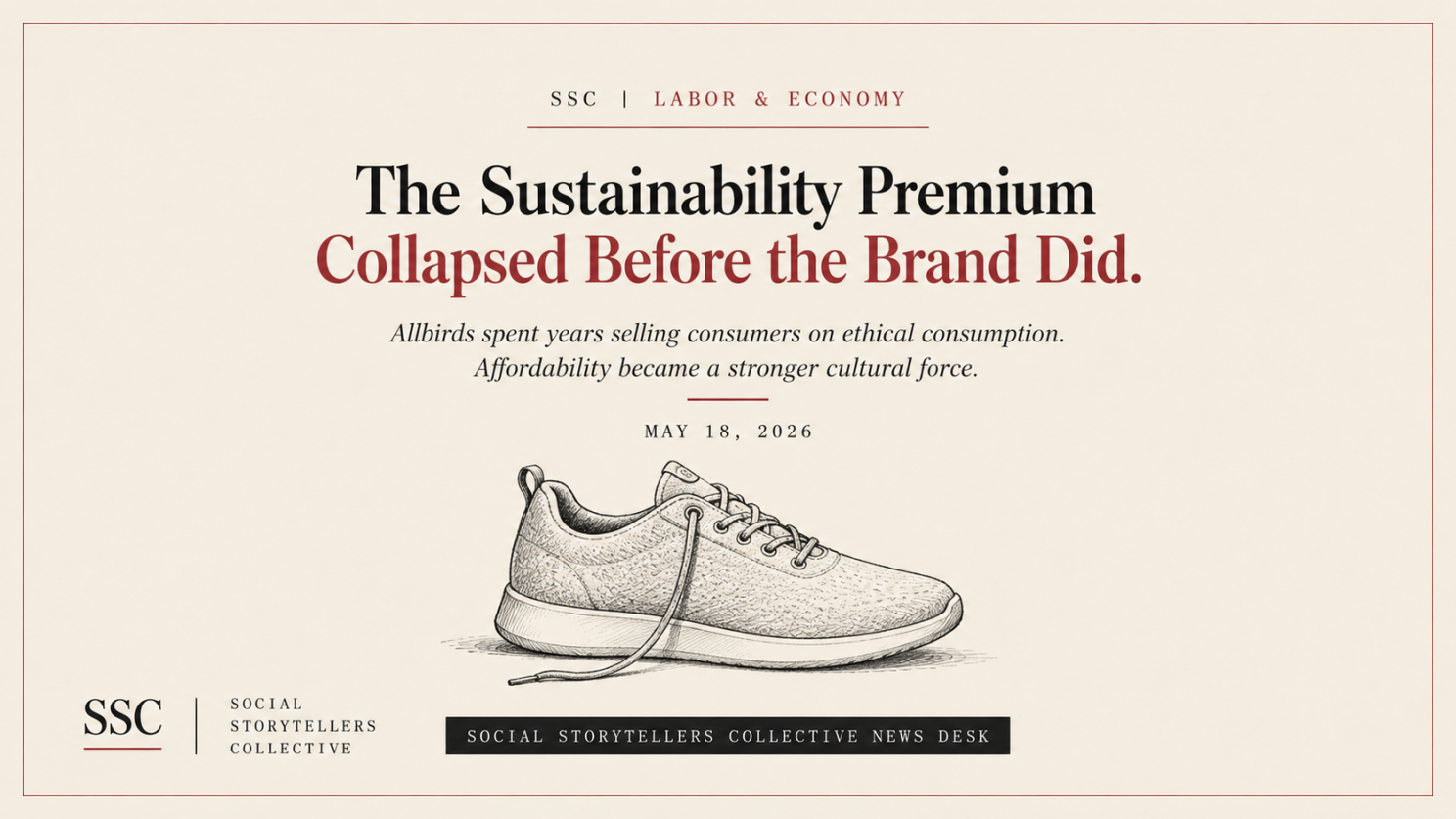
Allbirds spent years selling consumers on ethical consumption. The problem is that affordability eventually became a stronger cultural force than sustainability signaling.
Allbirds reached a market valuation near $4 billion after its 2021 IPO. Revenue climbed from roughly $102 million in 2018 to more than $277 million by 2021. The company built its reputation around wool sneakers, carbon footprint disclosures, and a consumer identity that let urban professionals signal their values through their footwear. Celebrities, tech workers, and startup founders turned it into a professional-class uniform — particularly in San Francisco, New York, Seattle, and Austin.
That demographic and the labor market underneath it began contracting at almost exactly the same time.
The industries that made Allbirds a status object are now living through layoffs, hiring freezes, and AI disruption anxiety. Consumers didn’t stop caring about sustainability. They stopped being able to afford to signal that they do. Ethical consumption frequently operates like a luxury category — available in full only to those whose budgets were never really in question. When the budget gets tight, the virtue premium is the first thing renegotiated.
The sustainability economy is not disappearing. It is stratifying. Ethical consumption is drifting upward toward households wealthy enough to treat it as fixed spending, while everyone else recalibrates toward price. Allbirds is not simply closing stores. It is marking the moment when a generation’s consumer optimism met a balance sheet and had to choose.
Then the Everlane news landed. And the story got darker.
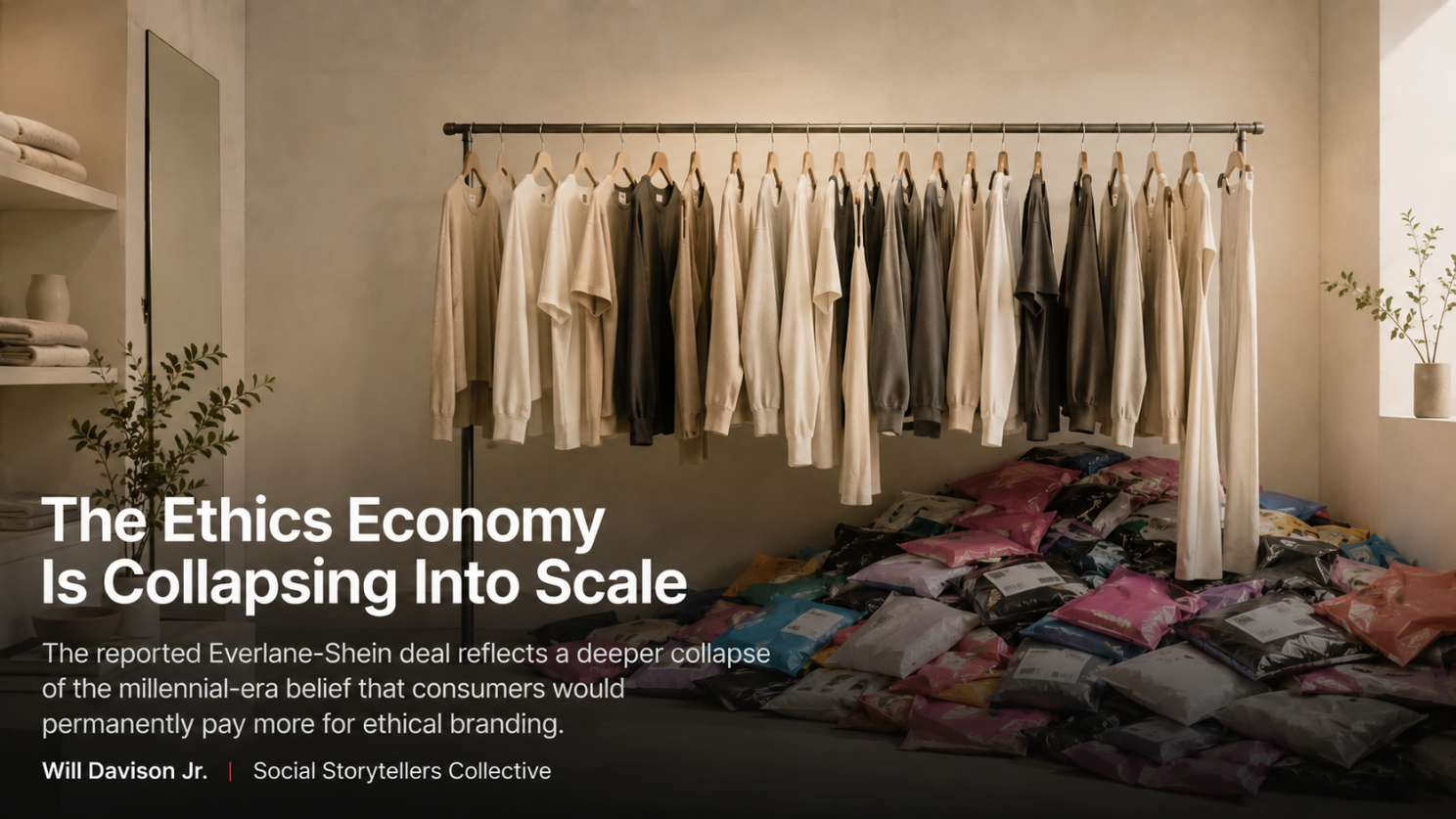
The reported Everlane-Shein deal reflects a deeper collapse of the millennial-era belief that consumers would permanently pay more for ethical branding.
Everlane was one of the defining ethical fashion brands of the 2010s — built on transparent pricing, responsible sourcing, and explicit anti-fast-fashion messaging. It was, in some ways, Allbirds for your wardrobe. Same consumer, same values, same bet that people would permanently pay more to feel good about what they bought.
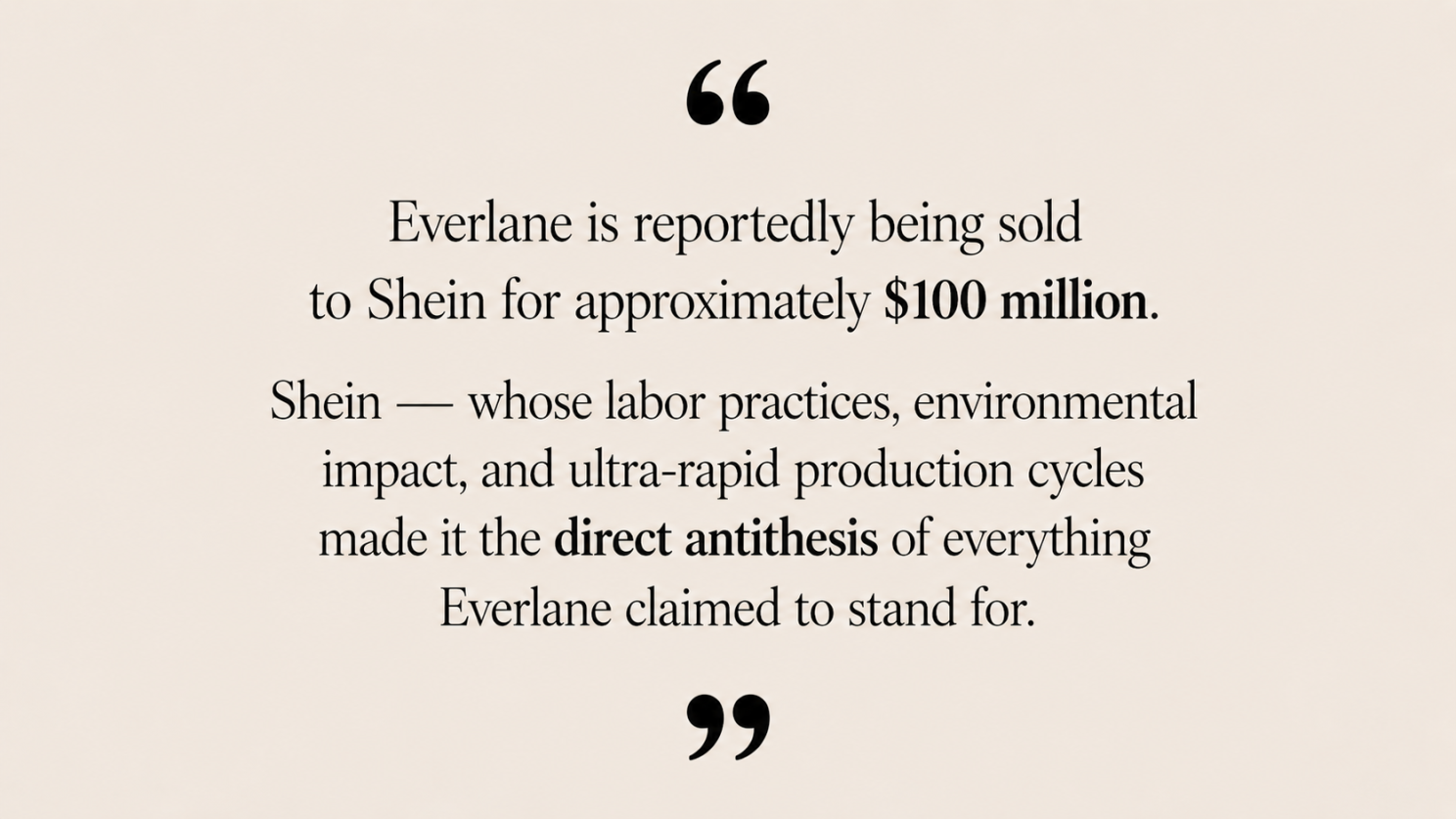
Everlane is reportedly being sold to Shein for approximately $100 million. Shein — whose labor practices, environmental impact, and ultra-rapid production cycles made it the direct antithesis of everything Everlane claimed to stand for.
Allbirds ran out of road. Everlane reportedly drove straight into the thing it was built to oppose. Same week. Same collapse. Different endings — but the same fine print underneath both of them. The ethics economy was never a business model. It was a market condition. And the condition changed.
When a founder and a board fight over a company’s future, the market is really asking something neither side wants to answer.
Lululemon sent a letter to shareholders Monday informing them that founder Chip Wilson — the man who built the brand — has “outdated” and “misguided” perspectives about how to run it. Wilson has been leading a proxy battle to remake the board ahead of next month’s annual meeting as the athleticwear brand navigates a real business downturn. Incoming CEO Heidi O’Neill and the current board, per the letter, are best positioned to spark a turnaround. Giving Wilson what he wants risks “derailing our progress.”
The proxy war is a brand story as much as a governance one. What Lululemon is really adjudicating is who owns the narrative of the company’s decline — and who gets to write the next chapter. The founder thinks he knows what the company is. The board thinks that version of the company no longer exists. Both might be right. That’s the problem.
What a disco ball logo and a swift reversal reveal about brand equity, user psychology, and the anniversary trap companies keep falling into.
Spotify swapped its familiar green circle for a glittering green disco ball to mark its 20th anniversary. The response was immediate and brutal. Users called it “beyond awful.” Within days the company reversed the decision, clarifying the update was always temporary. It was not framed that way when it launched.
Cracker Barrel went through something similar last year when a logo refresh contributed to an actual sales decline. The pattern is consistent: brands underestimate how much equity lives in the familiar, and overestimate how much their audiences want to celebrate alongside them. Sometimes the anniversary gift nobody asked for is the logo you already had.
The Definition of Refugee Just Got Rewritten
The Trump administration announced Monday it will admit up to 17,500 Afrikaners — white South Africans descended mainly from Dutch settlers — as refugees through September, declaring an “emergency refugee situation” to justify the expanded numbers. The administration initially set the figure at 7,500. The new total reflects a $100 million resettlement commitment from a government that has spent the last two years cutting overall refugee admissions to historic lows.
The South African government says the claims of persecution are baseless. Experts in South Africa say there is no evidence of white farmers being targeted for their race, though farmers of all races face violence in a country with a high overall crime rate. The Trump administration disagrees — and under U.S. law, that disagreement is sufficient to trigger the emergency designation.
What’s worth sitting with is the selectivity. The United States has a refugee system that has spent two years being told it cannot absorb more people — that the numbers are too high, the resources too strained, the process too slow. That argument was used to justify turning away people fleeing gang violence, political persecution, and active conflict zones. The emergency designation existed then too. It wasn’t invoked. It is being invoked now — for a group defined by race, from a country with no war, no famine, and a government that disputes the premise entirely. The fine print of who qualifies just changed. It is worth asking what changed with it.
Daily Visual Signal
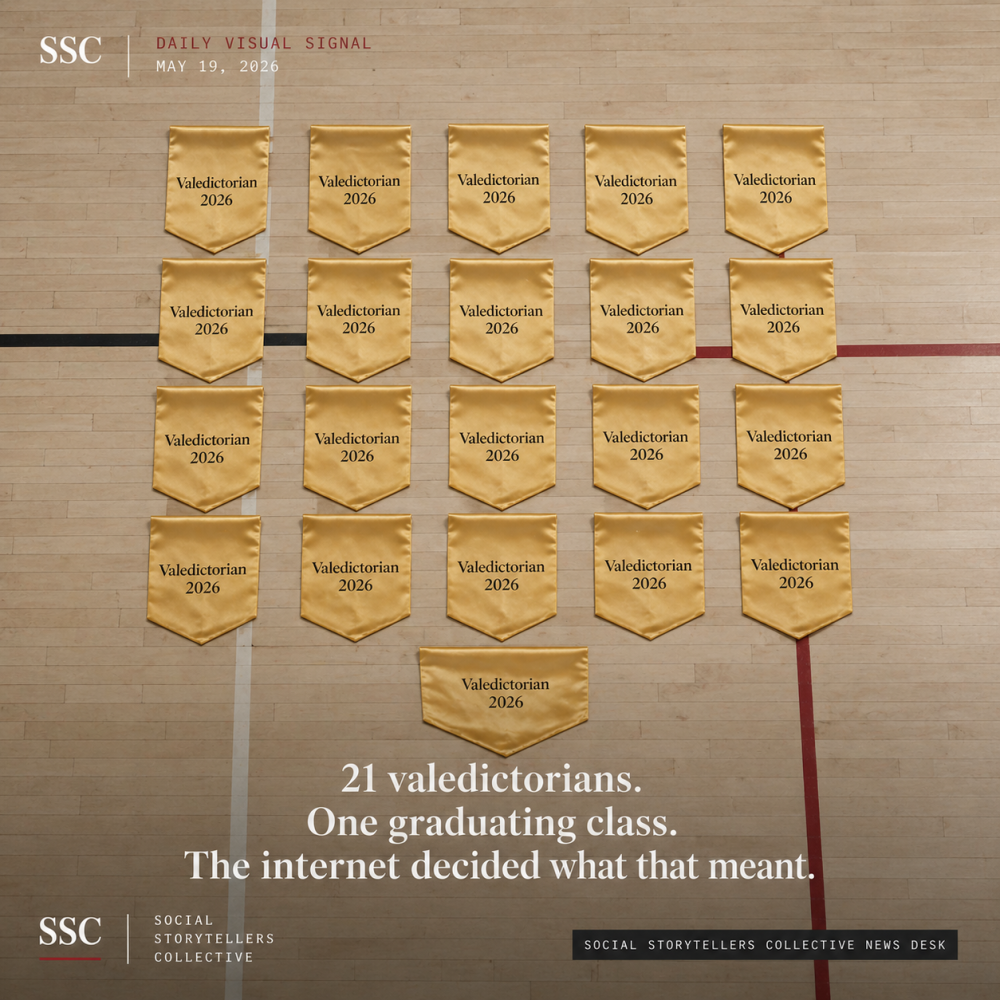
Twenty-one sashes laid flat on a gymnasium floor. Each one reads Valedictorian 2026. The students who earned them got straight A-plusses for four years. The internet got there first and decided what it meant. The sashes say valedictorian. The comment section said something else entirely.
Featured Story
Today’s featured story is The Valedictorian Is Becoming a Category.
A Long Island high school announced 21 valedictorians in a single graduating class this week. Days earlier, CNN spotlighted the Spelman Seven — seven Black women graduating together as co-valedictorians at Spelman College. On the surface, two separate education stories. Together they reveal something the coverage of both largely avoided naming.
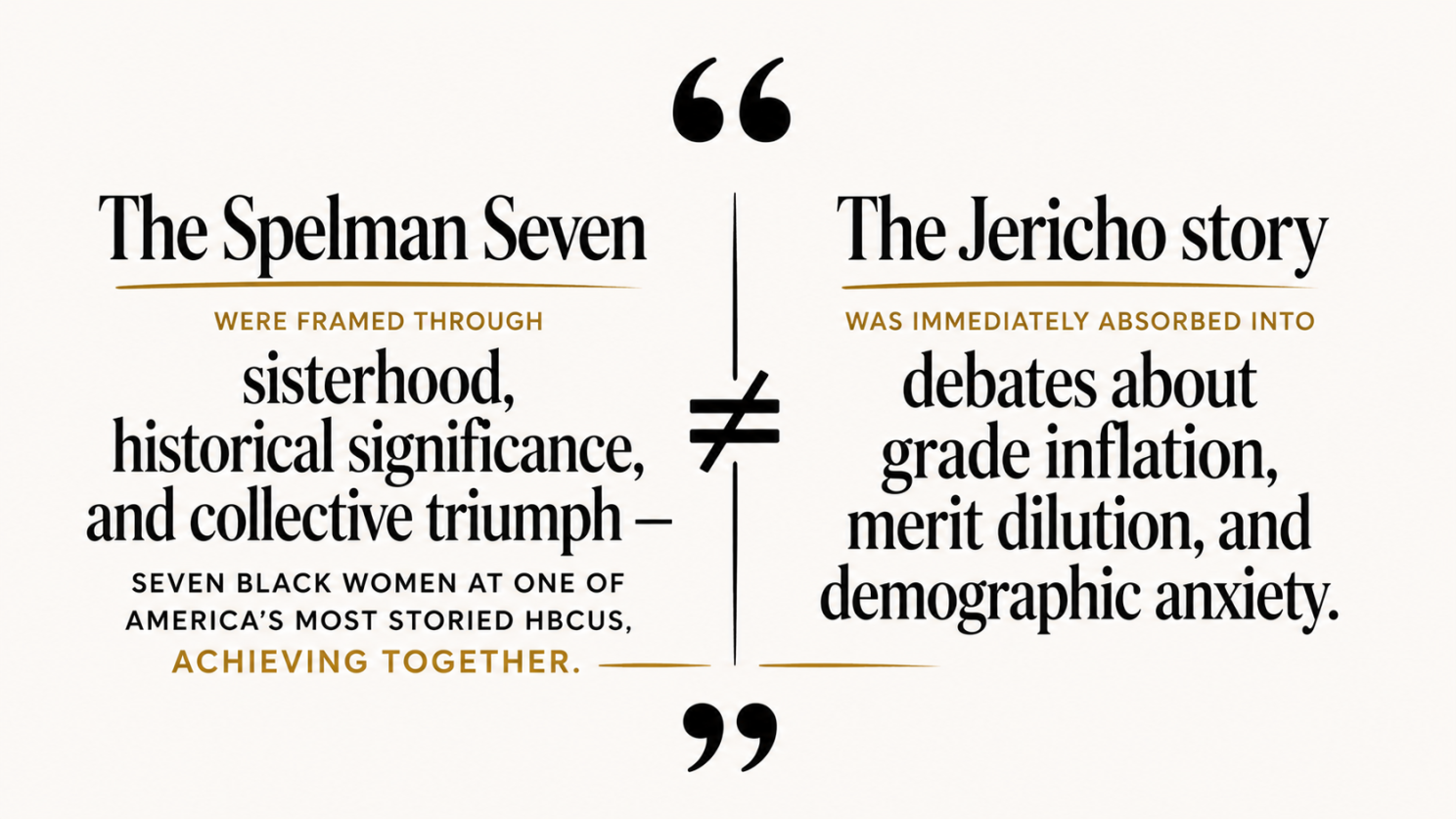
The Spelman Seven were framed through sisterhood, historical significance, and collective triumph. The Jericho story was immediately absorbed into debates about grade inflation, merit dilution, and demographic anxiety. The top comment on the NY Post coverage — pulling thousands of impressions — suggested the students wouldn’t get into college “because they’re not Black,” a reference to affirmative action’s repeal delivered as a punchline. That comment tells you more about the national conversation around academic achievement than the story itself did.
Here is what actually happened at Jericho: twenty-one students earned straight A-plusses in every class for four years. The school grades on a letter system — a 97 or higher earns an A-plus. That is not grade inflation. That is a cohort that worked. The valedictorian list gets longer because the system designed to produce one produced twenty-one instead.
The deeper tension is about who gets to own the narrative of their own excellence. The Spelman Seven were celebrated. The Jericho twenty-one were subjected to a demographic read — their achievement filtered through the post-affirmative action anxiety that now colors every conversation about who deserves what in American education. The question underneath that debate — whether Asian American academic achievement is being read as a problem rather than an accomplishment in the current moment — went largely unasked in the mainstream coverage.
The valedictorian is becoming a category. The question is who gets to inhabit it without their achievement being converted into someone else’s argument. Those students are seventeen and eighteen years old. They earned it. That should have been the whole story.
Today’s stories are not separate events. They are the same negotiation running across different institutions simultaneously. A credential losing the market’s confidence in the jobs it was built to access. A platform selling back the participation it once gave away. A privacy promise with a competitor’s architecture underneath it. A refugee system that spent two years saying it had no room — until it found room, for a specific group, defined by race, from a country with no war and a government that disputes the emergency entirely. A shoe brand and an ethical fashion company that learned the values economy contracts before the regular one does — and gets sold to the players it was built to oppose. A founder told the thing he built no longer belongs to his version of it. A streaming giant that tried to rewrite its own identity for an anniversary and got told no by its own users. And twenty-one teenagers whose straight A-plusses became a proxy for a national argument they were never invited to join.
The fine print is doing the same work in every register. Moving the terms after the agreement was signed. Moving the cost after the purchase was made. Moving the goalposts after the race was run.
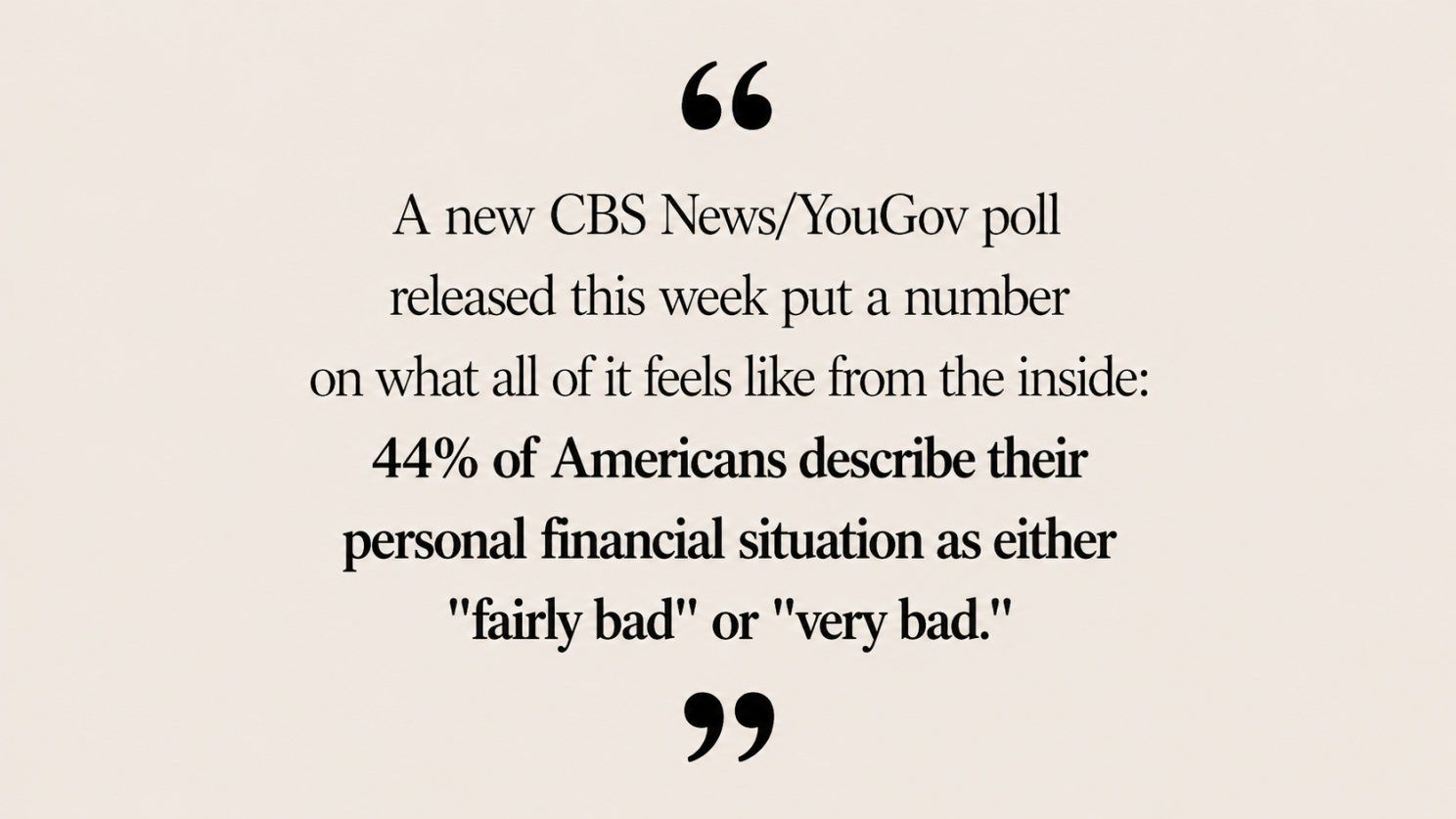
A new CBS News/YouGov poll released this week put a number on what all of it feels like from the inside: 44% of Americans describe their personal financial situation as either “fairly bad” or “very bad.” 57% say the president’s policies are making them financially worse off. Gas is sitting at $4.51 a gallon — up from $3.19 a year ago. The fine print of the American economy is no longer abstract. It has a number now. And the number is not moving in the right direction.
The question Tuesday keeps asking: who reads the fine print before they sign — and who only finds it after?
We will be back tomorrow with Part III of The Degree Economy: Who Gets Left Out of the Sale. More soon.
— SSC
Join SSC Systems & Signals — our private LinkedIn group for deeper conversation. linkedin.com/groups/20390015