
NEWS BRIEF | NATIONAL
This is not a regulatory delay. It’s a sequencing problem — and the market is already filling the gap.
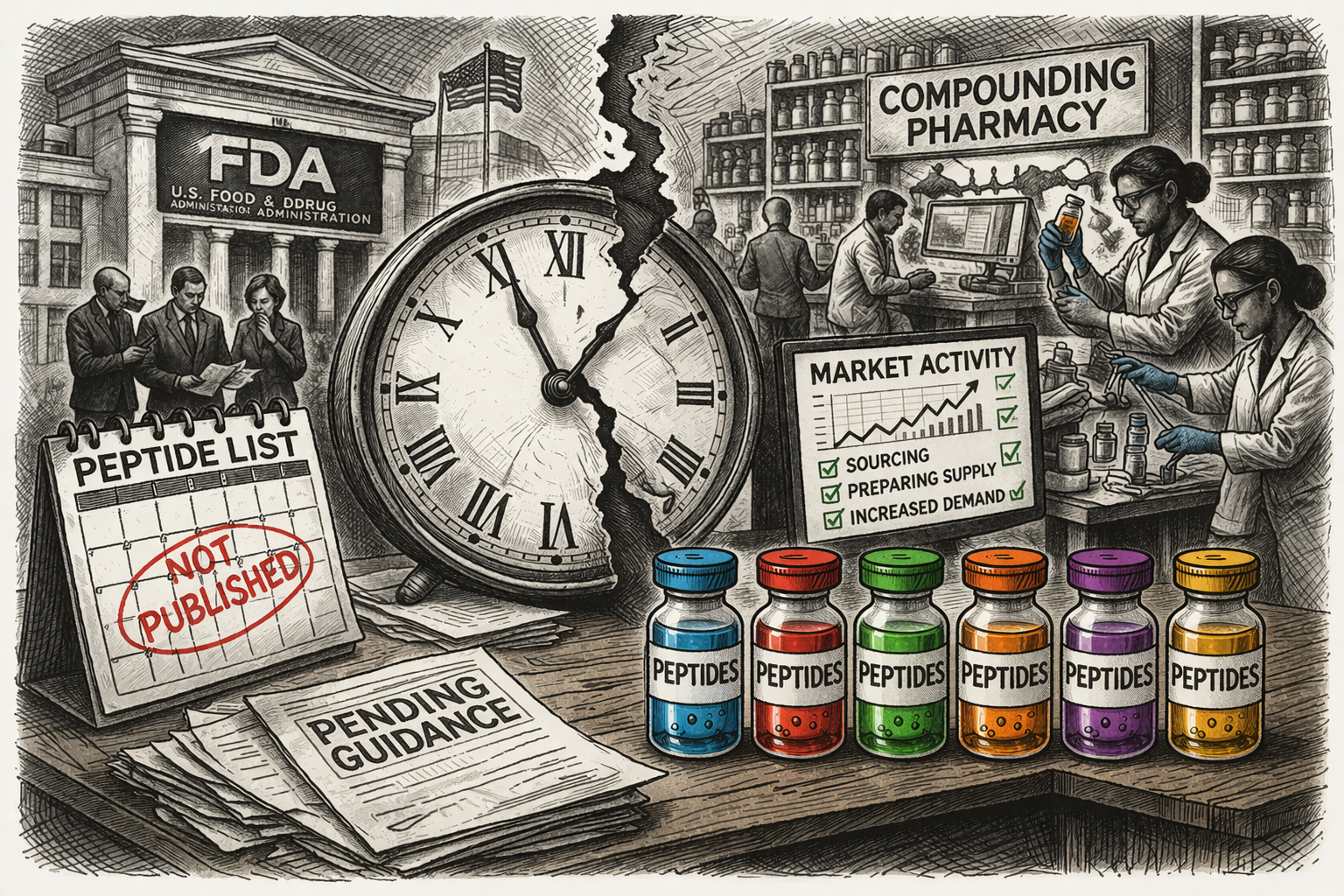
On March 26, NPR confirmed that the federal government is preparing to lift restrictions on certain peptide treatments following Robert F. Kennedy Jr.’s February 27 announcement. The signal was clear: the regulatory posture around peptides is shifting. But more than a month later, the formal FDA list detailing which compounds are permitted still hasn’t been published. Officials say it is expected “within weeks.”
In the meantime, the market is not waiting. Compounding pharmacies are already preparing for expanded demand, adjusting sourcing strategies, and evaluating which peptides may soon move into compliant production. Patients are asking questions in real time about access, safety, and legality. Without updated federal guidance, both groups are operating in a gray zone — defined not by prohibition, but by uncertainty.
The scale of the expected shift is significant. According to industry tracking from Elite NP, 14 of the 19 peptides currently classified under Category 2 are expected to move to Category 1 — a designation that would allow broader compounding and clinical use. That reclassification would represent one of the most significant expansions of peptide access in years. But the official FDA list confirming those changes has not been released.
This pattern is not new. It defined the GLP-1 market. It has characterized much of the broader wellness economy. Policy gets announced before infrastructure is clarified. Access expands informally before it is stabilized formally. Demand moves. Standardization follows — if it follows at all.
This moment connects directly to two threads we’ve already been tracking. In RFK Jr.’s MAHA Plan Could Supercharge America’s Peptide Craze, the question was how federal endorsement would accelerate demand. In The Wolverine Stack Isn’t a Breakthrough, the focus was on how quickly that demand outpaces evidence and oversight. What’s happening now sits directly between those two realities: policy is enabling growth, but the guardrails haven’t arrived yet.
When guidance lags behind behavior, the market fills the vacuum. Decisions get made without standardization. Access expands without consistency. And the line between medical treatment and consumer experimentation becomes harder to draw — not because the line doesn’t exist, but because no one has officially moved it yet.
The FDA list will be published. By the time it is, the market it is meant to regulate will have already made its own decisions.