
The feud between Donald Trump and Candace Owens did not begin tonight. It has been building in public for fifteen days, across three escalating Truth Social posts, and what it reveals by the end is something the attention economy analysis alone cannot fully account for.
The rupture has substantive roots. The Iran war accelerated the fracture sharply. Following U.S. strikes on Iranian nuclear sites in summer 2025, Owens said publicly: “He’s been a chronic disappointment, and I feel embarrassed that I told people to go vote for him.” In March 2026, she went further, urging U.S. troops to reconsider military service given the direction of the conflict. On April 7, after Trump threatened to “take down” Iran entirely, Owens posted: “The 25th Amendment needs to be invoked. He is a genocidal lunatic. Our Congress and military need to intervene.”
That post appears to have triggered what came next.
On April 9, Trump published a 485-word Truth Social post grouping Owens with Tucker Carlson, Megyn Kelly, and Alex Jones, calling them “low IQ losers,” “nut jobs,” and “troublemakers” seeking “free and cheap publicity.” He accused all four of thinking “it is wonderful for Iran, the Number One State Sponsor of Terror, to have a Nuclear Weapon.” On Owens specifically, he made it personal — bringing up the defamation lawsuit against her by French President Emmanuel Macron over her theories about Brigitte Macron, and comparing the two women’s appearances. Owens responded the same day with a single line: “It may be time to put Grandpa up in a home.”
On her podcast the following day, she delivered a direct address to the president, reading what she framed as an open letter. She took a mocking tone at points, questioned Trump’s focus on personal grievances, and accused him of losing touch with the base that helped fuel his political rise. In her sharpest criticism, she accused Trump of prioritizing foreign conflict over domestic concerns and questioned the justification for military action.
Trump did not let it go. On April 17, he posted again — this time targeting Owens alone, calling her “really dumb and mentally ill” in a late-night Truth Social rant that grouped her with other former allies who had publicly soured on him.
Then came tonight. In a Friday evening post on April 24, Trump singled Owens out again — and escalated to imagery. The post included a doctored TIME magazine cover titled “Vile Person of the Year,” featuring a close-up, unflattering black-and-white photograph of Owens with blurbs reading “Candace Owens Lies, Lies, Lies,” “Uses Rich White Men,” “0% Fact Check Ratio On All Credible Fact Checking Sites,” and “Protects Sex Offenders.” The image was produced by an account called @canyoufactsme and reshared by the sitting president without qualification or context. His accompanying text read: “Candace Owens’ stock, which was never very high, has fallen a long way. Her attack on the First Lady of France is despicable. I believe, in this case, without verification, she is an extremely Low IQ individual!”
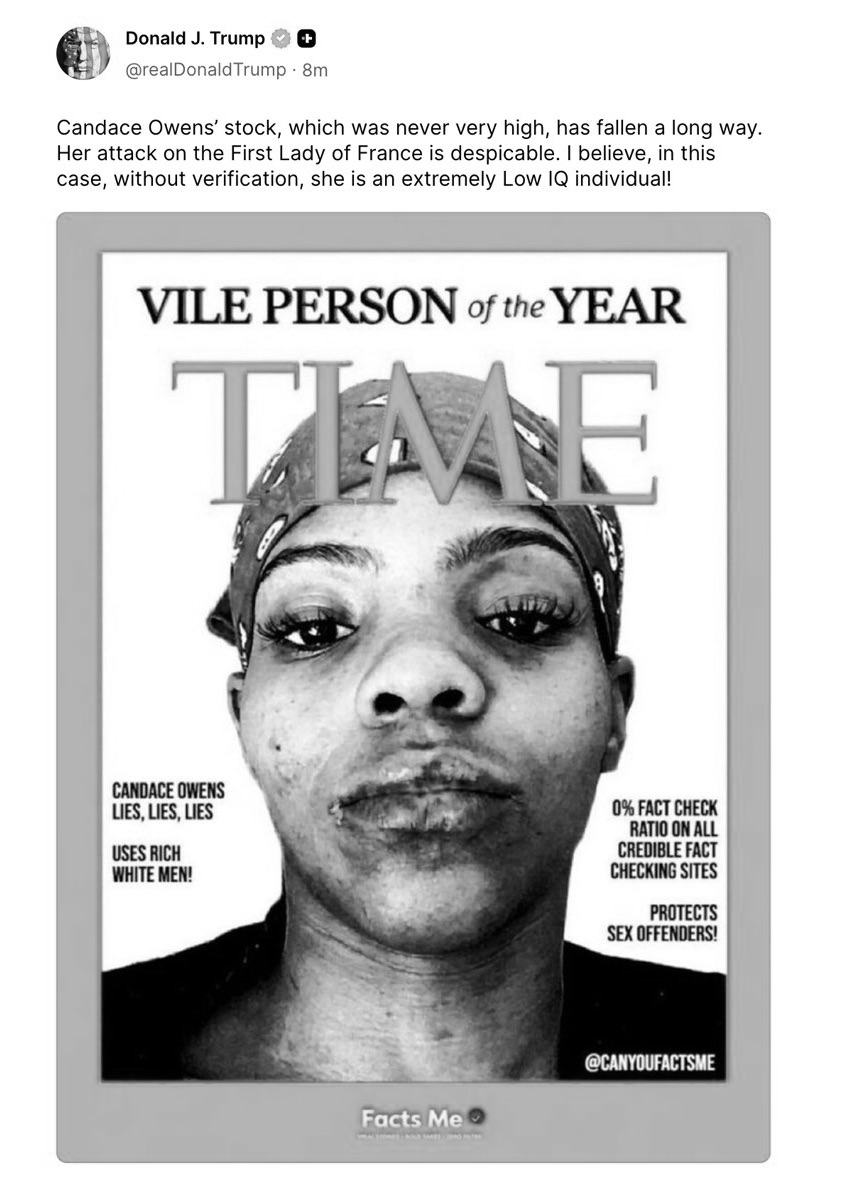
The phrase “without verification” is doing extraordinary work in that sentence. The president of the United States is explicitly acknowledging that he does not know whether what he is amplifying is true — and posting it anyway. That is not a rhetorical slip. It is a confession of intent. The goal was never factual accountability. It was humiliation. And the vehicle for that humiliation was a fabricated magazine cover designed to make a Black woman look criminal, dishonest, and sexually exploitative — imagery that maps directly onto some of the oldest and most durable stereotypes used to dehumanize Black women in American public life.
This is where the structural analysis the attention economy model provides runs out of explanatory power. The conflict-as-strategy reading explains why the exchange happened on a public platform rather than privately. It does not explain why the specific language, imagery, and accusations directed at Owens differ so markedly from what Trump posted about the white critics named in the same April 9 post. Minutes after posting the fake TIME cover tonight, Trump used the same “low IQ” language against House Democratic leader Hakeem Jeffries. Days earlier he had applied it to Supreme Court Justice Ketanji Brown Jackson — a double Harvard graduate. The pattern across all three targets is consistent: the “low IQ” framing appears repeatedly against Black public figures who challenge or refuse to defer to him, regardless of their political alignment.
Tucker Carlson, Megyn Kelly, and Alex Jones were all named in the April 9 post. None of them received a doctored magazine cover calling them liars who exploit rich men and protect sex offenders. None of them were the subject of a solo follow-up attack eight days later. None of them received a second solo attack fifteen days after the first. The intensity, the frequency, and the specific imagery were reserved for Owens. That asymmetry is not a detail. It is the argument.
This is not the attention economy being gamed. This is the president using the machinery of visibility to do something specific to a specific kind of person. The “low IQ” language, the fabricated cover, and the “uses rich white men” framing together constitute a repertoire — a set of rhetorical and visual tools that degrade Black women in public, in ways that are recognizable to anyone who knows the history of how Black women have been stereotyped and dehumanized in American media and political life.
As SSC examined in Nike Put Its Mark on a Black Body, perception does not wait for intent to catch up. And as The Comment Section Is Now the Story documented, the audience response to moments like this is no longer secondary to the content — it is part of the content itself, shaping how the original moment is read, remembered, and circulated.
Owens built her career on a theory that racial solidarity was a political trap and that Black Americans would be better served by individual conservatism than collective grievance. The president she championed posted a fabricated image designed to make her look criminal and sexually exploitative — three times in fifteen days, with escalating specificity — when she disagreed with him. He used the same language against Black women across the political spectrum in the same week. That is not an irony. It is data. And it is the part of this story that the attention economy analysis, left to itself, will never name.
Structural Reality | Culture in Motion | The Critic’s Desk