
At some point the romantic partner became responsible for everything. Not just love and companionship — but best friendship, therapeutic support, financial partnership, social calendar, sole emotional safety net, and primary witness to a life. That accumulation did not happen all at once. It happened gradually, as the other institutions that once distributed those functions — extended family, religious community, neighborhood networks, workplace relationships — contracted, atomized, or moved online. By the time anyone named what had happened, the romantic partner was carrying a weight that no single relationship was ever designed to hold.
48% of survey respondents say they are open to having parallel relationships — meaning one partner for their physical needs and another for their emotional needs. That number is being covered as a dating trend story — polyamory adjacent, generationally permissive, a sign of shifting moral frameworks around commitment. The structural reading is more precise. Nearly half of adults surveying their own relational needs have concluded that concentrating all of them in a single person is not working — and are reorganizing accordingly. That is not a rejection of commitment. It is a recognition that the model of commitment currently on offer has been asked to do too much.
The reorganization is happening across multiple dimensions simultaneously. 51% of survey respondents say they prefer to date or be friends with people who are in therapy, and 12% actively filter for it on apps — signaling that emotional labor capacity is now being evaluated as a relational asset before commitment is considered. People are not just looking for partners. They are looking for partners who have already done enough work on themselves that the relationship does not have to carry the full weight of their emotional development. That is a meaningful shift in what partnership is being asked to be.
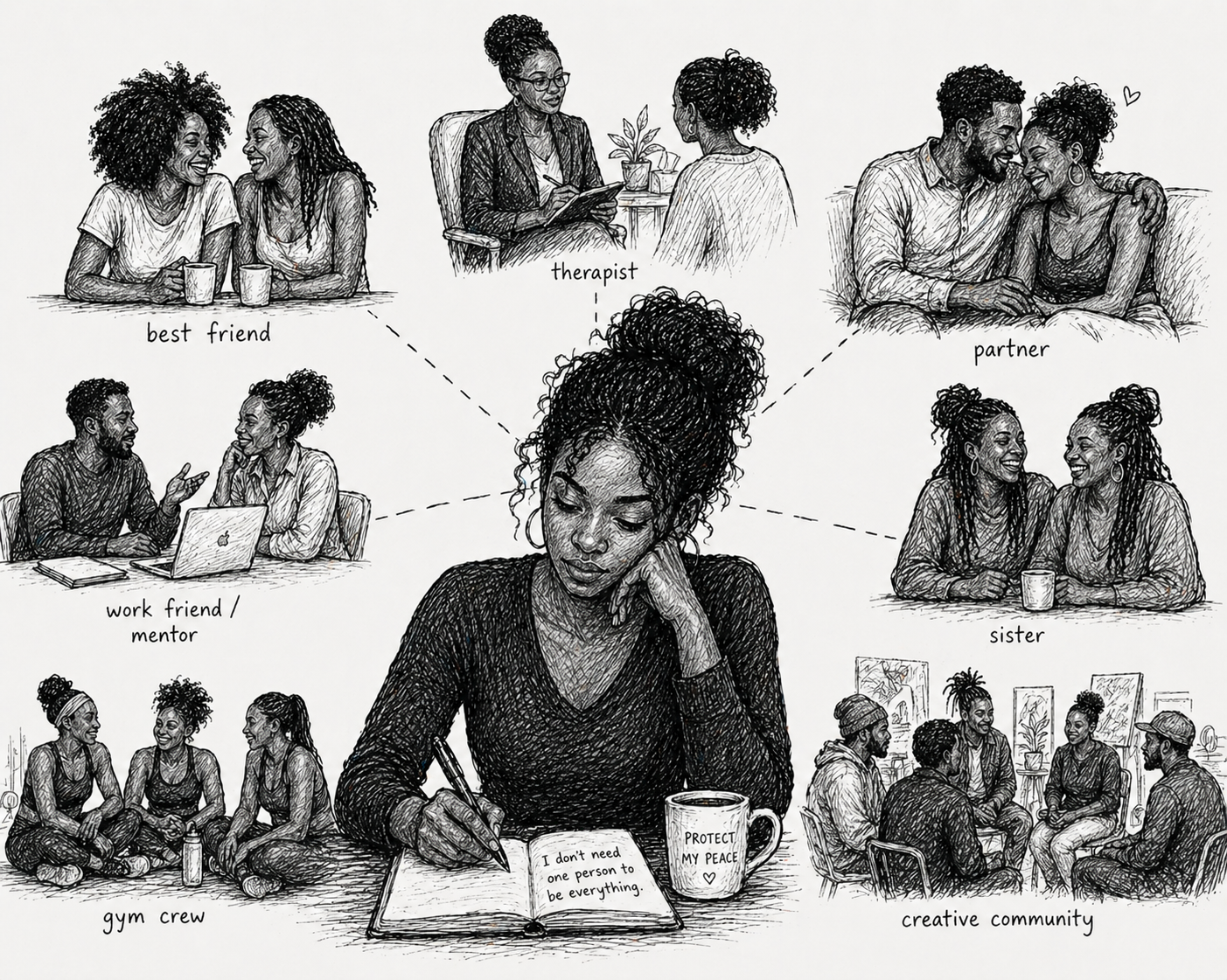
The emotional distribution model is not the same as non-monogamy, though the two can overlap. It is the broader recognition that different relationships serve different functions — that the friend who has known you for twenty years, the therapist who sees you clearly, the colleague who challenges your thinking, and the partner who loves you are all part of an ecosystem that no single person can replace. Treating that ecosystem as a support structure rather than a threat to romantic commitment changes how relationships are entered, maintained, and evaluated.
What is emerging is less a trend than a correction — a return to a more distributed model of human connection that existed before the nuclear family and the digital age combined to concentrate all relational responsibility in one place. The correction is still being negotiated in real time, in conversations about what commitment means, what partnership requires, and what people are actually owed by the person they choose. Those conversations are overdue. The data suggests they are finally happening.