
The latest Consumer Price Index showed consumer prices rising 0.5% in May and 4.2% over the previous 12 months — the first annual inflation reading above 4% in three years. More than 60% of the monthly increase came from higher energy prices tied to the conflict involving Iran. Core inflation, which strips out food and energy, rose 2.9% annually. Another figure deserves attention: inflation exceeded wage growth for the second consecutive month.
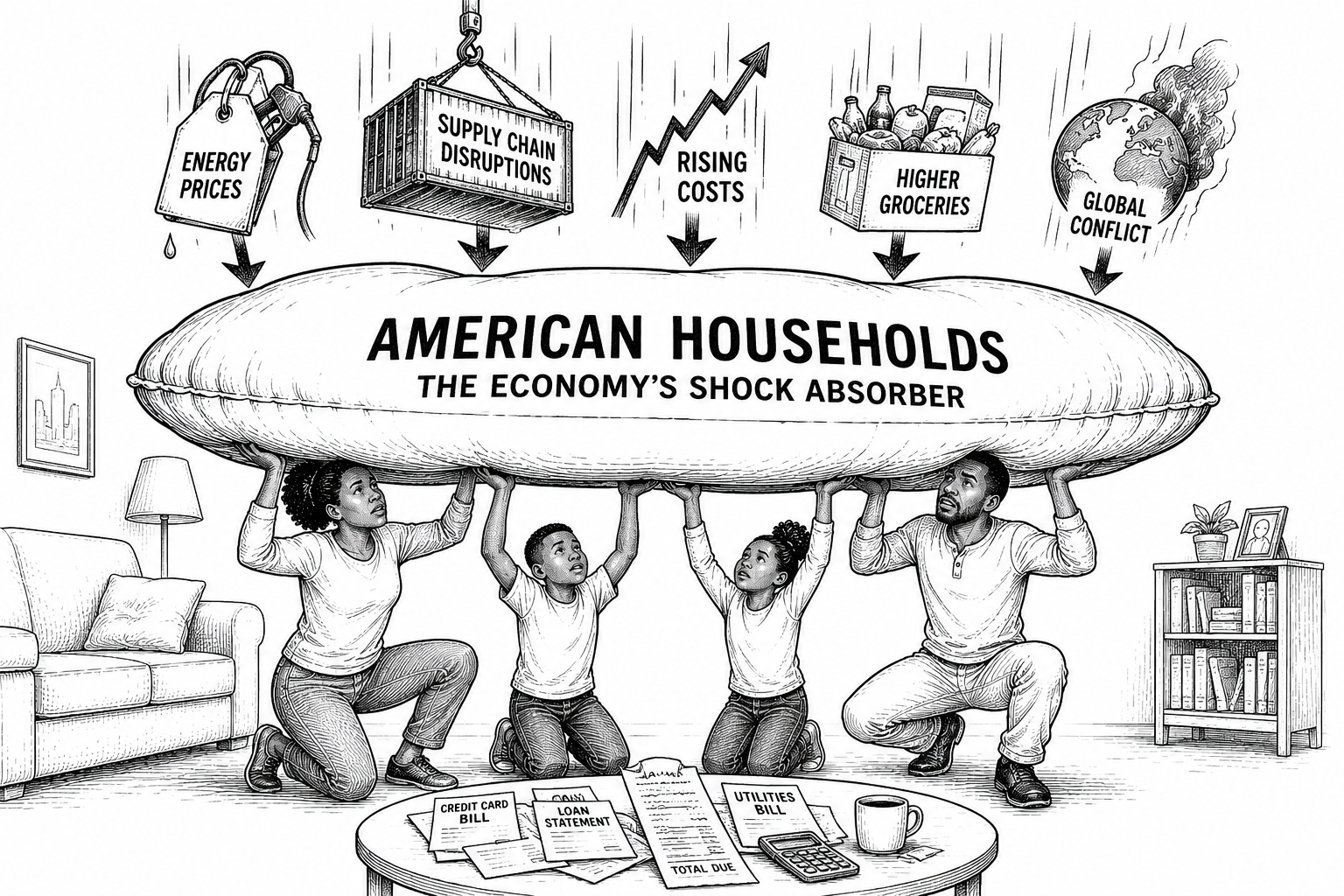
The United States has built an economy where costs rarely disappear. They move. A disruption in global energy markets becomes a higher transportation bill. Transportation becomes a higher wholesale price. Wholesale prices become more expensive groceries, household goods, and services. By the time the adjustment reaches a family’s checking account, the original cause may be thousands of miles away — but the financial obligation is sitting at the kitchen table.
That transfer lands on households that are already carrying the weight of prior shocks. U.S. household debt now exceeds $18 trillion, while credit card balances remain above $1 trillion. Consumer spending accounts for roughly two-thirds of the nation’s economic activity. An economy that depends on households to keep spending while asking those same households to absorb the shocks is running a test it has not announced.
For much of the post-pandemic recovery, rising wages softened the impact of higher prices. Workers were still frustrated, but many paychecks were growing fast enough to keep pace. The latest data suggest that cushion is shrinking. Families facing higher costs generally have only a handful of options: postpone purchases, reduce savings, or borrow. None of those choices eliminates the cost. They simply determine when it will be paid.
Mohamed El-Erian noted that headline inflation has returned to a 4% range, while economist Daniel Altman pointed to rising long-term inflation expectations as a more consequential signal. When expectations shift, businesses raise prices before costs arrive. Workers demand raises before wages fall behind. Markets reprice in hours. Household budgets reprice in crises.
The Federal Reserve can influence interest rates, but it cannot determine the price of oil or resolve geopolitical conflict. Energy companies can adjust prices. Financial markets can reprice assets. Businesses can pass along costs. Families have one mechanism: absorb it. They stretch a paycheck, delay replacing a car, skip a weekend trip, or carry another balance on a credit card.
The inflation report measures prices. It also documents where the economy increasingly expects risk to live.
— SSC News Desk | Social Storytellers Collective
Get SSC analysis delivered to your inbox every day. Subscribe free on Beehiiv: socialstorytellerscollective.beehiiv.com