
The Dominican Republic has become the Caribbean’s most visited destination, welcoming over 10 million visitors in 2023 and generating tourism revenue that accounts for approximately 11.6 percent of GDP. The country hosted its fourth Trade Show in Miami in April 2026, drawing more than 1,200 travel industry professionals and emphasizing a $15 billion economic impact and nearly 480,000 jobs. The numbers are real and the growth has been consistent — the Dominican economy has averaged roughly five percent annual growth for decades, fueled by tourism, remittances, and an expanding free trade zone sector. President Abinader has set ambitious targets: investment grade by 2028, doubled GDP and 1.7 million new jobs by 2036. The trajectory is credible. The questions worth asking about it are structural.
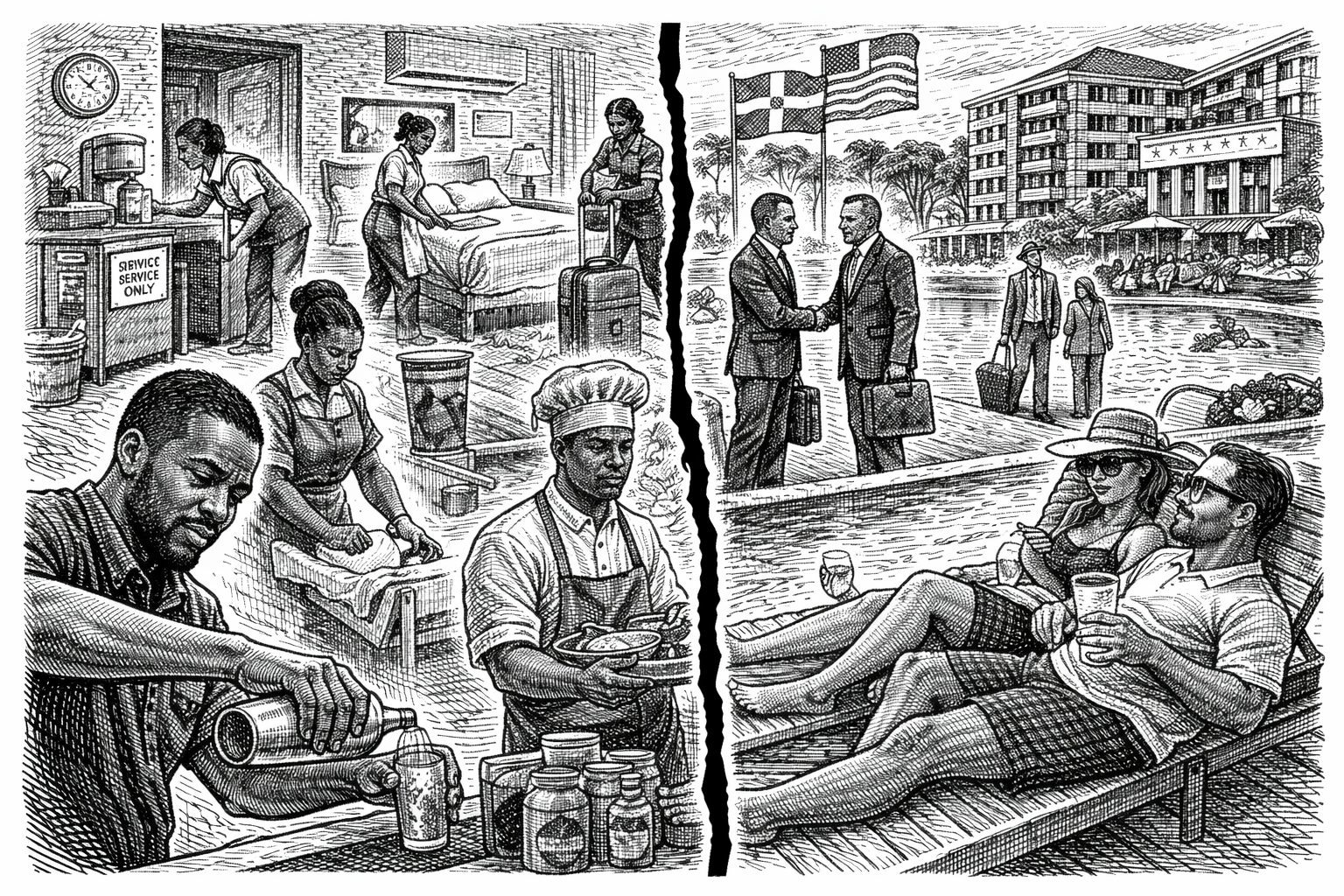
Tourism-driven economic growth has a specific distribution problem. The sector creates jobs, but the quality and compensation of those jobs vary enormously depending on where in the supply chain they fall. Front-of-house hospitality work in all-inclusive resorts — the model that dominates Dominican tourism — generates employment at wage levels that reflect the country’s cost of living rather than the revenue generated per tourist. International hotel chains and resort operators capture the majority of the margin on room rates and package prices. Local subcontractors, food suppliers, and service workers receive a fraction of the value the tourism economy produces. This is not a Dominican anomaly. It is the structure of resort tourism globally. But it means that the GDP figures and job numbers that define the Dominican tourism narrative do not fully describe who is building wealth from the boom, and who is providing the labor that makes it possible.
The racial dimension of that distribution is underreported. The Dominican Republic’s Afro-Dominican population — the communities whose cultural production, cuisine, music, and visual identity are central to the country’s tourism appeal — are not proportionally represented in the ownership, management, and high-margin segments of the tourism economy. The Colonial Zone in Santo Domingo, a UNESCO World Heritage site marketed heavily to international visitors, sits alongside communities that have not benefited equitably from the attention. The beach communities around Punta Cana and Samaná attract billions in foreign investment for resort development while local fishing and agricultural communities negotiate the environmental and economic disruption that development brings. The tourism brand draws on Afro-Caribbean cultural authenticity while the economic infrastructure concentrates returns elsewhere — a pattern that rhymes with what SSC has documented in other contexts where Black cultural production generates value that does not return to its origin communities.
The opportunity framing is real too, and deserves acknowledgment. African American investors are being actively recruited into the Dominican tourism economy, with investment pathways organized around cultural alignment, Afro-Caribbean identity connection, and boutique hospitality that centers diaspora narrative alongside economic return. If that investment is structured thoughtfully — with accountability to local Afro-Dominican communities, with employment and ownership models that distribute benefit rather than simply extract it — it could represent something different than the resort development model that has dominated. The distinction between diaspora investment that builds community and diaspora investment that replicates the extractive patterns it is supposedly offering an alternative to is exactly the kind of structural question the moment requires. The Dominican Republic’s tourism economy is growing fast enough that those structural choices are still being made. What gets decided in the next few years will shape who the boom actually serves.