
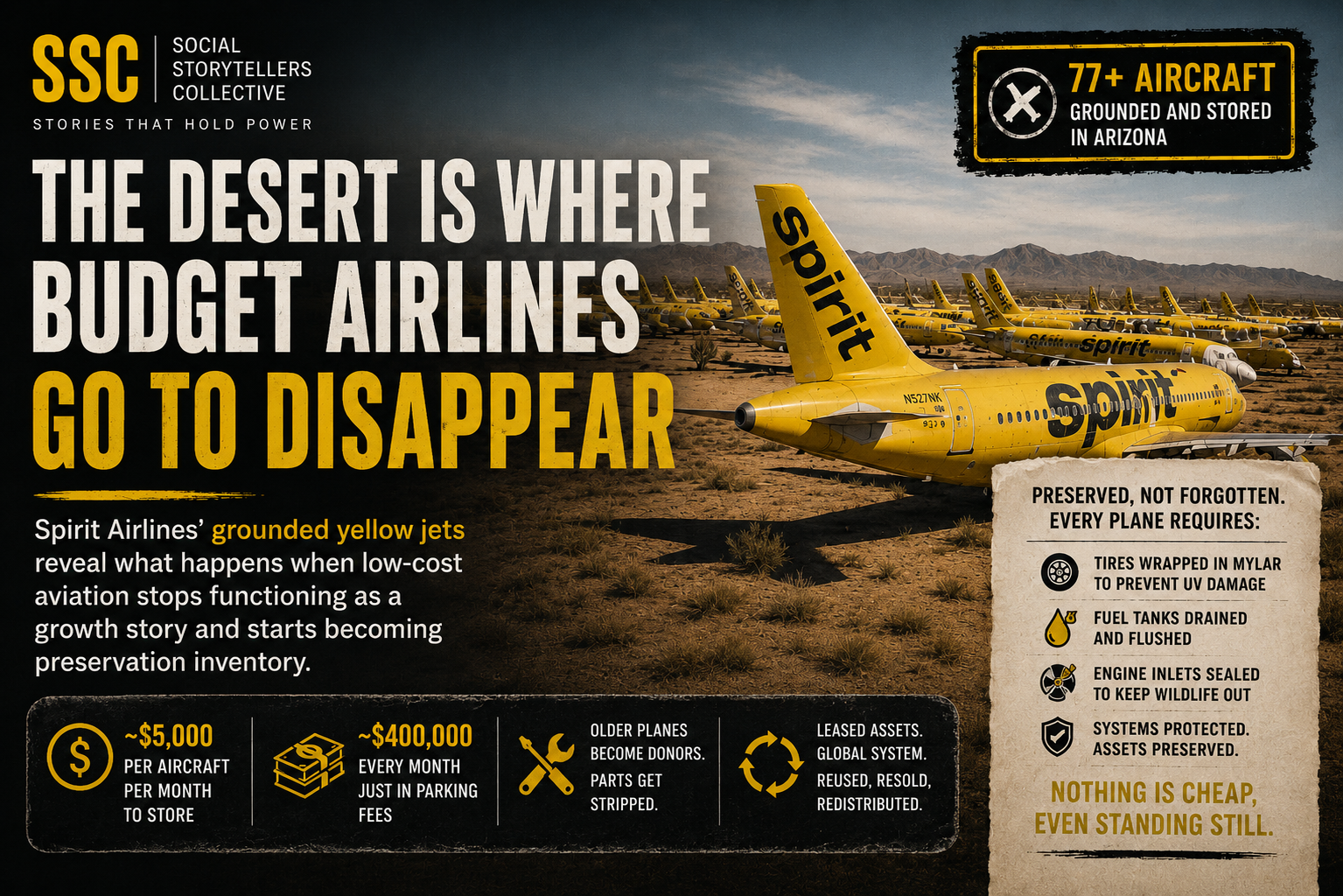
Months before Spirit Airlines officially collapsed, the warning signs were already visible from the Arizona desert. Rows of bright yellow Airbus jets sat parked at Phoenix Goodyear Airport — engines covered, windows sealed, tails lined up in silence under the dry heat. By the time Spirit shut down operations in May 2026, more than 77 aircraft had already been sidelined, many grounded because of Pratt & Whitney geared turbofan engine recalls that disrupted carriers worldwide. What initially appeared to be a temporary maintenance problem became something larger: a low-cost airline losing the operational rhythm its entire business model depended on.
The engine recalls exposed a structural vulnerability built directly into ultra-low-cost aviation. Spirit’s economics required planes in the air constantly. Grounded aircraft meant fewer routes, fewer seats, and less revenue flowing into a company already carrying significant debt, rising labor costs, and volatile fuel prices. Larger airlines could redistribute aircraft across wider fleets and absorb maintenance delays more easily. Spirit could not. As more planes disappeared from schedules, the finances grew increasingly fragile. The yellow jets parked in Arizona stopped looking temporary long before the shutdown became official.
Those aircraft are now entering the strange second life that commercial aviation storage creates. Planes in desert facilities are not simply abandoned. They are carefully preserved through a process designed to protect them from corrosion, contamination, mechanical decay, and wildlife intrusion while leasing companies determine whether the aircraft will return to service, be sold, or be dismantled for parts. Tires are wrapped in reflective Mylar to shield rubber from ultraviolet damage. Fuel tanks are drained and chemically flushed to prevent residue buildup. Engine inlets and exhaust systems are sealed against birds, rodents, insects, and blowing debris. Even parked aircraft require ongoing inspections and maintenance cycles to remain viable assets.
The costs are enormous even in stillness. Desert storage runs approximately $5,000 per aircraft per month depending on preservation requirements — placing Spirit’s inactive fleet near an estimated $400,000 monthly burden at its peak. But not every plane waiting in the desert is expected to fly again. In commercial aviation, older aircraft frequently become donor planes when long-term restoration economics no longer make sense. Parts are systematically stripped and redistributed: seats, avionics, landing gear components, hydraulics, auxiliary power units, cockpit instruments, wiring systems, sections of fuselage paneling. The engines themselves are often the most valuable remaining assets. What passengers once boarded as a complete aircraft eventually becomes a parts ecosystem feeding other fleets still in operation.
That transformation reveals how airlines function less like transportation companies and more like asset management systems built around utilization efficiency. Spirit’s aircraft were engineered for maximum movement — short turnarounds, dense seating, constant departures, minimal downtime. Once the economics break, the planes stop functioning primarily as vehicles and start functioning as inventories of recoverable value. The Arizona desert facilities become industrial triage centers: deciding which aircraft return to service, which stay preserved for future demand, and which are dismantled piece by piece to sustain the rest of the network.
The symbolism extends beyond aviation. Spirit represented a specific era of American consumer life in which affordability itself became a business model. The airline normalized ultra-cheap access even as critics mocked the fees, cramped cabins, and stripped-down experience. Its existence pressured larger carriers to keep base fares lower across the market. The collapse of Spirit does not simply remove one airline from the landscape. It reflects how difficult low-cost systems are becoming to sustain under rising operational expenses, debt pressure, supply-chain fragility, and tightening profitability demands. The business model was always leveraged against conditions staying favorable. They did not.
The parked yellow aircraft in the Arizona desert carry that weight visibly. Some remain carefully preserved — wrapped and sealed against decay while owners wait for market conditions that may or may not return. Others are being quietly hollowed out for reusable parts, their value redistributed into surviving fleets. The distinction is economic as much as mechanical. Certain systems are still being protected in the hope they can return. Others are already being cannibalized so the rest of the structure can continue operating a little longer. The desert doesn’t just store what failed. It clarifies, slowly and without sentiment, what was worth saving and what was always just inventory waiting to be absorbed.
SSC | Labor & Economy — May 17, 2026 — Social Storytellers Collective News Desk