
No independent oversight. And a deadline set to expire one month before the next inauguration.
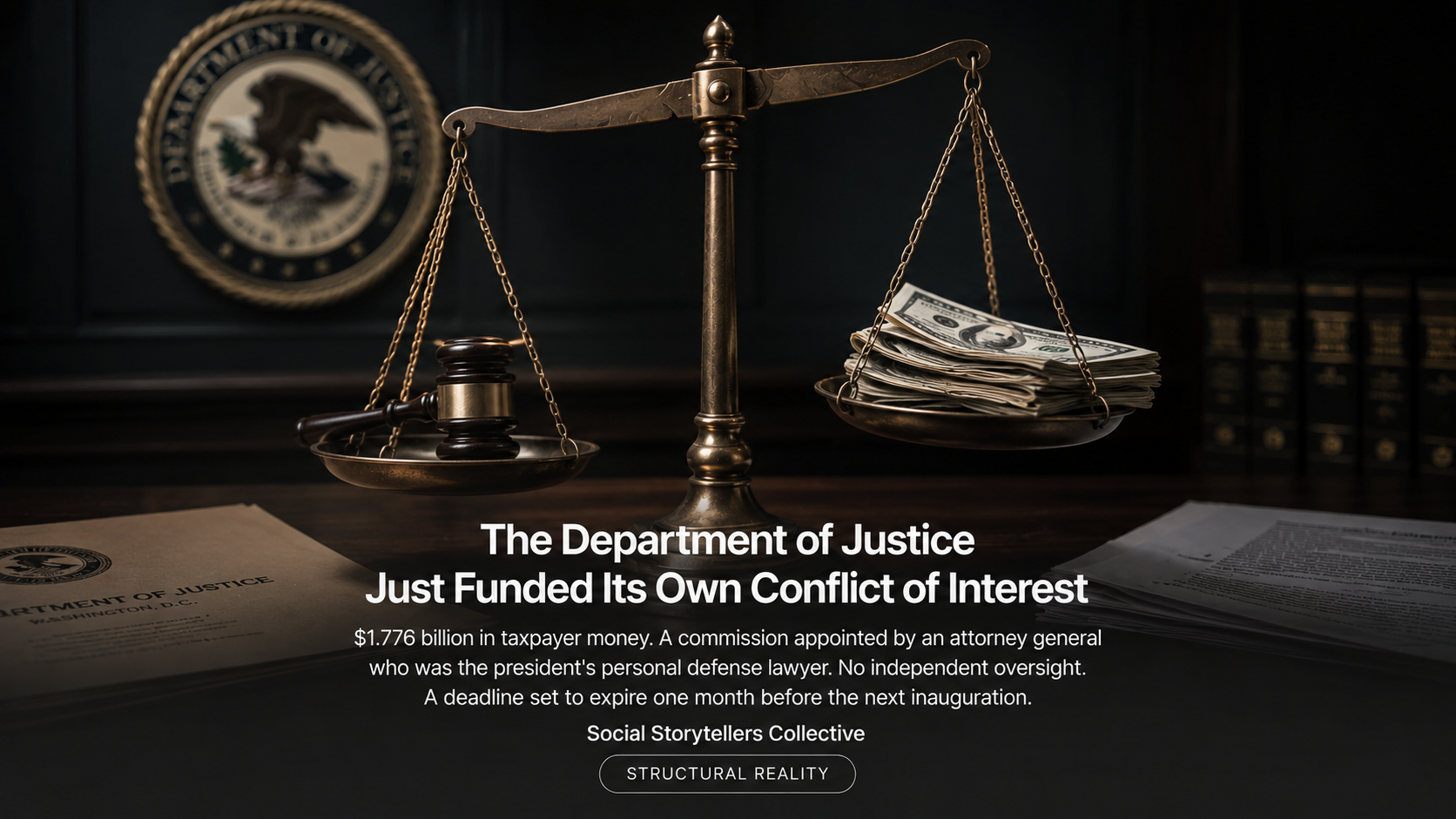
The Department of Justice announced Monday the creation of the “Anti-Weaponization Fund” — $1.776 billion drawn from the federal Judgment Fund, the permanent Treasury appropriation used to pay legal settlements against the government. The fund was established as part of settling President Trump’s lawsuit against the IRS over the leak of his tax returns. The president and his family will receive a formal apology. No direct monetary damages. In exchange, they dropped the IRS lawsuit, an administrative claim related to the FBI raid on Mar-a-Lago, and a claim tied to the Russia investigation.
The fund’s stated purpose is to provide “a systematic process to hear and redress claims of others who suffered weaponization and lawfare.” Anyone who believes the government targeted them for political, personal, or ideological reasons may file a claim. The commission has the power to issue formal apologies and monetary relief. Submission is voluntary. There are, the DOJ notes, no partisan requirements to file.
That last line is doing a great deal of work.
The fund will be overseen by a five-member commission. All five members are appointed by the Attorney General. One will be selected “in consultation with congressional leadership.” The Attorney General who signed the memo establishing the fund is Todd Blanche — who, before becoming acting Attorney General, served as Donald Trump’s personal defense attorney in the federal cases against him, including the prosecution over alleged efforts to overturn the 2020 election and the mishandling of classified documents at Mar-a-Lago.
The man who defended the president against federal prosecution is now the man who controls the commission deciding who was wrongfully prosecuted by the federal government. The commission he appoints will determine who qualifies as a victim of government overreach — and how much they receive from $1.776 billion in taxpayer funds.
This is not a guardrail problem. It is an architecture problem. The guardrails were never installed.
The potential beneficiaries are not abstract. The fund stops processing claims on December 15, 2028 — one month and five days before the next presidential inauguration. Among those who could benefit are the roughly 1,600 defendants convicted or charged in connection with the January 6th attack on the Capitol — many of whom Trump has already pardoned, and whose cases he has repeatedly framed as examples of government weaponization. Trump allies investigated or prosecuted under the Biden administration may also file claims. The definition of “weaponization” is broad enough to encompass virtually any federal investigation that the current administration has chosen to characterize as politically motivated.
The DOJ cited the Obama-era Keepseagle fund as legal precedent — a $760 million settlement for Native American farmers who alleged racism by the federal government over decades. The comparison is instructive primarily for how different the two situations are. Keepseagle addressed a documented pattern of racial discrimination against a specific, historically marginalized group, verified through years of litigation. The Anti-Weaponization Fund addresses claims of political targeting, defined by a commission appointed by an attorney general with a direct personal stake in which claims are considered legitimate.
The precedent being set is worth stating plainly. Among the most likely beneficiaries of the Anti-Weaponization Fund are the roughly 1,600 defendants convicted or charged in connection with the January 6th attack on the United States Capitol — people who were prosecuted not for political speech or lawful dissent, but for physically breaching the Capitol building, assaulting law enforcement officers, and attempting to disrupt the certification of a presidential election. Many have already received pardons. Some are now being positioned to receive financial compensation from a taxpayer-funded account administered by a commission that reports to the president whose certification they tried to prevent. The fund that was framed as protection against government overreach is being used to financially rehabilitate the people who committed the most visible act of political violence in recent American history. Calling that weaponization is not a legal argument. It is a rebranding. And the $1.776 billion now sitting in the Judgment Fund is the price of making it official.
The public trust dimension of this story is not a side argument. It is the center of it.
Consider the context in which this fund was announced. A CBS News/YouGov poll released this week found that 44% of Americans describe their personal financial situation as either “fairly bad” or “very bad.” Gas is sitting at $4.51 a gallon — up from $3.19 a year ago. Grocery prices remain elevated across every major market. The same week that Americans are recalculating whether they can afford to fill a tank or a grocery cart, the Justice Department moved $1.776 billion in taxpayer money into a fund administered by a commission appointed by the president’s former personal defense attorney.
That is not an abstraction. That is a values statement rendered in dollars. The administration that has spent two years telling Americans that the budget cannot accommodate expanded healthcare, housing relief, or student debt forgiveness just found $1.776 billion — not through an act of Congress, not through an appropriations process, but through a settlement in a lawsuit filed by the sitting president against his own government. The Judgment Fund is a permanent Treasury appropriation. It does not require congressional approval. The money moved without a vote.
Institutions derive their authority from the belief that they operate according to rules that apply regardless of who is in power. The Justice Department’s credibility — its ability to prosecute, investigate, and enforce the law in ways the public accepts as legitimate — depends on the perception that it is not an instrument of the administration it serves. That perception has been under sustained pressure since January 2025. Career prosecutors were fired. Investigations into Trump allies were dropped. The FBI’s leadership was restructured. The DOJ’s building now features a banner of the president’s image.
The Anti-Weaponization Fund is not a single departure from institutional norms. It is the latest in a sequence moving in the same direction: the DOJ as an instrument of political settlement rather than legal accountability. The fund uses the language of justice — redress, process, claimants, relief — while concentrating the power to define justice entirely within the hands of people whose personal and political interests are directly implicated in who gets classified as a victim.
When institutions stop operating according to rules that apply regardless of who is in power, the public eventually stops trusting that the rules exist at all. That erosion does not happen through a single announcement. It happens through accumulation — through each decision that redefines what the institution is for, until the definition has moved so far from its original meaning that the language is the only thing that remains.
The machinery of government, the DOJ said Monday, should never be weaponized against any American.
The commission that will decide what counts as weaponization reports to the man who defended the president against the government he now leads.
That is not irony. It is the architecture.