
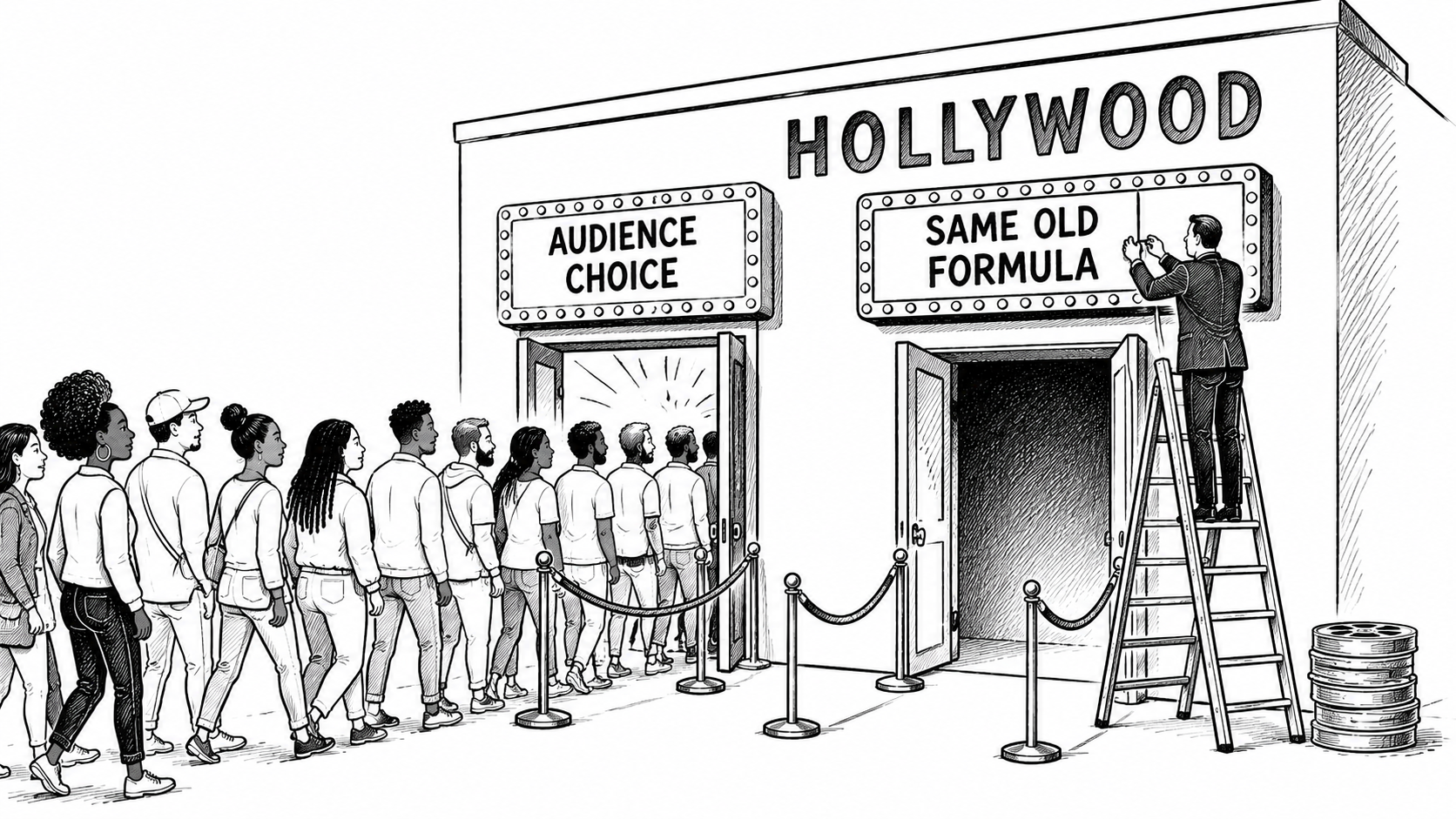
UCLA’s 2026 Hollywood Diversity Report, released in March by researchers at the Institute for Research on Labor and Employment, opens with a finding the industry should not be able to dismiss: films with casts that were 41 to 50 percent BIPOC achieved the strongest performance across every single box office metric in 2025 — highest median global receipts at $117.1 million, largest average theatrical releases at 3,460 domestic theaters, and widest international distribution. That diversity range happens to mirror the 45.2 percent BIPOC share of the U.S. population. The report cited Ryan Coogler’s Sinners — which SSC covered in depth when it made history as the most Oscar-nominated film of all time — as the clearest proof of concept. BIPOC moviegoers purchased the majority of opening-weekend domestic tickets for 11 of the top 20 films globally in 2025. The audience is not a niche. It is the market.
And yet the industry moved in the opposite direction. White actors increased their share of lead roles to 76.9 percent in 2025. Black actors held 6.5 percent. Latinx actors accounted for less than 3 percent. Women’s representation in lead roles fell below 2022 levels to 37 percent. This is not a plateau — it is a third consecutive year of reversal following the representation gains that followed 2020. The industry is actively moving away from what its own audience data is telling it to do.
The standard explanation is that studios default to familiar formulas out of risk aversion. That explanation collapses when the data on familiar formulas is this consistently weak and the data on diverse casts is this consistently strong. What the UCLA report is documenting is not a knowledge problem. Studios have access to the same box office numbers everyone else does. It is a decision-making problem — which means it is a power problem. The people deciding what gets made, who gets cast, and which stories get greenlit are not reflecting the audience. They are reflecting themselves.
Sinners is not the anomaly Hollywood should be celebrating as a rare exception. It is the argument for a different way of doing business entirely — one built on creative ownership, cultural specificity, and trusting the audience that is actually in the seats. The films that keep underperforming are the ones built on the assumption that a white male lead is the default commercial anchor. That assumption has been disproven by the data for years. It persists not because it is commercially rational but because it is institutionally comfortable. Hollywood is not struggling to figure out what audiences want. It is choosing, repeatedly, not to give it to them.
Read SSC’s earlier piece on Sinners as a structural proof of concept: The Sinners Effect: Ryan Coogler and Michael B. Jordan Are Rewriting What Black Cinema Can Do.