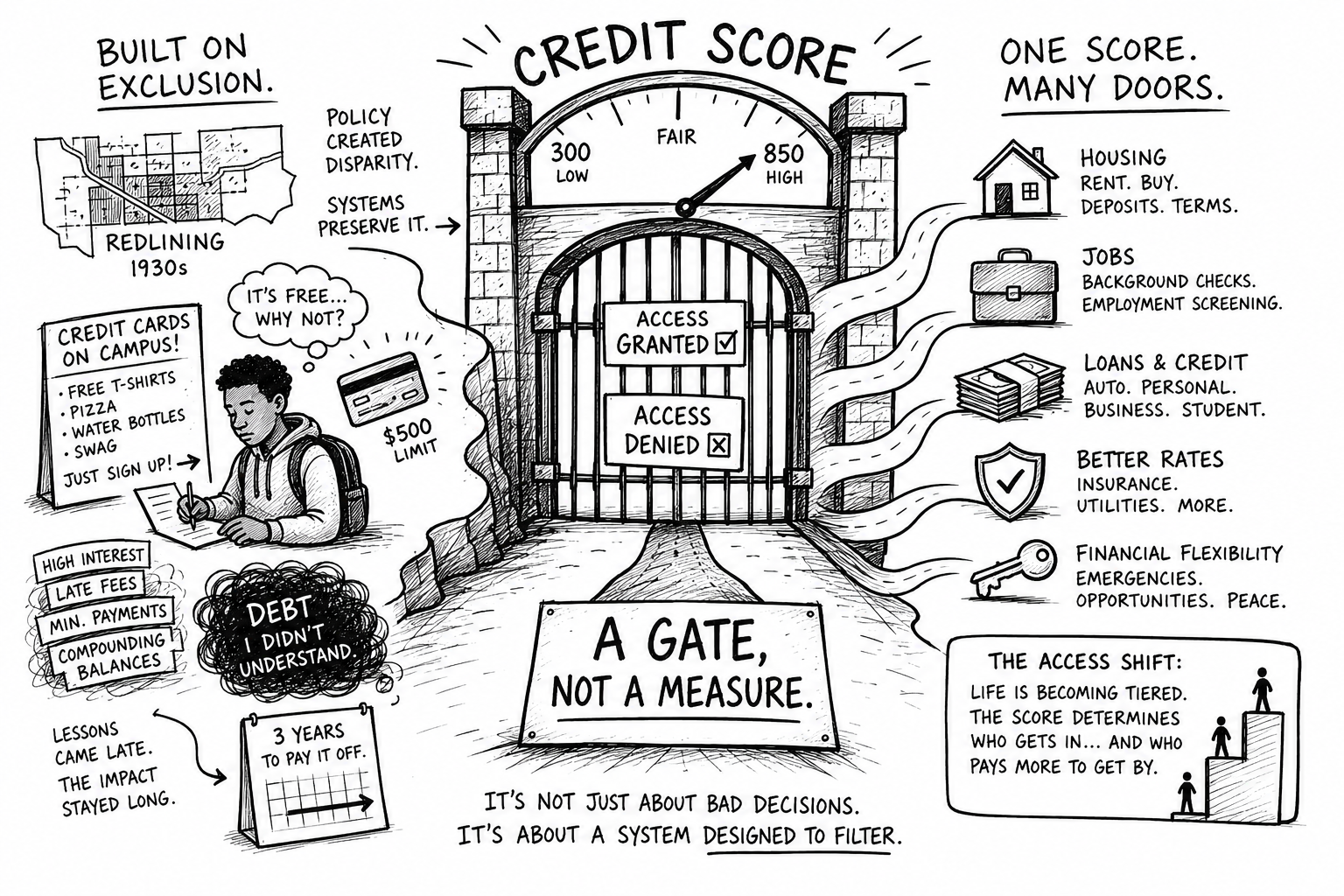
For decades, Americans have been taught to treat the credit score like a neutral reflection of personal responsibility. A number. A measure. A supposedly objective indicator of trustworthiness. The higher the score, the more “responsible” the person. The lower the score, the more risk they represent to banks, landlords, employers, and insurers. But the mythology around credit scoring has always depended on a fundamental public misunderstanding — about what the system was actually built to do. Credit scores were never designed to measure human value or financial intelligence. They were designed to sort populations into categories of access. And in the United States, systems of sorting have historically never existed apart from race, geography, class, and deliberate exclusion.
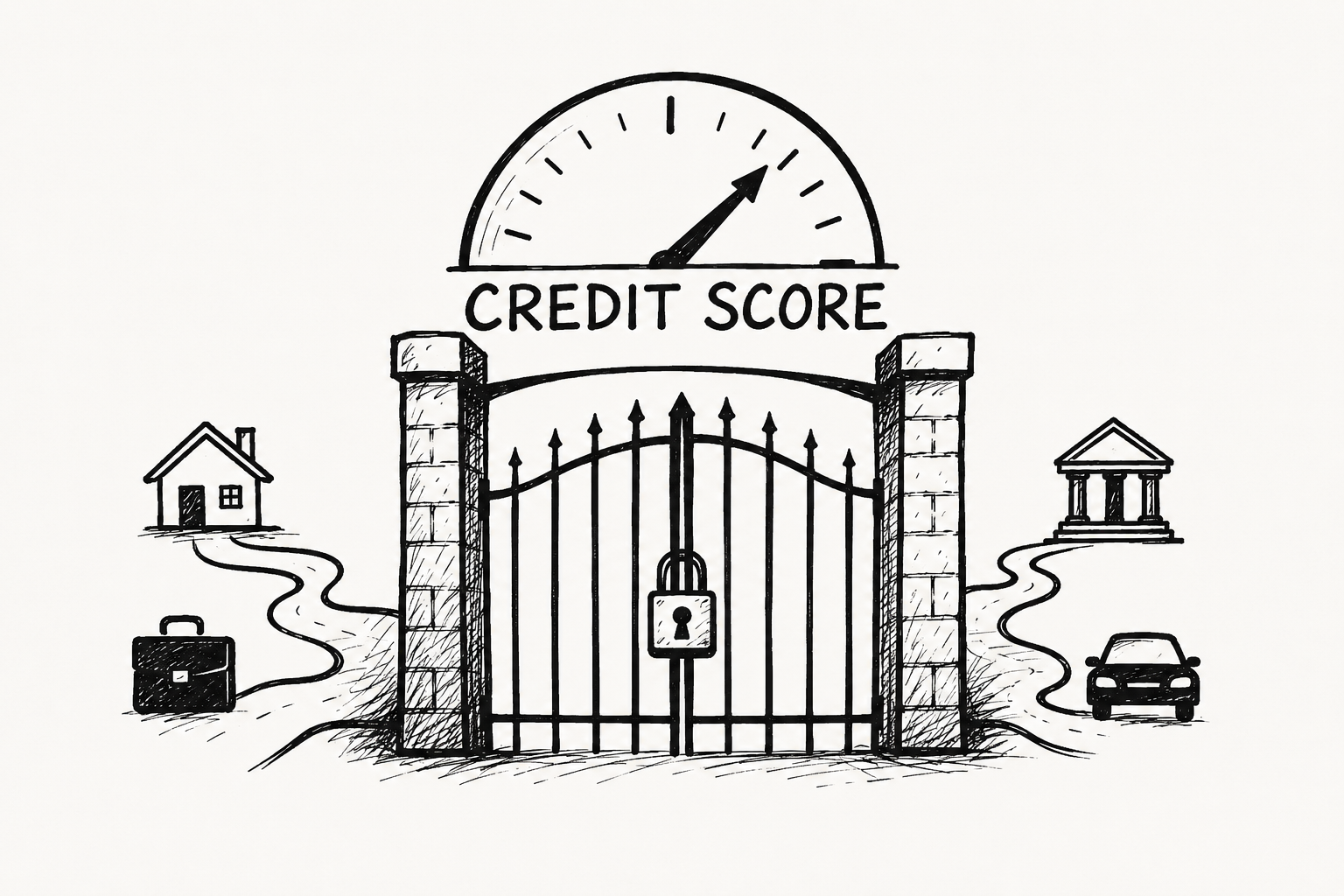
That distinction matters because the modern credit system now functions as one of the most powerful invisible infrastructures shaping American life. Credit scores influence whether someone can rent an apartment, buy a home, lease a car, qualify for lower insurance premiums, secure a business loan, or even get hired for certain jobs. In many ways, the score has become a shadow citizenship system layered on top of economic life itself. The problem is not simply that the system produces unequal outcomes. The problem is that inequality was embedded into the architecture from the beginning.
I encountered part of that system the way a lot of young Black men do — before I had the language to name what was happening. In college, credit card companies set up tables on campus with free T-shirts, pizza, and water bottles. The pitch was casual, almost harmless. It felt less like entry into a debt system and more like participation in adulthood itself. I signed up without fully understanding interest rates, compounding balances, or how quickly a $500 limit could become a years-long financial burden. What started as spending flexibility turned into debt that took nearly three years to pay down. That experience wasn’t unusual. It was by design. Entire industries have historically targeted young adults — particularly young Black adults on campuses with limited financial infrastructure around them — before they possess the literacy or economic stability to navigate the consequences of revolving debt systems built to generate profit from prolonged repayment.
Long before those tables showed up on campus, the United States had already established a financial geography that determined which communities would receive investment and which would be systematically starved of it. Redlining created that blueprint. Beginning in the 1930s, federal housing maps categorized predominantly Black neighborhoods as financially hazardous, restricting access to mortgages, credit, and investment for generations. White families in suburban areas accumulated appreciating property wealth while Black families were locked out of the most powerful wealth-building mechanism in modern American history. That wealth gap did not disappear when redlining formally ended. It evolved into new systems that appeared race-neutral on paper while continuing to reproduce the same structural outcomes.
Credit scoring became one of the most effective tools for accomplishing that transition because it translated historical deprivation into individualized risk profiles. Families denied generational wealth accumulation were more likely to have thinner credit histories, higher debt burdens, lower savings cushions, and greater exposure to predatory lending. The algorithm does not need to explicitly identify race to reproduce racialized outcomes. The economic conditions created by decades of policy had already encoded the disparities into the data itself. The machine learned inequality because inequality was what it was trained on.
That is the gap that contemporary conversations about “financial literacy” consistently fail to address. Financial education matters. But literacy cannot solve structural exclusion on its own. A person can understand budgeting perfectly and still struggle to build credit if wages remain stagnant, rents continue rising, healthcare costs consume disposable income, and emergencies force reliance on high-interest debt products. This contradiction becomes especially visible in housing, where landlords increasingly require high credit scores to secure apartments even as inflation, student debt, medical debt, and rising living costs push more households into financial strain. The system rewards stability while simultaneously making stability harder to maintain — and then treats the resulting instability as evidence of personal failure. As SSC has reported in The Paycheck-to-Paycheck Economy, financial strain is no longer the exception in American life. It is the architecture.
The expansion of algorithmic decision-making has only intensified this dynamic. Fintech companies and data brokers now analyze everything from payment histories to spending patterns, subscription behavior, location data, and transactional activity to build risk profiles. Supporters frame this as innovation because it allows companies to assess consumers more efficiently. But efficiency is not the same thing as fairness, and the distinction matters enormously when the datasets being used are built on historical exclusion. Algorithms trained on historically unequal data do not neutralize that inequality — they operationalize it. They learn historical deprivation as a predictive pattern and then apply that pattern going forward. The language shifts from redlining to machine learning, but the structural outcome remains remarkably similar. Exclusion becomes automated, scaled, and harder to identify as exclusion at all.
This is where the credit system connects directly to how the broader economy is being reorganized. Modern American life is increasingly distributed through invisible filtering systems that determine who absorbs friction and who bypasses it. Housing, healthcare, mobility, and basic financial flexibility are becoming tiered experiences — not because of visible discrimination, but because of gatekeeping that looks administrative. The credit score operates as one of the central filters inside that architecture. Two people may need the same apartment, but one pays a lower deposit because their score grants them institutional trust. Two people may need transportation, but one receives favorable financing while the other pays significantly more over time for the exact same vehicle. The inequality is not just at the point of transaction. It compounds through every stage of economic participation, accumulating in ways that are difficult to trace back to any single decision.
That compounding effect explains why reform efforts consistently fall short of the problem they claim to address. Lowering the impact of medical debt on scores or adjusting reporting windows may improve outcomes at the margins, but neither intervention touches the role credit scoring plays inside the larger system. The score still functions as a gatekeeper that converts past economic vulnerability into future restrictions — and because access determines quality of life at nearly every level, those restrictions ripple outward into education, housing stability, health outcomes, entrepreneurship, and intergenerational mobility. Reforming the gate while leaving the gate in place is not reform. It is maintenance.
What the system actually measures is not discipline or responsibility. It measures proximity to institutional stability — how close a person already is to the conditions that make the system work in their favor. That is why the most consequential question is not how individuals can improve their scores. It is why so much of modern life requires a high score to access in the first place, who designed that requirement, and what it protects. Numbers appear objective because they are precise. But precision and neutrality are not the same thing. And systems built during eras of deliberate exclusion do not become equitable simply because the exclusion is now being performed by an algorithm.