
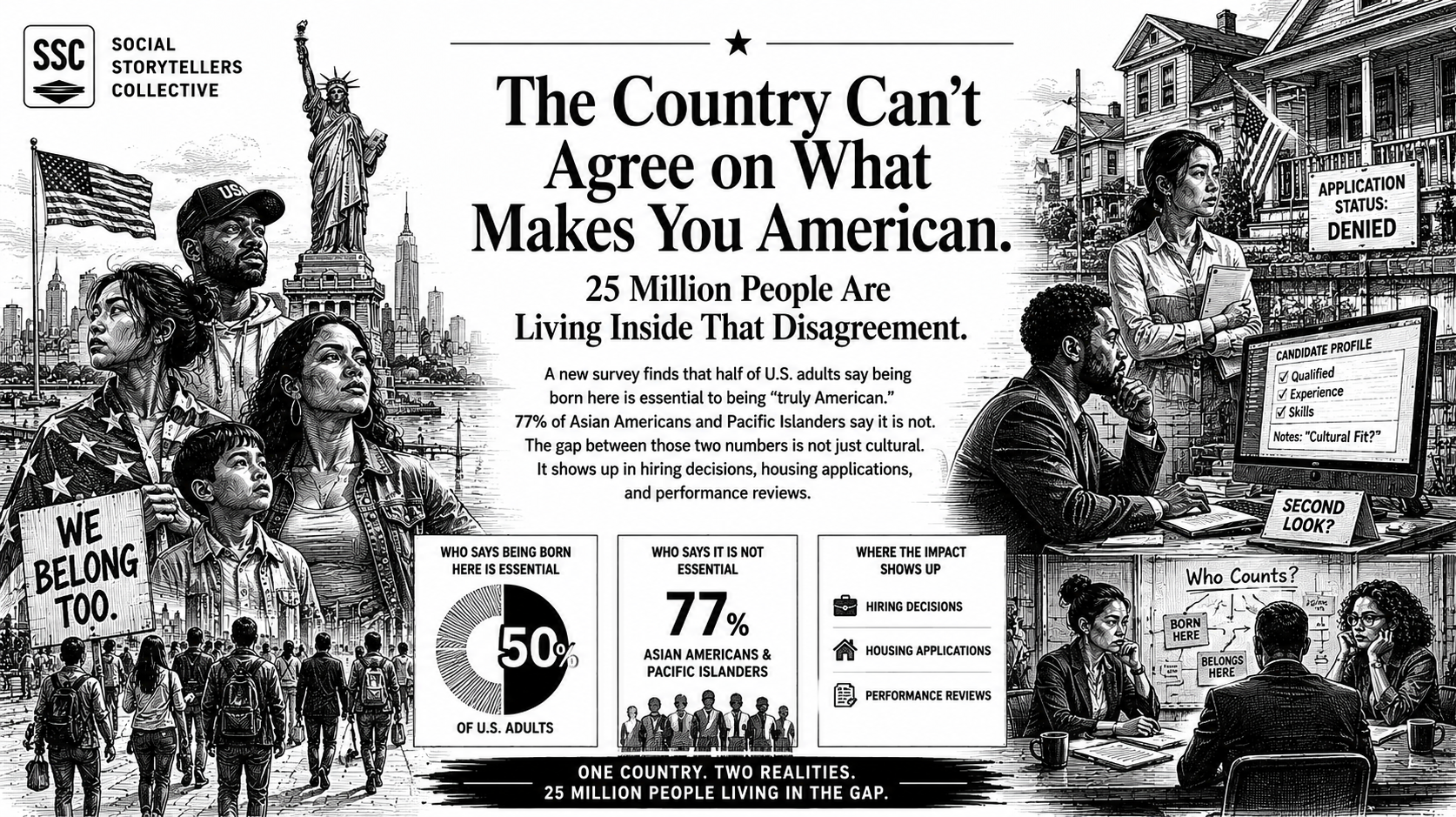
The gap between those two numbers is not just cultural. It shows up in hiring decisions, housing applications, and performance reviews.
Race, Identity & Power · Structural Reality
50% of U.S. adults say being born in the United States is important to being “truly American.” 77% of Asian Americans and Pacific Islanders say it is not — a higher share than any other racial or ethnic group in the survey. That gap is not a philosophical disagreement about national identity. It is a lived reality for 25 million people navigating a country that cannot decide whether they belong to it — and it has consequences that reach well beyond the question of belonging itself.
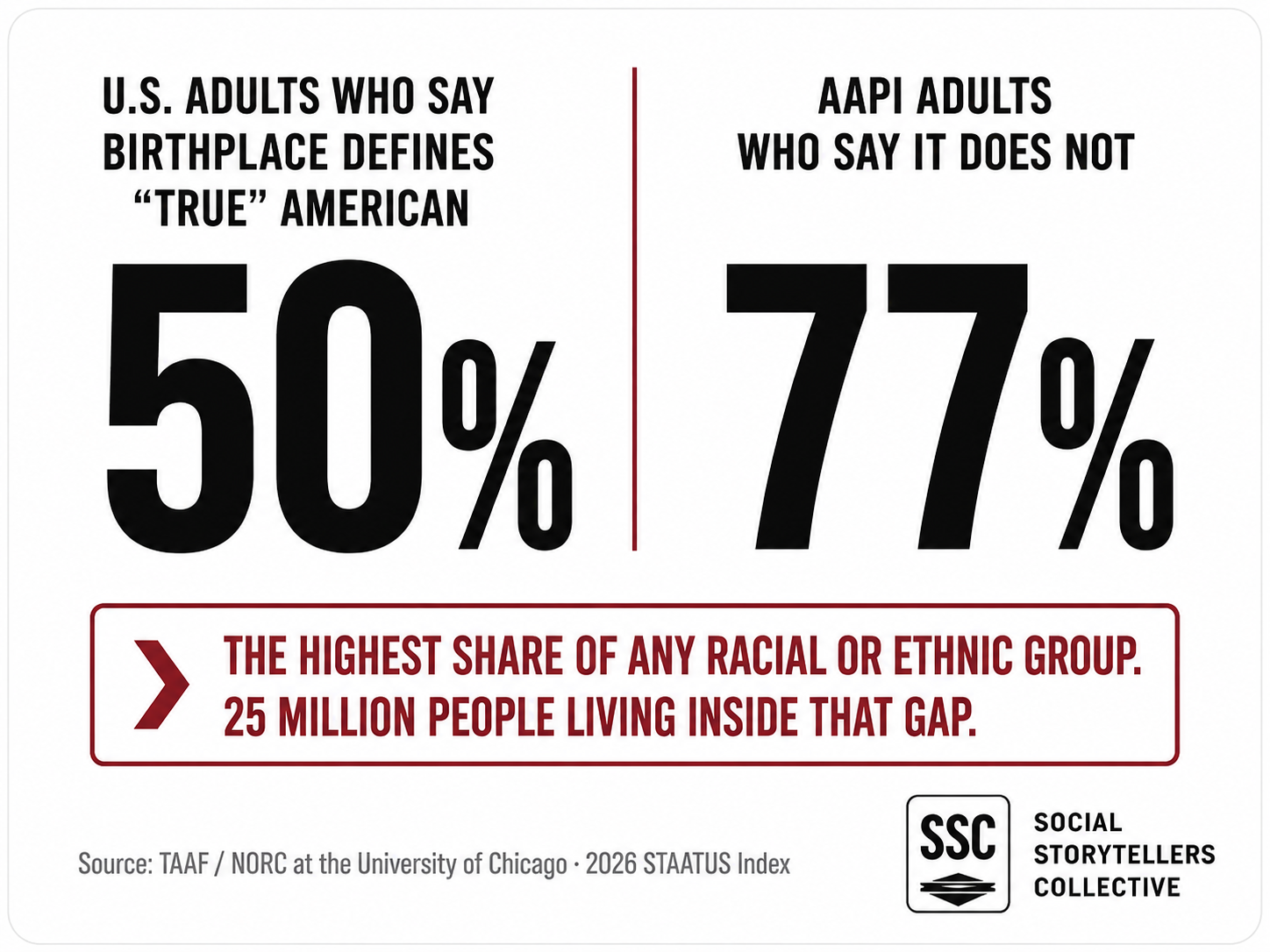
The 2026 STAATUS Index — the sixth annual Social Tracking of Asian Americans in the U.S., conducted by NORC at the University of Chicago for The Asian American Foundation (TAAF) — finds the country sharply divided over a fundamental question at the precise moment it is preparing to celebrate 250 years of independence. The timing is not incidental. The Supreme Court is currently weighing the birthright citizenship case. Sruthi Chandrasekaran, TAAF’s Director of Data and Research, named the connection directly: “This almost feels like the most important finding — especially as we know the Supreme Court is weighing the birthright citizenship case.”
The data underneath the headline number is specific and unsettling. White Americans see the status of Asian Americansin U.S. society as more similar to white people (64%) than to people of color (31%). Most AAPI, Black, and Hispanic adults disagree with that characterization entirely. 1 in 5 U.S. adults are concerned that Chinese Americans pose a threat to U.S. society. 1 in 5 AAPI adults reported being insulted, threatened, or harassed because of their race in the past 12 months — years after the pandemic-era surge in anti-Asian violence was declared over. Worry (44%) ranked above hope (40%) as the most commonly reported emotion among AAPIs — a distinction no other racial or ethnic group shared.
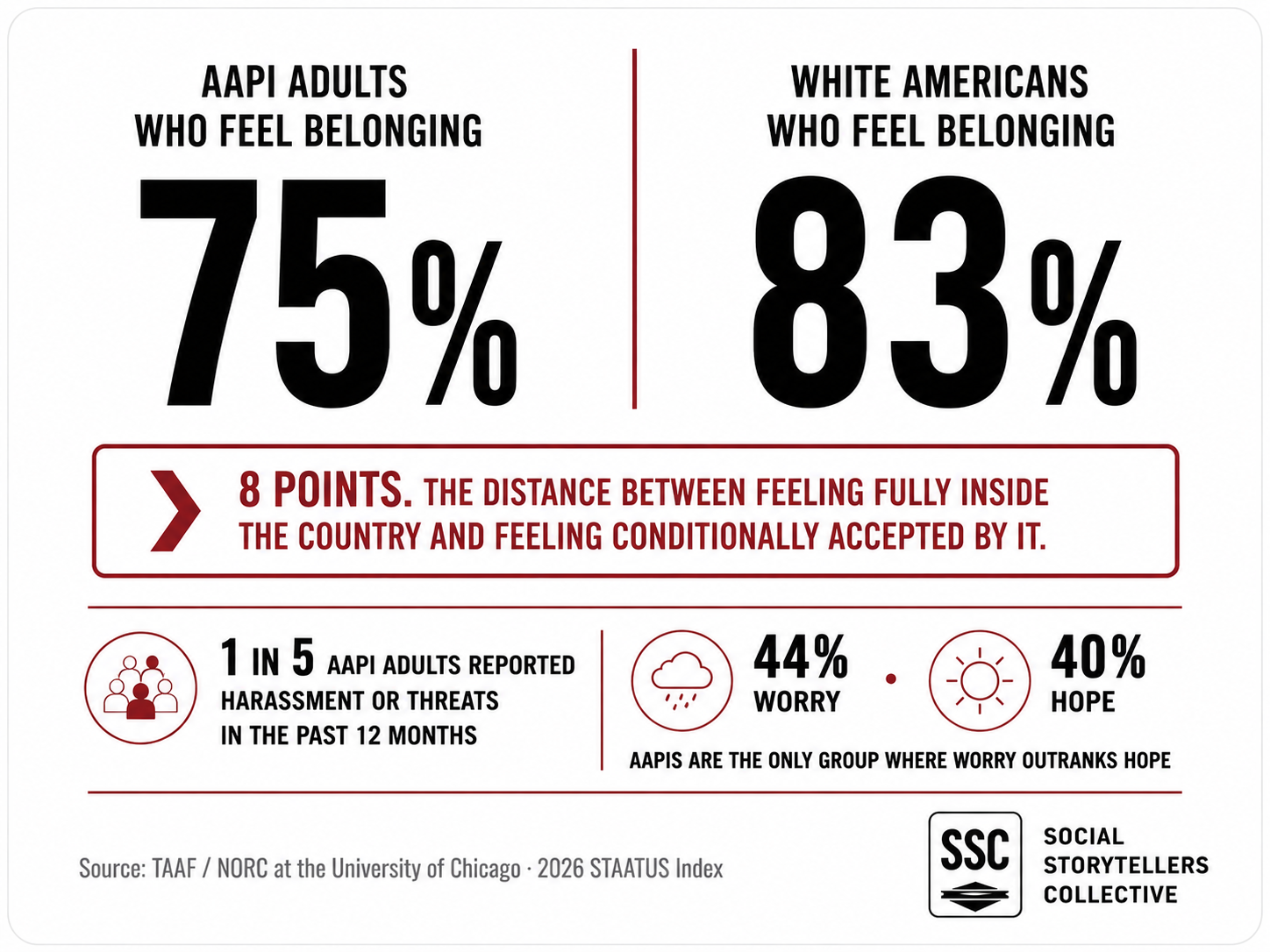
Three-quarters of AAPIs said they feel belonging overall — compared with 83% of white Americans. That 8-point gap is not abstract. It is the distance between feeling fully inside the country and feeling conditionally accepted by it.
Conditional belonging has economic consequences that the survey data points toward but mainstream coverage rarely names. When 64% of white Americans perceive Asian Americans as more similar to white people than to people of color — while AAPIs themselves and most other communities of color disagree — that perceptual gap shapes real decisions. Hiring managers make assumptions about cultural fit. Promotion committees make judgments about leadership potential. Investors make calls about who gets the benefit of the doubt. The model minority framework that positions AAPIs as adjacent to whiteness does not protect them from discrimination — the 1-in-5 harassment statistic and the persistent worry-over-hope emotional profile make that plain. What it does is make the discrimination harder to name and harder to document, because the framework says it shouldn’t be happening.
This is the same dynamic the Ambition Without Access report from the Julian Bond Institute documented for Black and Hispanic Americans this week — aspiration at rates that exceed their white peers, structural barriers that consistently narrow the gap between what they want and what the system allows them to build. The STAATUS Index finds a version of that same gap inside AAPI communities: 25 million people who overwhelmingly define belonging through community connection, inclusion, and having a voice — and who are 8 points less likely than white Americans to feel that belonging fully.
Norman Chen, CEO of TAAF, named the mechanism: “Despite our community’s growing power, a significant share of the public is still forming views about America’s fastest-growing racial group with no direct connection or information.” That information gap is not neutral. It is the space where stereotype fills in for knowledge — and where policy gets made about communities whose actual experience the policymakers have never been required to understand.
The 250th anniversary is the backdrop for this data. The Supreme Court birthright citizenship case is the immediate policy context. The Caesar Rodney statue returning to Freedom Plaza is the symbolic frame. All three are asking the same question from different angles: who counts as American, who gets to decide, and what does the answer cost the people on the wrong side of it. The STAATUS Index is the data version of that question. 25 million people are living the answer every day.
Sources: The Asian American Foundation / NORC at the University of Chicago · 2026 STAATUS Index · May 1, 2026. NextShark, AAPI News, American Bazaar, NW Asian Weekly · May 2026.
SSC covers race, identity, power, and the structural forces shaping American civic life.