

Hill County, Texas approved a one-year pause on new data center development this week after local officials raised concerns about water use, energy demand, and long-term infrastructure strain tied to rapid AI expansion. The decision arrived as Texas continues attracting massive technology investment because of cheap land, business-friendly regulation, and expansive energy infrastructure. Artificial intelligence is still discussed publicly through software, productivity tools, and consumer applications. On the ground, communities are beginning to confront it as a physical industrial system with measurable environmental costs.
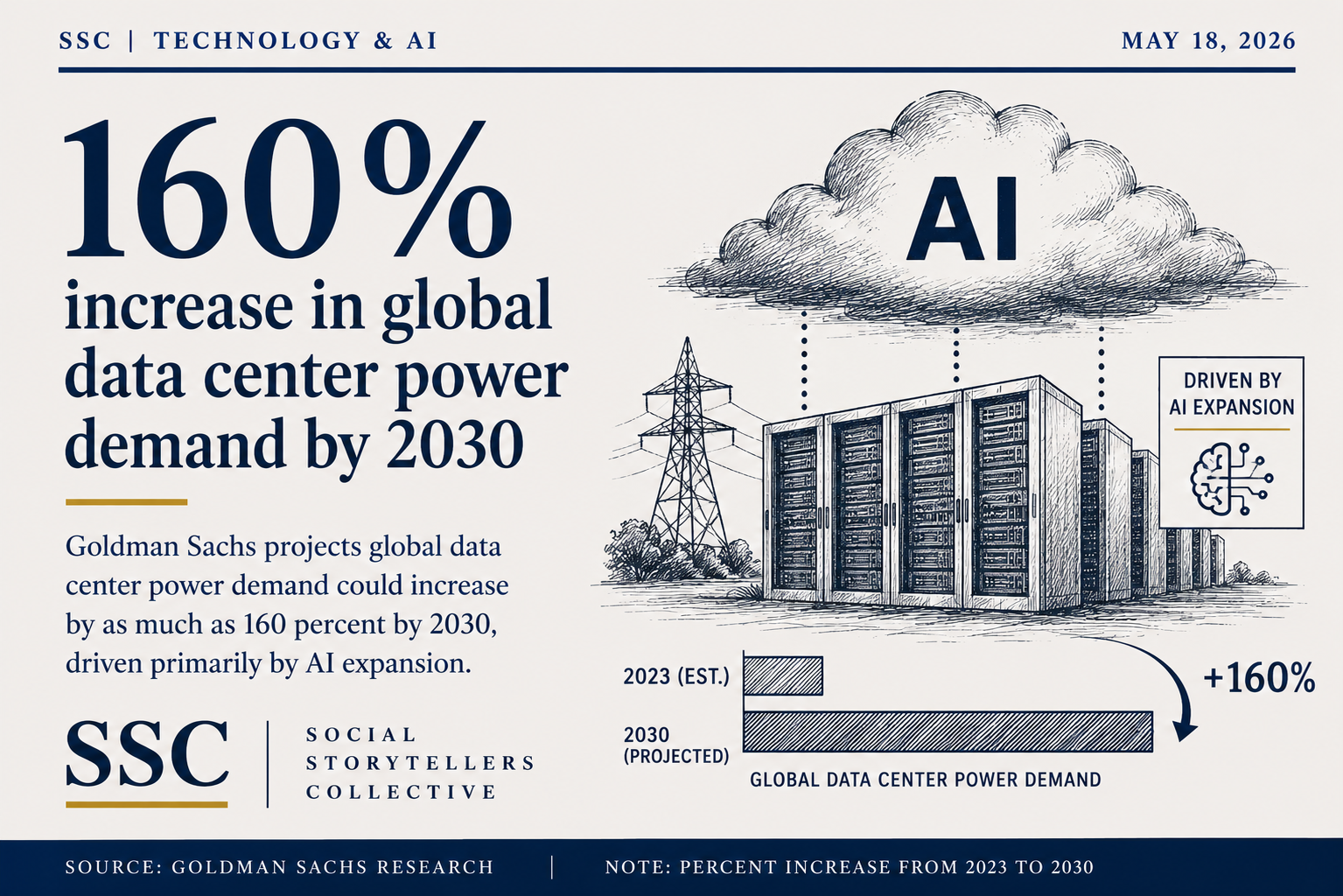
Those costs are growing fast. Modern AI models require enormous computing power, which demands large quantities of electricity and water for cooling. Researchers at the University of California estimated that generating a 100-word AI response can consume roughly one bottle of water’s worth of cooling resources depending on server location and infrastructure. Goldman Sachs projects global data center power demand could increase by as much as 160 percent by 2030, driven primarily by AI expansion. What appears digitally weightless on a smartphone screen increasingly depends on resource-intensive physical infrastructure running somewhere else.
Texas sits at the center of that transformation. The state has become one of the country’s most important corridors for cloud computing, semiconductor manufacturing, logistics, and AI infrastructure — drawing technology investment that is now spilling into rural counties that were historically organized around agriculture, manufacturing, or energy production. Hill County is not an outlier. It is an early signal. Communities across the state are being asked to absorb hyperscale computing facilities that consume electricity at levels comparable to small cities, with little advance preparation for what that actually requires.
The central contradiction is that AI is consistently marketed as frictionless innovation while depending on deeply material systems underneath. Large technology companies promote efficiency gains, automation capabilities, and digital transformation without foregrounding the physical footprint sustaining those services. Water access, transmission infrastructure, land use policy, and grid reliability become secondary stories in public coverage — even though they determine whether expansion is operationally possible. The cloud still depends on pipes, roads, substations, and cooling towers.
Communities are beginning to register that imbalance. Rural officials increasingly worry that data centers can overwhelm local utilities while generating fewer permanent jobs than traditional industrial projects. Construction phases produce economic activity, but staffing levels once facilities become operational are often relatively low. Residents face a difficult trade-off: absorb significant infrastructure pressure in exchange for uncertain long-term economic benefit. That tension resembles earlier fights over pipelines, distribution hubs, and manufacturing plants — except the political branding around AI often obscures the industrial parallel entirely.
There is also a geopolitical dimension developing beneath local zoning debates. The United States, China, the Gulf states, and European governments are all racing to secure AI dominance through semiconductor production, cloud infrastructure, and energy access. Data centers are quietly becoming strategic assets tied to national competitiveness. That pressure incentivizes rapid expansion even when local governments raise environmental or resource concerns, because the decision calculus is no longer purely local. Rural communities are negotiating against global technological priorities operating on timelines and at scales they cannot fully see.
The Hill County decision points toward the next phase of the AI conversation — one that is less about software ethics or workplace disruption and more about who is asked to physically sustain the systems powering the digital economy. Water rights, energy grids, land governance, and community consent are becoming AI policy questions even when they do not appear in AI policy discussions. The future conflict over artificial intelligence may not center on what the technology can do. It may center on what it costs, and who pays.
SSC | Technology & AI — May 18, 2026 — Social Storytellers Collective News Desk