
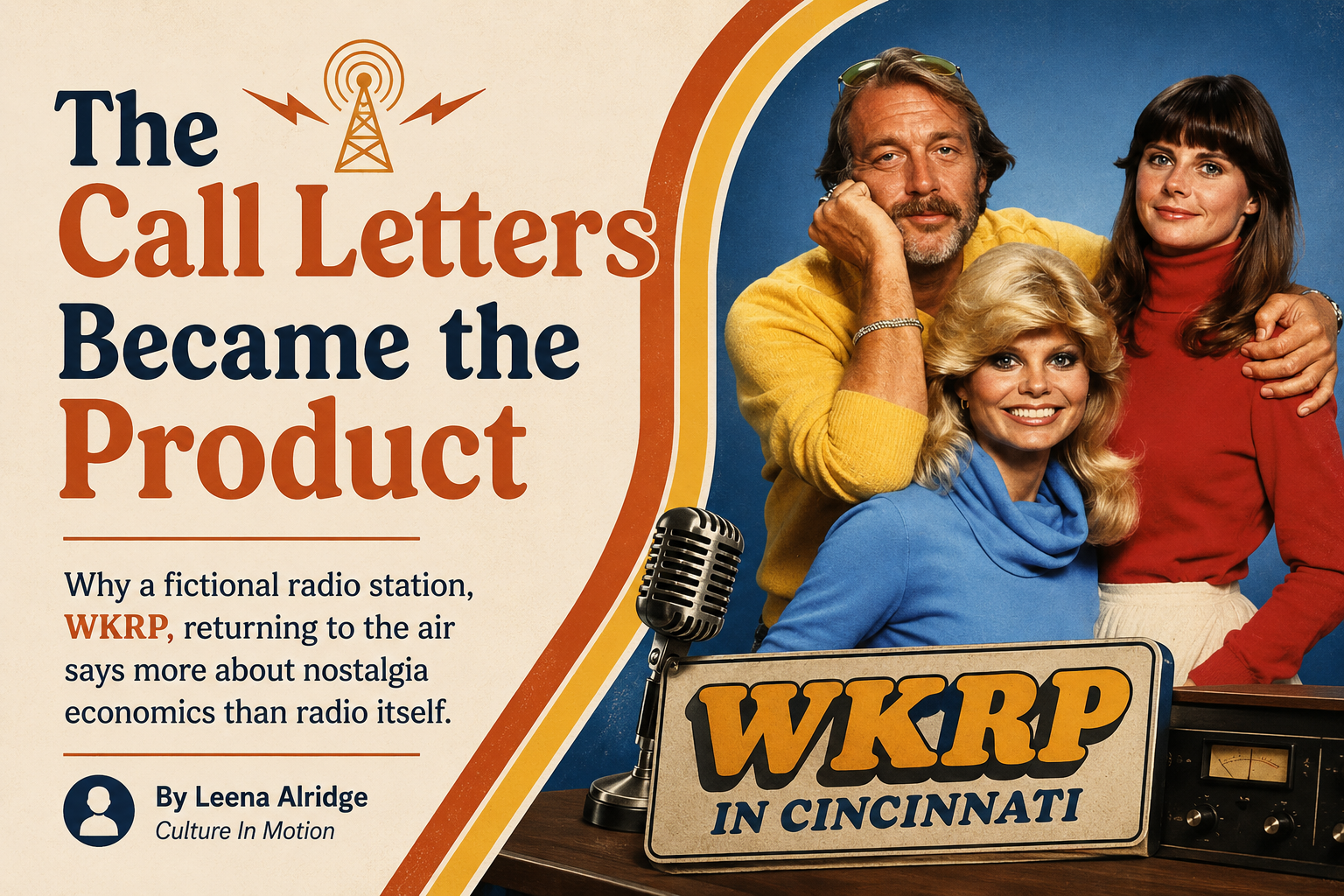
On May 4, 2026, a Cincinnati radio station aired the WKRP theme song for six straight hours before the changeover became official. Jeff Ziesmann, who owns the three-station network that now broadcasts as WKRP in Cincinnati across 97.7 FM in the Cincinnati area, 106.7 FM in Northern Kentucky, and 94.5 FM in Dayton, acquired the call letters from a low-power nonprofit station in Raleigh, North Carolina, that had put them up for auction as a fundraising effort. Gary Sandy — who played program director Andy Travis on the original 1978-82 CBS sitcom — recorded promotional announcements for the launch. The fictional station is now real. And the reason it works has almost nothing to do with radio.
“We play essentially the same music that they played on WKRP. It made more sense for us to do this than any other station in town,” Ziesmann told Cincinnati public radio station WVXU. That logic is straightforward. What it reveals structurally is more significant.
The WKRP rebrand is not a nostalgia stunt. It is a case study in how media increasingly monetizes familiarity instead of discovery — and why that shift is happening now, at this specific cultural moment, with this specific intensity.
The global collectibles market has topped $496 billion in 2025, driven by cross-generational appeal, scarcity, and the thrill of the hunt. Streaming services marketing titles as revivals or reboots of 1980s and 1990s IP are driving a 33% average new subscriber spike in the two weeks surrounding their premiere date. Nostalgia fosters emotional responses that lift sales by up to 23%, and 81% of Gen Z consumers enjoy when brands revive childhood trends — even trends from eras they never personally experienced. Recognition is no longer just a marketing advantage. It has become the product itself.
Ziesmann understood this precisely. The three stations had already been positioned for a retro audience, targeting listeners over 45 who were most likely to remember the TV show. What the WKRP call letters gave him was something more valuable than a format change: instant emotional context. A brand that arrives with forty-eight years of cultural memory already attached. A name that requires no introduction, no marketing explanation, no audience education. In a fragmented attention economy where building recognition from scratch is increasingly expensive and increasingly difficult, acquiring it from an existing cultural memory system is a rational strategic decision.
For decades, radio stations built identity through local personality. DJs became civic figures. Stations reflected neighborhoods, generations, regional humor, and local music ecosystems. YouTube’s internal Creator Economy Report confirmed that retro commercial compilation channels collectively surpassed 9.4 billion total views in the prior 12 months — a 54% year-over-year increase — because the symbolic memory of media may now be more culturally powerful than the media itself. People are not nostalgic only for old shows. They are nostalgic for the feeling of shared cultural infrastructure — a time when millions of people consumed the same things simultaneously and local media still felt personal rather than optimized.
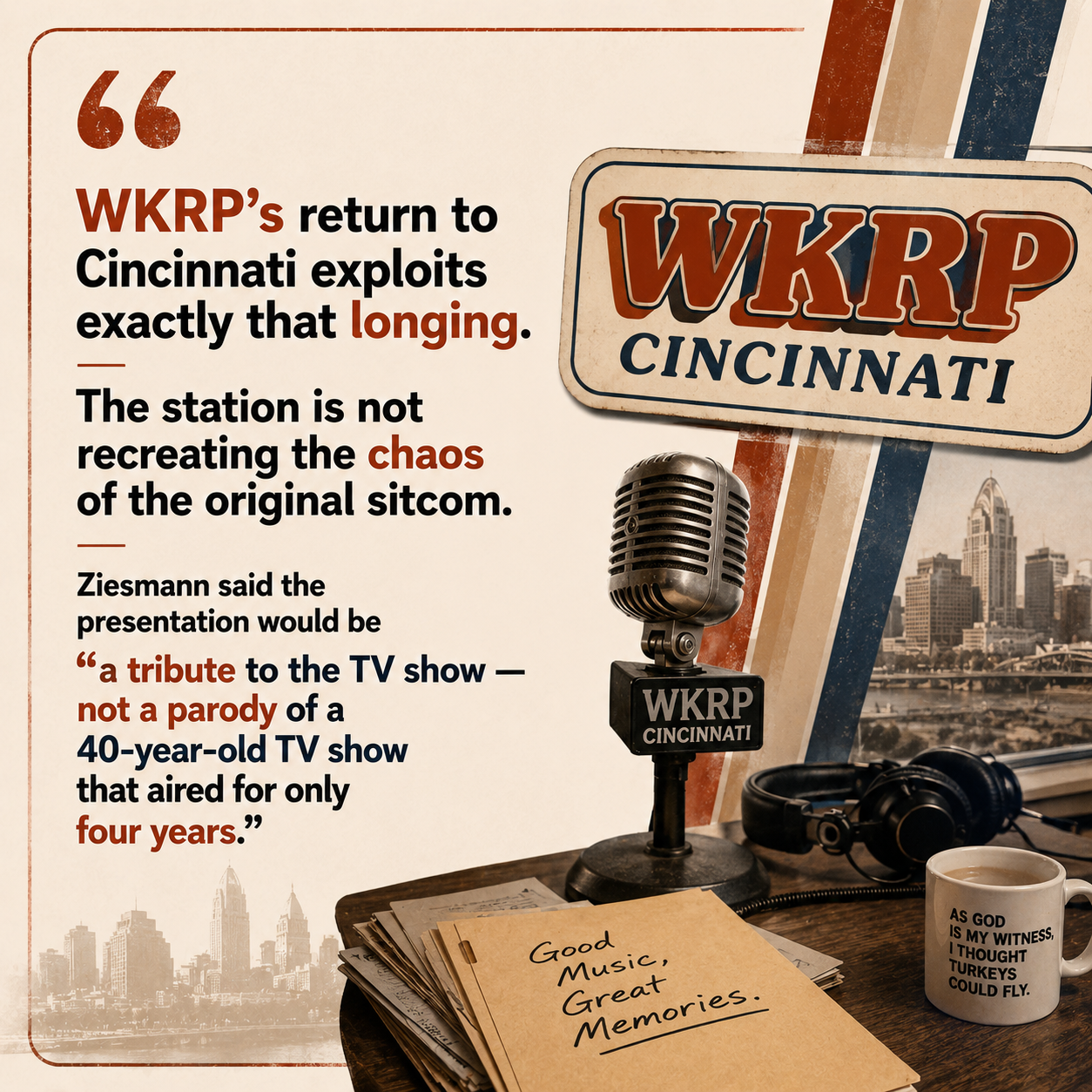
WKRP’s return to Cincinnati exploits exactly that longing. The station is not recreating the chaos of the original sitcom. Ziesmann said the presentation would be “a tribute to the TV show — not a parody of a 40-year-old TV show that aired for only four years.” It is doing something more strategic: borrowing emotional recognition from an existing cultural memory system. The call letters themselves now carry enough symbolic value to function as intellectual property independent of the original show.
There is also something fitting about a radio station becoming a nostalgia object at the precise moment radio itself occupies a more uncertain cultural position. Traditional broadcast radio once shaped national culture in real time. DJs broke artists. Morning hosts became local celebrities. Call letters carried regional identity. Today, audiences move fluidly between Spotify playlists, TikTok clips, podcasts, SiriusXM channels, YouTube mixes, and algorithmic recommendation systems. In that environment the symbolic memory of radio may actually become more culturally powerful than radio’s current influence itself.
The irony is precise. The original WKRP in Cincinnati was a show about instability inside media institutions — dysfunction, collapsing authority, generational clashes, commercial pressure, and chaotic attempts to remain culturally relevant. Those themes now feel more recognizable in 2026 than they did during the show’s original run. What was once satire increasingly looks like documentation. Media companies today still chase audience fragmentation, advertiser pressure, identity confusion, and collapsing trust. Only the platforms changed.
That may explain why the story resonates beyond simple nostalgia. The return of WKRP is comforting because it offers audiences a recognizable cultural artifact in a moment where media itself often feels unstable, disposable, and algorithmically flattened. According to WARC, 62% of people say nostalgic content feels comforting — like returning home after a hard day. People are not only nostalgic for the show. They are nostalgic for the conditions that made it possible — a time when a local radio station could become a civic institution, when a fictional station could become a cultural touchstone, when media felt like it belonged to the communities it served.
In that sense, the real product being sold is not the radio station. It is cultural continuity. And in an entertainment economy where reboots drive subscriber spikes and nostalgia lifts sales by nearly a quarter, continuity may be one of the most valuable commodities left.