
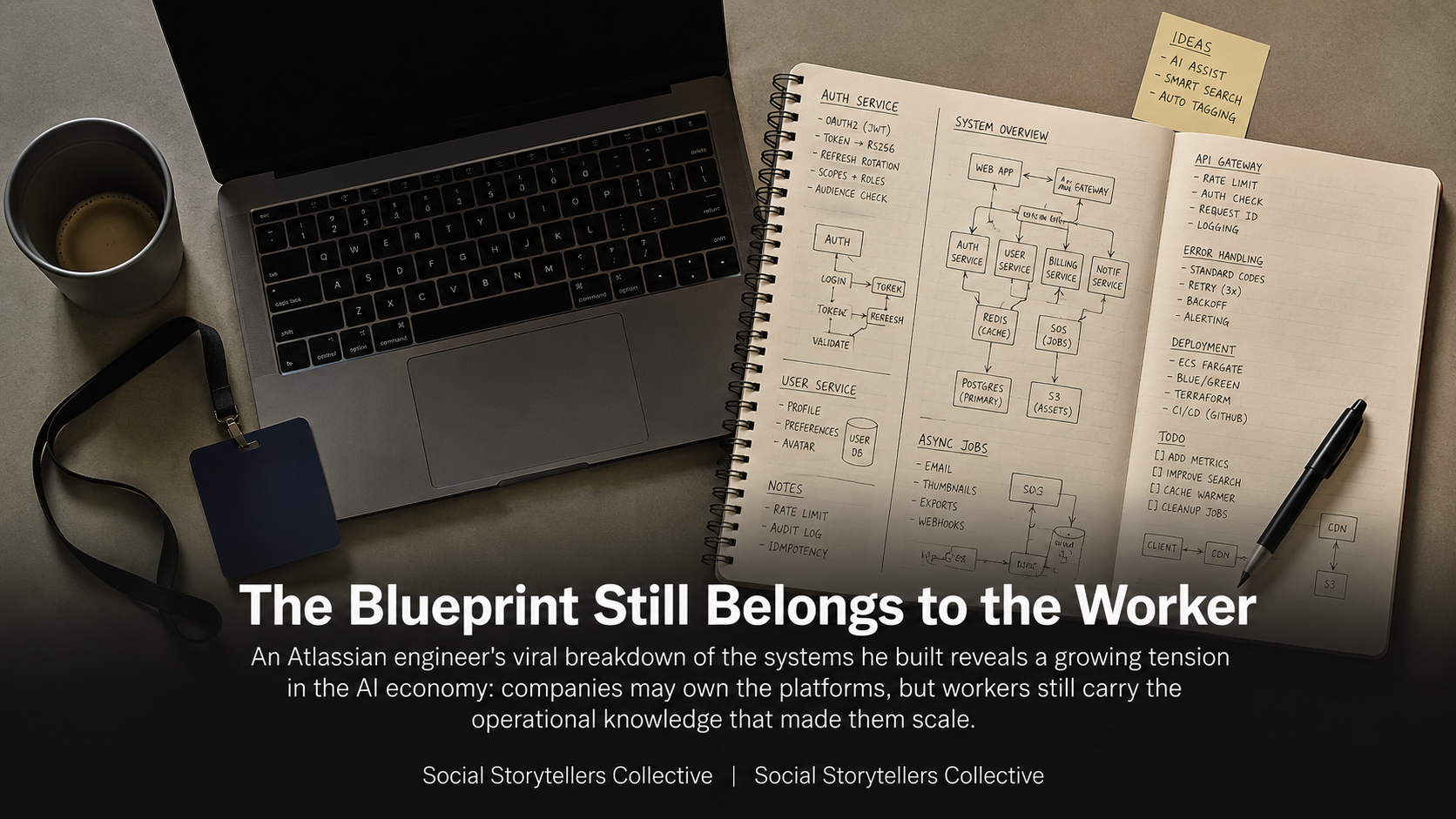
Companies may own the platforms, but workers still carry the operational knowledge that made them scale.
Atlassian reported roughly $1.79 billion in quarterly revenue and reaffirmed its long-term investment in AI infrastructure. Around the same time, a senior systems engineer named Vasilios Syrakis — who had spent nearly eight years helping build critical backend systems inside the company — was laid off as part of a broader workforce restructuring. In the current tech climate, that story would have barely registered. Layoffs have become so normalized across the industry that even highly compensated engineers are now discussed less as long-term institutional assets and more as adjustable operating costs.
What made this one different was what happened next.
Instead of posting a grievance-filled LinkedIn thread, Syrakis uploaded a detailed 38-minute educational video walking viewers through the architecture patterns, infrastructure decisions, and scaling strategies behind the systems he helped build. No proprietary code. No confidential business logic. What it offered instead was something arguably more valuable in today’s labor market: operational understanding. Complex backend engineering — the invisible layer beneath consumer technology — suddenly became legible to millions of people who never think about how platforms actually function. The video went viral. The engineer who got laid off became the one doing the teaching.
That distinction matters because modern technology companies rely on a specific separation between visibility and dependency. Consumers interact with polished interfaces and AI features, but the real operational value lives inside deeply technical systems maintained by relatively small groups of engineers. Routing layers, orchestration systems, deployment pipelines, authentication frameworks — the infrastructure that allows billion-dollar platforms to operate continuously at global scale. Most of that labor remains culturally invisible until something breaks. Syrakis pulled back the curtain. The response told him — and everyone watching — exactly how hungry people were to see behind it.
The virality also exposed a broader shift in how expertise travels. For years, companies operated on the assumption that institutional knowledge stayed trapped inside corporate walls. The internet dismantled that assumption permanently. Engineers, analysts, strategists, and operators can now demonstrate competence in ways entirely independent of employer branding. Documentation has become content. Technical literacy has become audience-building material. The worker may leave the platform, but the accumulated systems thinking does not disappear — and in the modern creator economy, the ability to translate specialized expertise into public education is increasingly its own form of leverage.
That dynamic becomes more complicated inside AI-driven restructuring. Across the technology sector, companies are simultaneously increasing investment in artificial intelligence while reducing the workforces that built the infrastructure AI now runs on. The public narrative emphasizes productivity and efficiency. The quieter reality is that many workers are being asked to build systems that ultimately reduce the long-term necessity of their own labor. The fear is not simply replacement. It is extraction. Employees spend years optimizing infrastructure, automating deployment, and standardizing operations — only to find that the more efficient they make the system, the easier the organization becomes to restructure around them.
What the Atlassian story compressed into one clean moment is exactly that anxiety. It was a layoff story. It was an AI economy story. It was a story about invisible labor becoming visible on the worker’s own terms. Atlassian may own the product, the codebase, and the platform. But Syrakis carried the blueprint in his head. And in the modern economy, that blueprint can become its own form of capital — if the person holding it decides to make it public.
The signal extends well beyond engineering. Across industries, professionals are quietly rethinking how they preserve ownership over their expertise, visibility, and leverage as institutional loyalty stops guaranteeing institutional protection. The workers building the systems whose long-term value accrues upward — toward platforms, shareholders, and executive strategy rather than toward the people maintaining the infrastructure — are starting to ask a different question. Not just what they owe the company. But what they should be keeping for themselves.
Social Storytellers Collective | Business & Professional Life Read the full End of Day Closing Note — drops at 3PM CDT weekdays.