
Part of Culture in Motion — an ongoing series examining who defines culture, how it moves, and what it reveals about the moment.
I grew up with TLC on my bedroom wall. CrazySexyCool was a whole education — not just in music, but in what it meant to see Black women take up space unapologetically. But even then, even as a girl, I noticed something. Chilli got a different kind of attention. She was the one the mainstream gravitated toward first. Racially ambiguous, light-skinned, her features reading closer to a Eurocentric beauty standard in ways that gave her a particular kind of cultural protection. T-Boz — stunningly beautiful, with traditional Black features and a presence that commanded every room — occupied a different lane in how the world received her. That gap was never about talent. It was about whose beauty the culture decided was easiest to consume.
I say all of that because it matters here. When someone who has spent a career benefiting from that kind of proximity and pretty privilege turns around and amplifies content that targets and demeans Michelle Obama — a Black woman whose beauty and intelligence have been mocked, questioned, and conspiracy-theorized about for years — it lands differently for Black women who grew up loving her. The hurt isn’t only political. It’s personal. It’s the specific sting of watching someone you built up reveal that the protection was never mutual.
Chilli says it was an accident. She had “no clue” the repost had happened until she started getting phone calls, and when she found it, she took it down immediately. She would never disrespect Michelle Obama. She would never disrespect any woman. Then came something more formal — a video statement that addressed not just the repost but the FEC records showing donations to Trump-aligned groups, which she reframed as support for veterans, not MAGA. “I am not MAGA and do not support any of the many policies that are causing great harm to the American people,” she said.
Now the moment has structure. Because this isn’t just a repost followed by a quick explanation. It’s a layered response — an initial clarification, followed by a more deliberate statement that repositions intent, values, and identity all at once. The message evolves as the scrutiny does. And that evolution is the story.
What makes this harder to read as a simple mistake is the context surrounding it. The repost reportedly remained visible on Chilli’s account for nearly 24 hours. The content included an altered image of the Obamas alongside text falsely claiming Michelle Obama had registered to vote as a male — a conspiracy that has been repeatedly debunked by fact-checkers and dismissed by Michelle Obama herself. It also isn’t Chilli’s first brush with this territory. In 2017, she caught backlash for saying “all lives matter” during a UK interview — a phrase widely understood not as neutral, but as a direct response that flattens the specific history of Black Lives Matter. And the FEC records, separate from the repost, show a pattern of political giving that the veteran framing alone doesn’t fully account for. Each of these moments, taken alone, might read as isolated. Taken together, they begin to form something harder to dismiss as accident.
That context changes how people read everything that follows. What might have been interpreted as a mistake instead gets absorbed into a broader pattern — not necessarily of intent, but of association, of positioning, of signals that over time begin to feel less isolated and more connected. Once that connection is made, the explanation no longer resets the narrative. It competes with it.
T-Boz understood this immediately. She didn’t wait to be swept into the same frame. She made it clear she is not aligned with Trump, distancing herself not just from the moment but from the broader framing around it. She even pointed to how Chilli’s past “all lives matter” comment had already shaped perception in ways that affected her by proximity. In doing so, she wasn’t just clarifying her stance — she was actively separating identity from association in public, in real time, before the grouping could stick.
The apology doesn’t just address the moment. It reorganizes it. But so do the responses around it. This is what can be called the apology complex — a system where the mistake, the reaction, and the explanation are all expected outcomes. In that system, intent becomes secondary to timing. The faster and more clearly something is addressed, the more it signals control. But management is not the same as accountability, because the original action still traveled. It reached people. It shaped perception before any explanation entered the frame. And once that perception forms, it doesn’t disappear. It sits alongside the explanation, creating two versions of the same moment — one defined by impact, the other by intent.
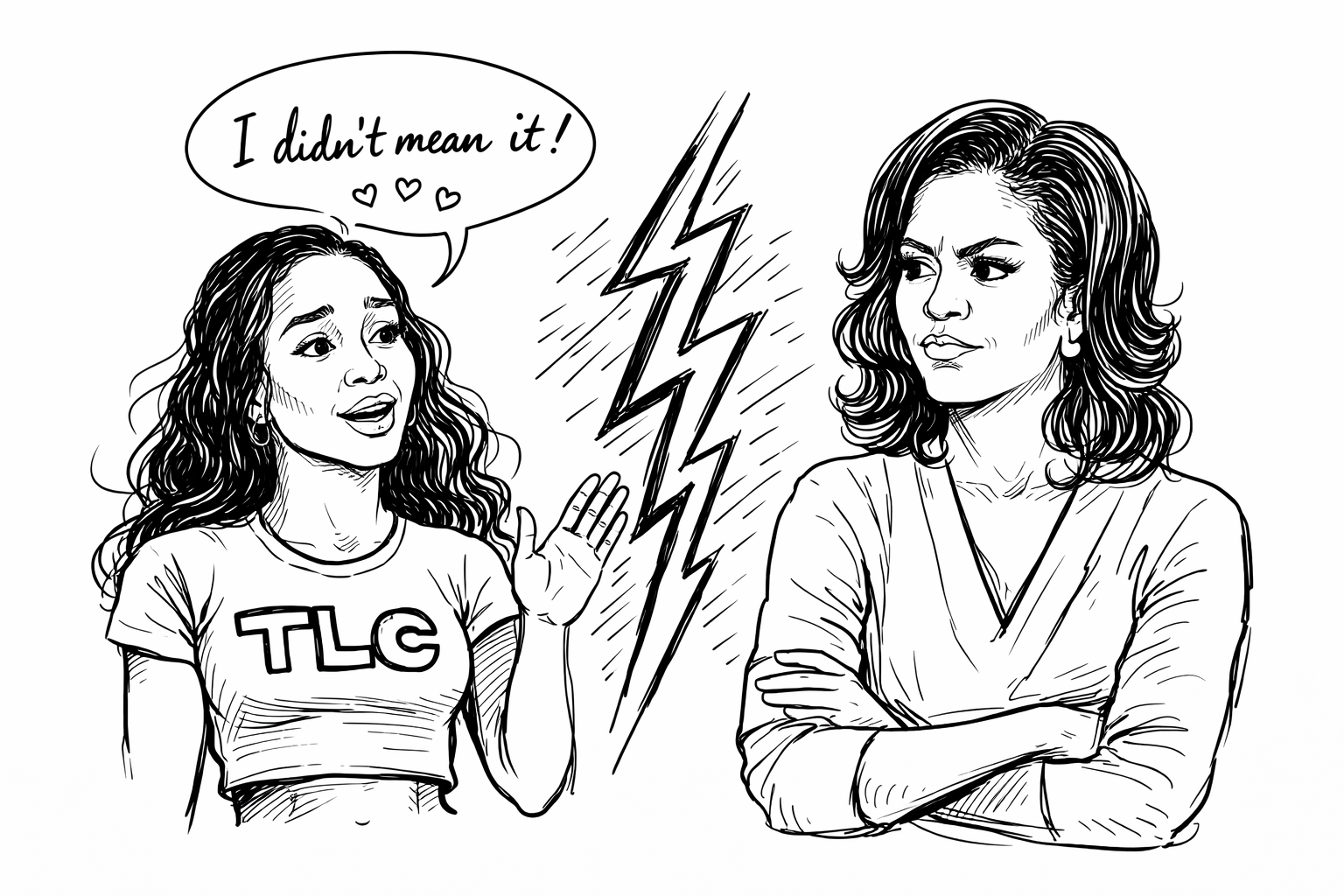
A repost, even accidental, is still distribution. A donation, even misunderstood, is still alignment in the eyes of the public. That’s the gap the apology industrial complex operates inside — because in a networked culture, intent doesn’t travel with the content. Impact does. And impact is what people respond to. That’s why the conversation didn’t stop at whether it was a mistake. It moved to what it reflects, what it signals, and what people believe it fits into. The apology becomes less about resolution and more about positioning. “I didn’t mean it” becomes part of a larger system of narrative control — and the moment perception begins doing the work that context used to carry, the story is already further along than the correction.
This dynamic has a name and a history. In The Apology Industrial Complex on The Silent Work, Will Davison traced how the apology script became a genre — one optimized for audience management rather than repair. The statement arrives within 24 to 48 hours. It acknowledges minimally, contextualizes quickly, and pivots to a future commitment that is rarely specified. The form has been mastered. The function has been hollowed out. What Chilli’s response demonstrates is that script running in real time — the video, the second statement, the repositioning of identity — executed with enough speed and clarity to signal control. But as Davison notes, the people most harmed by the original action are often the least served by the response. Black women who grew up loving TLC, who built Chilli’s platform through decades of loyalty, deserved more than a well-managed statement. They deserved acknowledgment of what the content actually was, what it targets, and why amplifying it — even accidentally — carries a specific weight that “I didn’t mean it” cannot fully absorb.
Why This Matters
The apology industrial complex reflects a shift in how accountability functions in public life. It is no longer defined by whether something happened, but by how quickly and effectively it is addressed once it does. That shift prioritizes speed, clarity, and narrative control — but it also exposes a deeper tension. Accountability is no longer negotiated in a single statement. It unfolds across layers — through initial reactions, follow-up explanations, public distancing, and audience interpretation. What T-Boz’s response shows is that people are not waiting to be defined by association. They are actively resisting it in real time. What Chilli’s statement shows is that identity itself now has to be reasserted just as quickly. The result is not resolution. It’s overlap. And in that overlap, the story doesn’t end with the apology — it becomes defined by everything that had to follow it.