
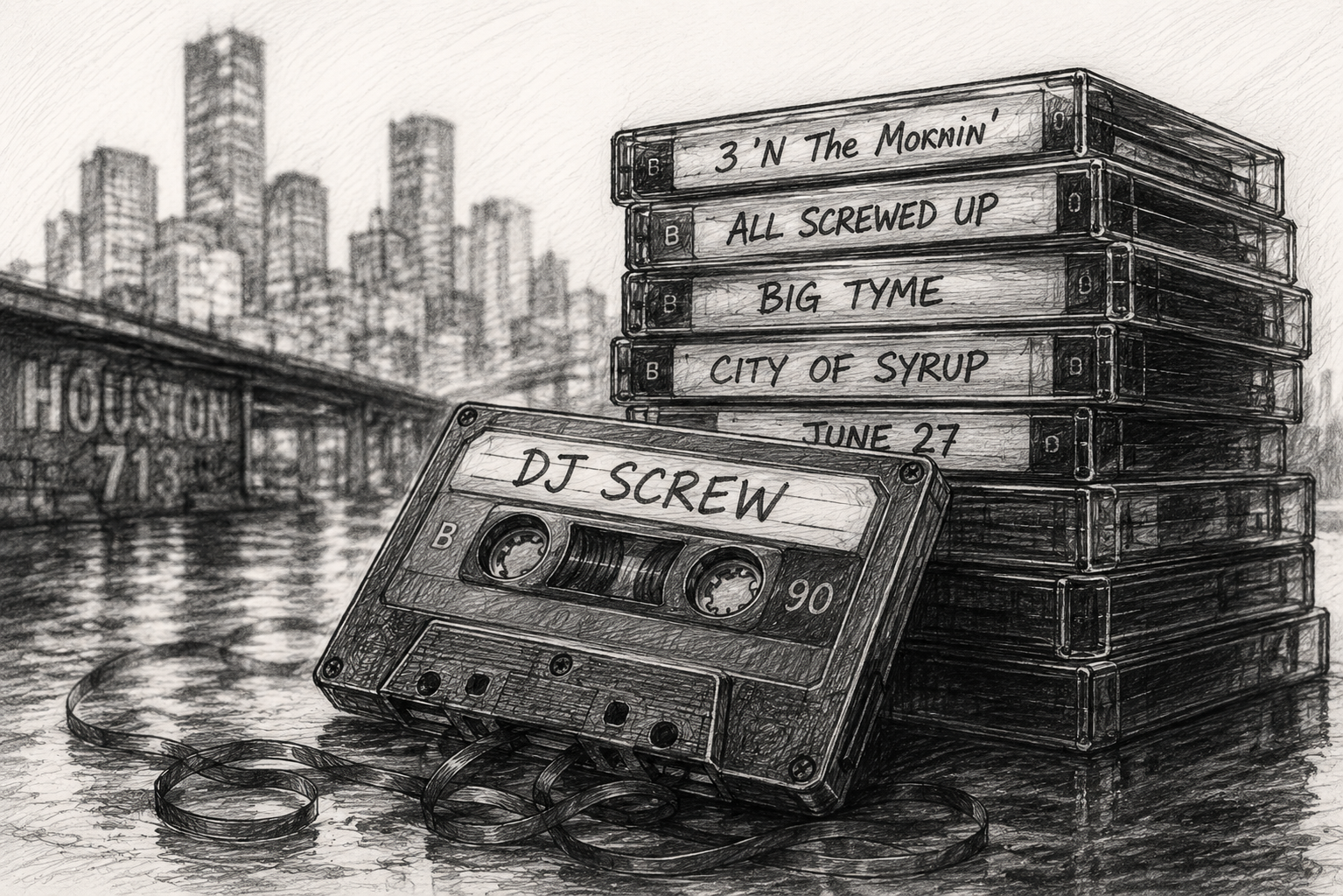
For more than two decades, Houston hip-hop operated on a different timeline than the rest of the music industry. While major labels chased radio singles and national distribution, the city’s cultural economy moved through car trunks, barbershops, corner stores, and hand-to-hand mixtape circulation. At the center of that ecosystem stood DJ Screw, whose chopped-and-screwed sound transformed not only how music was consumed but how an entire city understood itself. His catalog arriving on major streaming platforms represents more than overdue accessibility. It marks the formal entry of a regional archive into the modern algorithm — and the two things are not the same.
That distinction matters because streaming services have become the primary gatekeepers of cultural memory. For younger listeners, music that is not available on Spotify, Apple Music, or YouTube often effectively does not exist. Entire histories become invisible simply because they remain trapped in physical formats, licensing disputes, or fragmented unofficial uploads. DJ Screw’s legacy has survived largely through word-of-mouth, collectors, Houston devotees, and artists who carried his influence into the mainstream. But influence and accessibility are not the same thing. A sound can shape culture while remaining surprisingly difficult to find — and for a generation of listeners who were not in Houston when the tapes were circulating, the inaccessibility was the whole story.
The irony is that today’s music landscape is saturated with sounds that owe a direct debt to Screw’s innovations. Slowed-down vocals, atmospheric production, pitch manipulation, and mood-based listening have become commonplace across hip-hop, R&B, and pop. What was once a distinctly Houston aesthetic now appears throughout the streaming era. Millions of listeners have encountered the descendants of chopped-and-screwed music without ever hearing the original source material. The catalog’s arrival creates an opportunity to reconnect influence with origin — to give credit where the sound actually started.
The preservation question is older than streaming and more specific than nostalgia. American cultural history gets documented after it becomes commercially valuable — not while it is actively shaping communities. By the time institutions recognize the significance of a movement, the original context has already been partially lost, the primary sources have scattered, and the people who built it have moved on or died. Houston’s rap scene produced one of the most distinctive musical identities in modern American culture while existing in the shadow of New York, Los Angeles, and Atlanta — not because the music was less significant, but because significance and institutional recognition have never been the same thing for regional Black creative economies. The mainstream has always been more comfortable absorbing the sound than crediting the source. DJ Screw’s catalog arriving on streaming platforms does not resolve that history. It opens a door that should have been unlocked decades ago — and leaves unanswered the question of how many other archives did not survive long enough to make it through.
The timing carries its own significance. Streaming algorithms excel at surfacing old content for new audiences. A teenager in London, Lagos, or Tokyo can now encounter a DJ Screw tape as easily as a new chart release. That changes the relationship between geography and influence in ways that cut both directions. The same technology often criticized for flattening culture — rewarding what is familiar, suppressing what is niche — may also be the mechanism that finally gives regional archives the reach they were denied when they were being built. What once required living in Houston, knowing the right people, or finding the right tape can now happen through a recommendation engine. That is an incomplete kind of justice. It is also better than the alternative.
This moment is not primarily about nostalgia for longtime fans. It is about succession — the challenge every cultural movement faces when the people who built it are gone. DJ Screw died in 2000. His sound outlived him through the devotion of a community that kept it alive without institutional support, without major label backing, and without the streaming infrastructure that now makes global reach a baseline expectation. The tapes are becoming streams. The local is becoming global. And one of the most influential sounds in Southern hip-hop history is finally entering the digital record — not because the industry decided it was ready, but because the culture refused to let it disappear.