
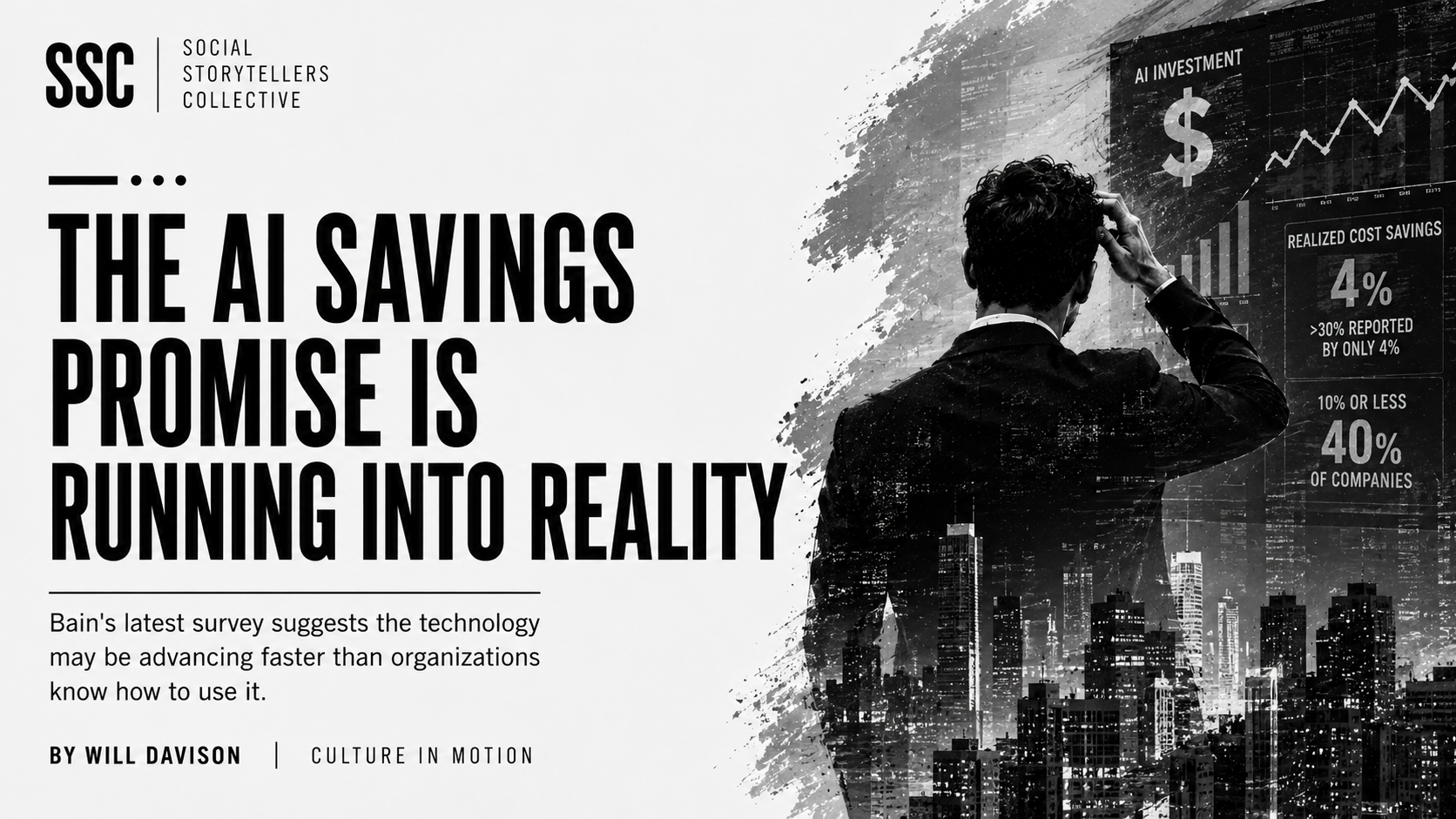
For two years, the corporate AI conversation has been running on a single premise: that the technology would make work cheaper. Boards approved new budgets. Executives promised efficiency gains. Consultants projected a future in which fewer hours of human labor would produce more output. The pitch was not simply that AI would change how companies operate. It was that AI would lower the cost of operating them — and that the savings would be significant, measurable, and soon.
A new survey from Bain & Company is where that premise meets the data. Among nearly 1,000 respondents from companies generating more than $100 million in annual revenue, 40 percent reported AI-related cost reductions of 10 percent or less. Only 4 percent reported savings greater than 30 percent. For an industry conversation built on promises of transformational efficiency, those numbers represent a gap that is difficult to explain away.
The survey does not argue that the technology has failed. In many cases the tools are functioning exactly as designed — summarizing information, automating repetitive tasks, generating content, accelerating research. The problem is that productivity gains do not automatically become financial gains. A task completed in half the time only produces savings if organizations redesign workflows, staffing models, and operational structures around that new reality. Technology alone does not create efficiency. Management decisions do. And management, it turns out, is the harder problem.
What the Bain findings expose is a pattern the technology sector has successfully obscured: companies are investing in AI because competitors are investing in AI, not because they have identified where the value will actually be created. Investment has become a signal of innovation rather than evidence of a business case. Executives approve large budgets because they fear being left behind, even when measurable returns remain uncertain. The result is a cycle in which the appearance of transformation substitutes for the substance of it — and the bill comes due quietly, in the gap between what was promised to the board and what showed up in the financials.
There is a distributional argument underneath this that is not getting made loudly enough. The workers who were told their roles were at risk — whose jobs were restructured, whose departments were thinned, whose institutional knowledge was treated as a liability rather than an asset — absorbed real and immediate costs while the efficiency gains that were supposed to justify those decisions are still, for most companies, waiting to arrive. The technology worked. The reorganization happened. The savings, for 96 percent of the companies surveyed, did not reach the threshold that was being used to justify the disruption. Power and profitability are not the same thing. Neither are capability and cost reduction. The next phase of the AI conversation will be less about what the tools can do and more about who paid the price for promises the numbers have not kept.