
U.S. employers announced 83,387 job cuts in April, a 38% jump from March, according to the latest report from Challenger, Gray & Christmas released this morning. The number marks April 2026 as the third-highest single-month cut total since 2009, trailing only April 2025 and the pandemic collapse of April 2020. And buried inside the data is a pattern that is becoming harder to dismiss: artificial intelligence is no longer just a background variable in layoff decisions. It is now the leading stated cause.
For the second consecutive month, AI led all cited reasons for job cuts — accounting for 21,490 of April’s announced layoffs, roughly 26% of the total. Year-to-date, AI has been cited in 49,135 planned cuts, representing approximately 16% of all 2026 layoff plans. That share was 13% through March. The acceleration is measurable, and it is not slowing.
Technology companies remain the epicenter. The sector announced 33,361 cuts in April alone, bringing its 2026 total to 85,411 — up 33% from the same period last year and the highest year-to-date pace since 2023. But the AI rationale is no longer confined to Silicon Valley. Chemical companies, which announced 4,975 cuts through April — a 167% increase over 2025 — are citing AI as their primary reason for reductions, alongside foreign competition. That expansion of AI as a layoff driver into manufacturing and industrial sectors marks a meaningful shift in the data.
Industrial goods manufacturers are also absorbing pressure from multiple directions. The sector announced 7,799 cuts through April, up 71% year-over-year. Tariffs, automation, an ongoing conflict in Iran, and shifting consumer behavior are all listed as contributing factors — a convergence of structural forces that makes recovery timelines difficult to predict.
Pharmaceutical companies present a separate but related story. The sector has announced 7,440 cuts through April, a 500% increase from the 1,238 cuts recorded in the same period last year. Patent expirations have historically driven pharma layoffs, but the sector is now also navigating regulatory turbulence, new technology disruption, and changing consumer behavior — a multi-front disruption that is compressing margins and accelerating workforce reductions.
The year-to-date figure, 300,749 total cuts, is down 50% from the same point in 2025. But that comparison requires context: 2025’s numbers were inflated by the mass federal workforce reductions tied to DOGE actions, which pushed government-sector cuts to 282,227 through April of that year. Stripped of that exceptional variable, the 2026 labor market is not as stable as the headline YTD figure implies.
Hiring plans tell a parallel story. April hiring announcements fell 69% from March to just 10,049 — down 38% from April 2025. Year-to-date, employers have announced plans to hire 60,936 workers, a 13% decline from the same period last year. Challenger forecasters expect hiring to remain muted through the summer, citing uncertainty around travel, consumer behavior, and cross-sector business conditions.
Geographically, Texas ranked second nationally in year-to-date cuts with 37,065 — up from 24,425 through April 2025, a 52% increase. California led all states at 41,857. Georgia (34,759) and Washington (31,674) round out the top four, with Washington’s total up significantly from 7,632 a year ago, a reflection of concentrated tech-sector exposure.
What this data documents is not a moment of volatility. It is a structural reorientation. The budget that once paid for a human role is increasingly being redirected toward AI infrastructure — and companies are saying so publicly, in their own layoff filings. The money has moved. The question now is whether policy, worker support systems, and public understanding will move with anything close to the same speed.
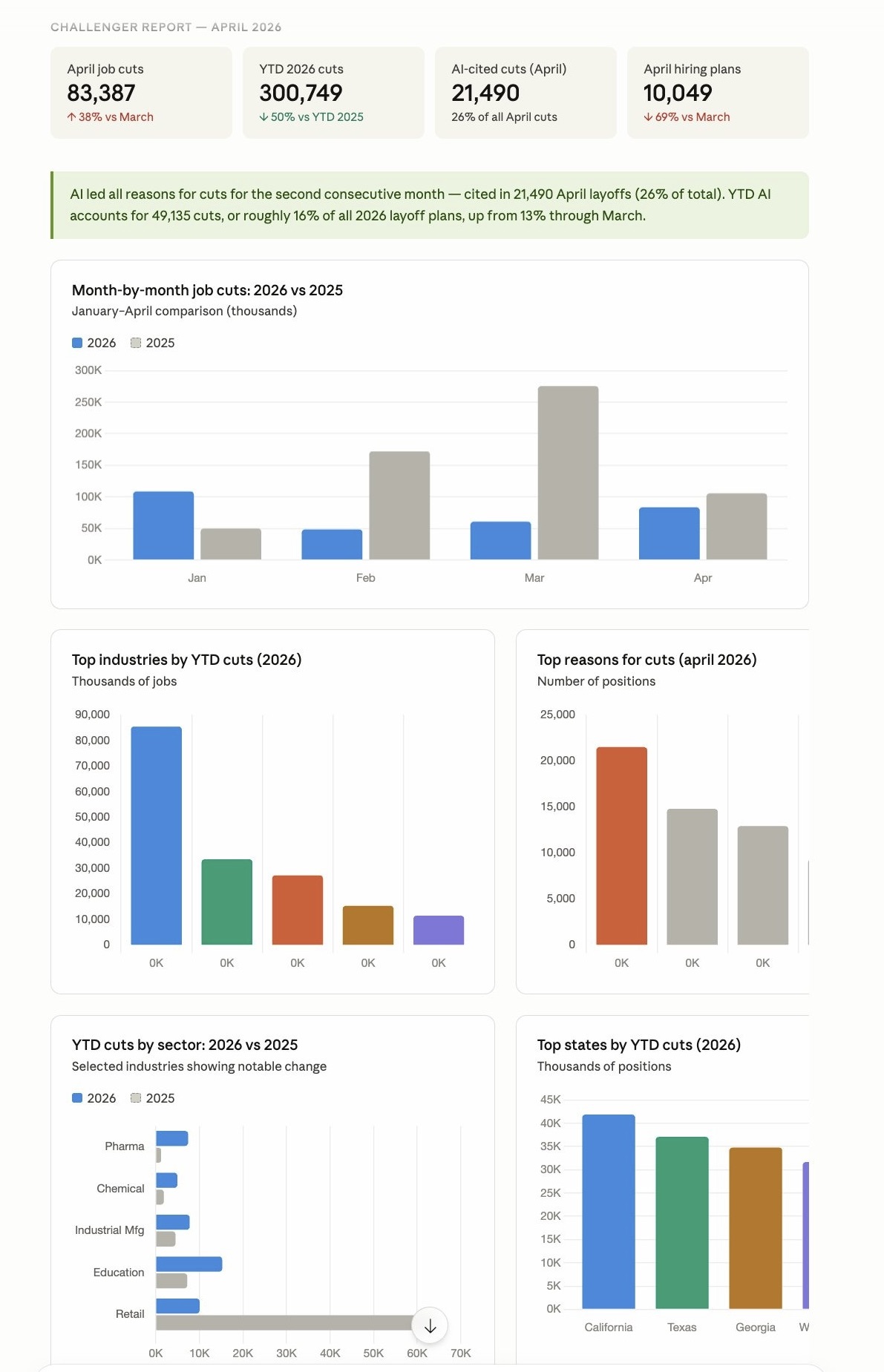
Source: Challenger, Gray & Christmas Job Cut Announcement Report, April 2026. Released May 7, 2026.