
Edelman kicked the door open. In late 2024, one of the most powerful independent public relations firms on the planet — more than 5,000 employees, 60 offices, over $1 billion in annual revenue — cut 330 people and shuttered several of its specialty brand firms. CEO Richard Edelman called it “simplification.” What it actually was: a signal flare for an entire industry that had been quietly rearranging deck chairs while the vessel was taking on water.
The cuts at Edelman weren’t an isolated moment. They were an opening act.
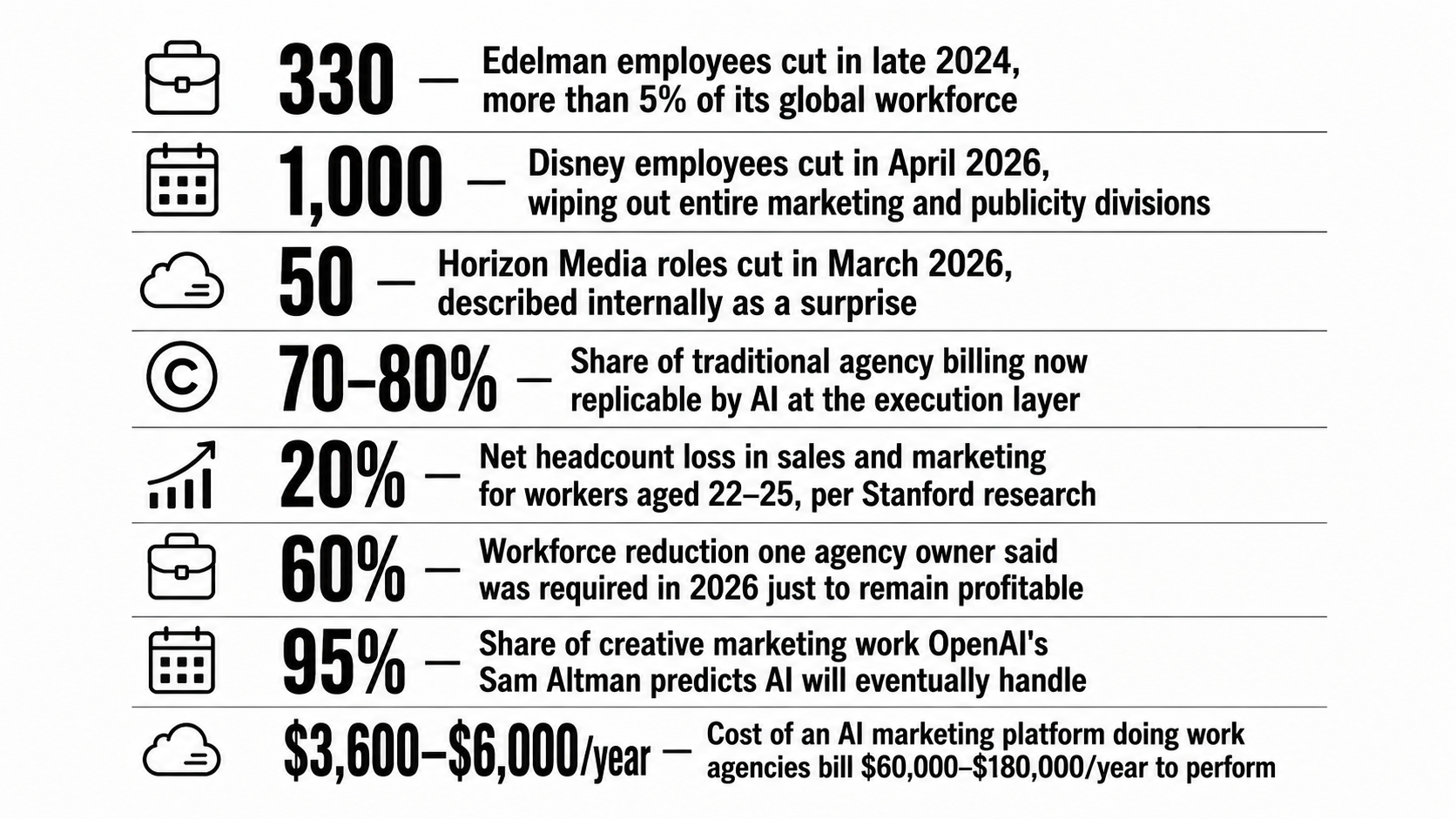
By February 2026, WPP launched its “Elevate28” overhaul, collapsing Ogilvy, VML, and AKQA into a single creative entity and targeting £500 million in annual savings — a restructuring analysts estimated would generate roughly £200 million in severance charges across 2026 and 2027. Horizon Media, one of the largest independent ad agencies in the world, trimmed 50 roles in March, with its CEO describing the cuts as a “skills optimization effort.” Publicis shed hundreds of jobs in April, some tied to return-to-office compliance, some to something harder to name. Disney’s marketing division lost entire units — the home entertainment team, the EPK unit, digital marketing leadership at every level — in a single round of April cuts affecting 1,000 employees across the company.
The language across all of these announcements follows the same template: streamlining, realignment, agility, technological enablement. Strip the euphemism and the message is consistent. The work that agencies have long billed for — content production, campaign execution, media planning, first-draft copy, performance reporting — is now being done faster and cheaper by machines. And the humans who built careers doing that work are absorbing the cost of that transition.
This is not a technology story. It is a labor story wearing technology’s clothes.
The efficiency argument is seductive because it is, in certain respects, true. AI can produce execution-layer marketing work — the tasks that constitute 70 to 80 percent of what agencies traditionally bill for — at a fraction of the cost and in a fraction of the time. A one-person shop in 2026 can manage volume that previously required a team. A client that once needed an agency retainer for content and reporting can now route that budget elsewhere. The market pressure that dynamic creates is real, and agencies that ignore it will not survive. Early-career workers have already felt it most directly: one Stanford study cited across the industry found that AI has caused a net loss of roughly 20 percent of headcount in sales and marketing roles for workers aged 22 to 25.
But efficiency is not the same thing as value. And the communications industry, more than almost any other, is built on the distinction.
The work that moved people — that shifted opinion, that built trust during a crisis, that made a brand feel like it understood something true about the people it was trying to reach — was never primarily a production problem. It was a perception problem. A relationship problem. A judgment problem. It required someone in the room who could read what was unsaid, who knew when a message would land wrong even if it read correctly on paper, who understood the cultural weight a word carried before a client got to find out the hard way. That capacity does not live in a model. It lives in a person who has been paying attention.
The firms that flatten themselves in pursuit of efficiency without interrogating what they are actually selling will discover, too late, that they optimized away their differentiation. Clients will not stay for speed they can buy elsewhere. They will stay for the thing no platform can replicate: the feeling that someone actually cares about the outcome, not just the output.
This is the argument creative professionals need to make — and more importantly, the practice they need to build. Not resistance to AI, which is both futile and beside the point, but a deliberate strategy for expanding what they do with it rather than simply using it to do less. The professionals who will remain irreplaceable are not the ones who use AI to lighten the load. They are the ones who use it to carry more — to take on more complex problems, to push into strategy that was previously out of reach, to develop capacities that make them harder to displace rather than easier to replace.
Critical thinking cannot be automated. Compassion cannot be prompted. The ability to hold a client’s trust through a moment of genuine uncertainty — to be the person in the room when the room gets hard — is not a feature set. It is the irreducible human element that the best communications work has always required. AI makes the execution cheaper. It does not make the judgment easier. If anything, as the execution layer commodifies, judgment becomes more valuable, not less.
The agencies that survive this moment will be the ones that understand the distinction and build toward it. The professionals who thrive will be the ones who treat AI as an accelerant for their thinking, not a substitute for it. And the industry as a whole will have to reckon with a harder truth: efficiency was never the product. Trust was. Care was. The capacity to sit with a problem long enough to actually understand it was.
Those are not things you can cut your way to.