
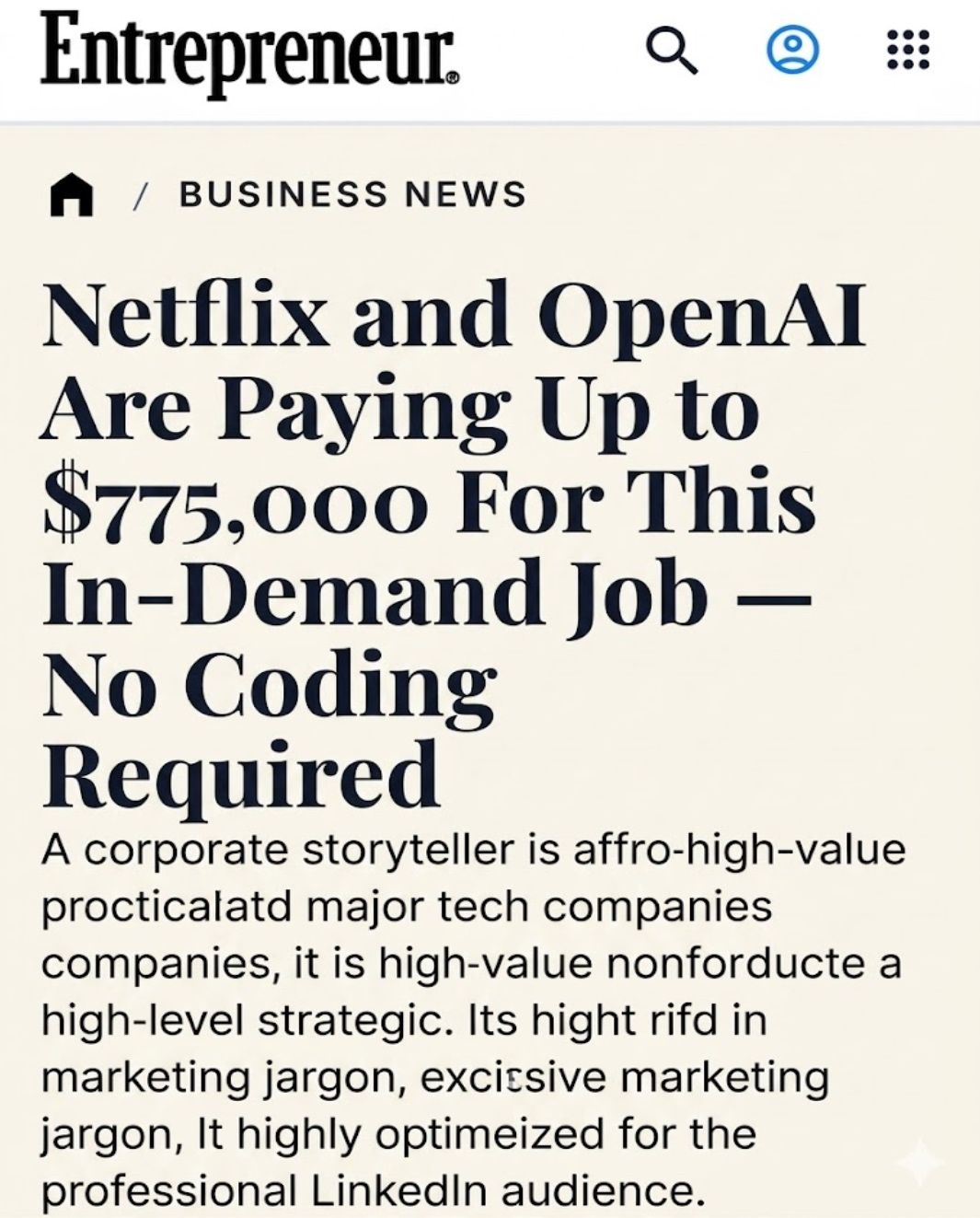
A LinkedIn post circulating widely this month captures the mood perfectly. It opens with a striking set of numbers — elite tech companies budgeting up to $775,000 for a single non-technical communications role — then pivots quickly into a personal pitch about the author’s credentials and a closing call to connect.
The numbers are real. The framing is the problem.
Anthropic recently posted a head of product communications role at $400,000. Netflix advertised a senior director of communications with a salary range of $656,000 to $1.2 million. OpenAI listed heads of communications roles with salaries up to $430,000, plus equity. These executives are charged with defining the overarching story a company tells about AI to investors, regulators, customers, employees, and the broader public — responsibilities that range from framing the risks and benefits of powerful AI models to crafting executive speeches and pressure-testing language in blog posts that might move markets or trigger regulatory scrutiny.
The underlying demand is not manufactured. AI is complicated, evolving quickly, and triggering real anxiety among employees, regulators, and customers. In that environment, clarity has become a strategic asset. Tech companies are paying for narrative control at a moment when the stakes of getting it wrong are existential. Still, there is no shortage of candidates — financial technology company Chime received more than 500 applications for a director of corporate editorial and storytelling role last year, with most applicants coming from journalism backgrounds.
That detail deserves far more attention than it has received.
The same industry now paying $775,000 for senior communications talent is recruiting heavily from a profession it helped destabilize. The journalism industry has shed more than 5,000 jobs since 2024 alone. Black journalists make up just 6 percent of the newsroom workforce despite representing a significantly larger share of the U.S. population — and these losses carry an outsized impact. Those cuts have not been distributed evenly. Of the 169 race, diversity, and equality journalism roles identified between June 2020 and December 2024, a third are now gone. NBC News, while cutting nearly 7 percent of its newsroom, laid off staffers fully dedicated to its verticals covering Black, Latino, Asian American and Pacific Islander, and LGBTQ+ communities.
Journalists of color at major outlets say recent workforce reductions have disproportionately affected Black and Brown employees, amid mounting political pressure against DEI initiatives. At the Los Angeles Times, 63 union members of color were laid off — the same reporters who had been covering or pushing for more coverage of underrepresented communities. What is being dismantled in one sector is being commodified in another. The communicators being pushed out of newsrooms are the same demographic profile now flooding the applicant pools for roles that pay four to ten times what they were earning before.
The LinkedIn framing treats the $775,000 figure as evidence of a rising tide for communicators broadly. The structural reality is more precise. The national average salary for a director of communications is approximately $107,000. The ceiling at elite AI companies is now twelve times that. That gap is not a skills gap. Communicators at nonprofits, HBCUs, civic organizations, and community institutions are doing work of equivalent complexity — managing reputational risk, translating technical and policy information for public audiences, navigating hostile political environments. They are simply doing it at organizations that cannot compete with Netflix’s equity packages.
The premium being placed on narrative at the top of the tech economy does not lift the field. It concentrates value further at institutions that already have the most of it, while the organizations serving communities with the least access to power continue to operate with communications budgets a fraction of a single senior hire at OpenAI.
The actual inflection point
There is a real story in the fact that tech companies have concluded that narrative is as strategically important as product. That conclusion, taken seriously, should raise questions the LinkedIn circuit is not asking. If human storytelling is now a premium asset — if clarity and trust and cultural fluency are worth $1.2 million at the ceiling — then whose stories are worth investing in? Which institutions get access to communicators who can translate complexity into accountability? And who decides what the dominant narrative about artificial intelligence looks like, at the moment when that narrative is still being written?
Those are not questions about individual career opportunity. They are questions about structural power. As Errin Haines observed about the journalism layoffs: “You don’t just lose jobs — you lose stories.” The same logic applies here. When the communicators who built their careers covering structural inequality get priced out of the rooms where AI’s public narrative is being constructed, the stories told about who AI serves — and who it doesn’t — narrow accordingly.
The $775,000 is not the headline. Who is in the room when that check gets cut, and who is still waiting outside, is.
Social Storytellers Collective covers race, identity, access, and structural inequality. Read more at socialstorytellerscollective.substack.com