
A Columbia Business School study of 259 billion ad impressions found that Black representation spiked after George Floyd’s murder and then settled back into its slower long-term rise. What didn’t change was how audiences responded, and that undercuts the business case for pulling back.
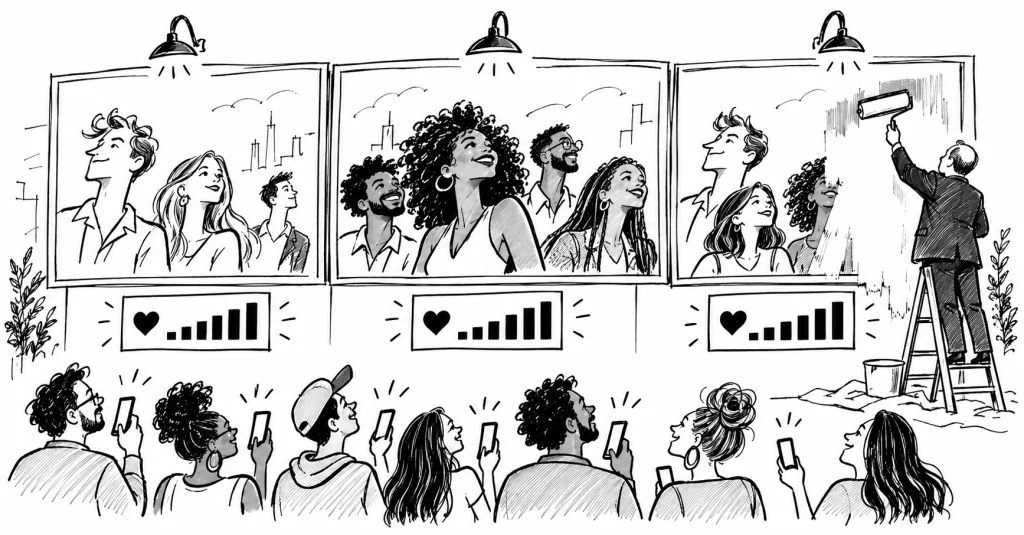
In the summer of 2020, it seemed as if all of corporate America had discovered diversity at once. Brands put out statements, agencies released internal demographic data, and marketing teams promised that the faces in their ads would look more like the country. By 2023, many of those same companies were retreating, citing backlash, legal risk and fatigue. Advertisers, the argument went, had gotten ahead of their customers.
Research from Columbia Business School suggests that argument has it backward.
What the data shows
Professor Oded Netzer and co-authors Jochen Hartmann and Rachel Zalta worked with the online ad firm Taboola to study real-world digital advertising rather than lab-based simulations. Using deep learning, they analyzed the racial makeup of models in tens of thousands of ads that ran between January 2019 and July 2021. Those ads came from 3,484advertisers and generated 259.4 billion impressions and 308.3 million clicks in the U.S.
The baseline showed a clear gap. Only 7.5% of the ads featured at least one Black model, compared with 67.3% that featured only white models. At the time, Black Americans made up 12.4% of the population, according to the 2020 Census.
But the researchers found the numbers were already improving before 2020. The share of ads with Black models and the click-through rates on those ads had been rising steadily, pointing to a gradual industry shift that was underway before the protests. For about six months after Floyd’s murder, both spiked. Then both returned to the earlier, slower trend line.
That distinction matters. The 2020 surge didn’t disappear so much as settle back into the gradual growth that had been happening all along. What the study captures is how temporary the urgency of that moment was. In the paper’s words, “social movements can influence the supply and demand of advertising.” They can also stop influencing it once public attention moves on.
The finding companies aren’t discussing
The most important result has nothing to do with the spike. Ads featuring Black models outperformed all-white ads consistently, before, during and after the 2020 peak.
The real-world data couldn’t identify the race of the people clicking, so the researchers ran follow-up lab experiments. Ads with at least one Black model performed better with consumers of every race, and white consumers showed a particularly strong preference for them. That challenges the widely held assumption that audiences mostly want to see people who look like themselves. According to the researchers, audiences prefer ads that reflect a diverse society, not just their own group.
In other words, the advertising that corporate America embraced in 2020 and later backed away from was also the advertising that performed better with consumers.
The retreat
The research dataset ends in mid-2021, so it can’t show what happened to representation afterward. Other reporting shows the direction the industry took. A 2023 review in the Journal of the Academy of Marketing Science noted that many brands were struggling to keep their post-2020 commitments or rethinking them amid budget cuts and legal challenges. The review cited reports that ads had become less representative and pointed to the reaction to Bud Light‘s partnership with a transgender influencer, which reportedly cost Anheuser-Busch $6 billion in market value in a week. Within the industry itself, the Association of National Advertisers found that people of color made up 30.8% of the marketing workforce in 2023, down from a record 32.3% a year earlier, the first decline in several years. By February 2026, Ad Age‘s review of Super Bowl advertisers found that most had moved away from diverse storytelling, with a few exceptions.
The pullback is usually framed as a response to audiences, whether that means backlash risk, polarized customers or consumer fatigue. The Columbia research points somewhere else. The best-documented consumer reaction to inclusive ads in its data was positive, and it held up across racial groups and across time. The backlash cases that led to the retreat were real and costly for the companies involved. But the broad click-through data suggests the retreat was driven less by the average consumer than by caution among executives, lawyers and brand managers watching a small number of high-profile controversies.
What this means for the business case
For five years, representation in advertising has been argued mainly on moral terms. Supporters said it was the right thing to do, and critics said it was political. The Columbia study moves the argument into terms marketers usually respond to: clicks and effectiveness. By that measure, the researchers describe diverse representation as a win-win, because it improves how underrepresented groups appear in media while also making campaigns work better.
That raises a harder question for the companies that pulled back. If the performance data favored inclusive ads throughout, then the retreat wasn’t about audience demand. It was about which risks executives decided to prioritize. Brands chose to avoid a visible controversy even at the cost of a smaller but steady performance advantage.
The 2020 surge was a response to a moment, and once that moment passed, the urgency did too. Audience preference didn’t change with it. The data suggests that if companies keep showing less of what their customers respond to, the loss will show up in their own results.
Sources: Columbia Business School, ResearchGate (working paper), Journal of the Academy of Marketing Science, Marketing Dive, Ad Age