
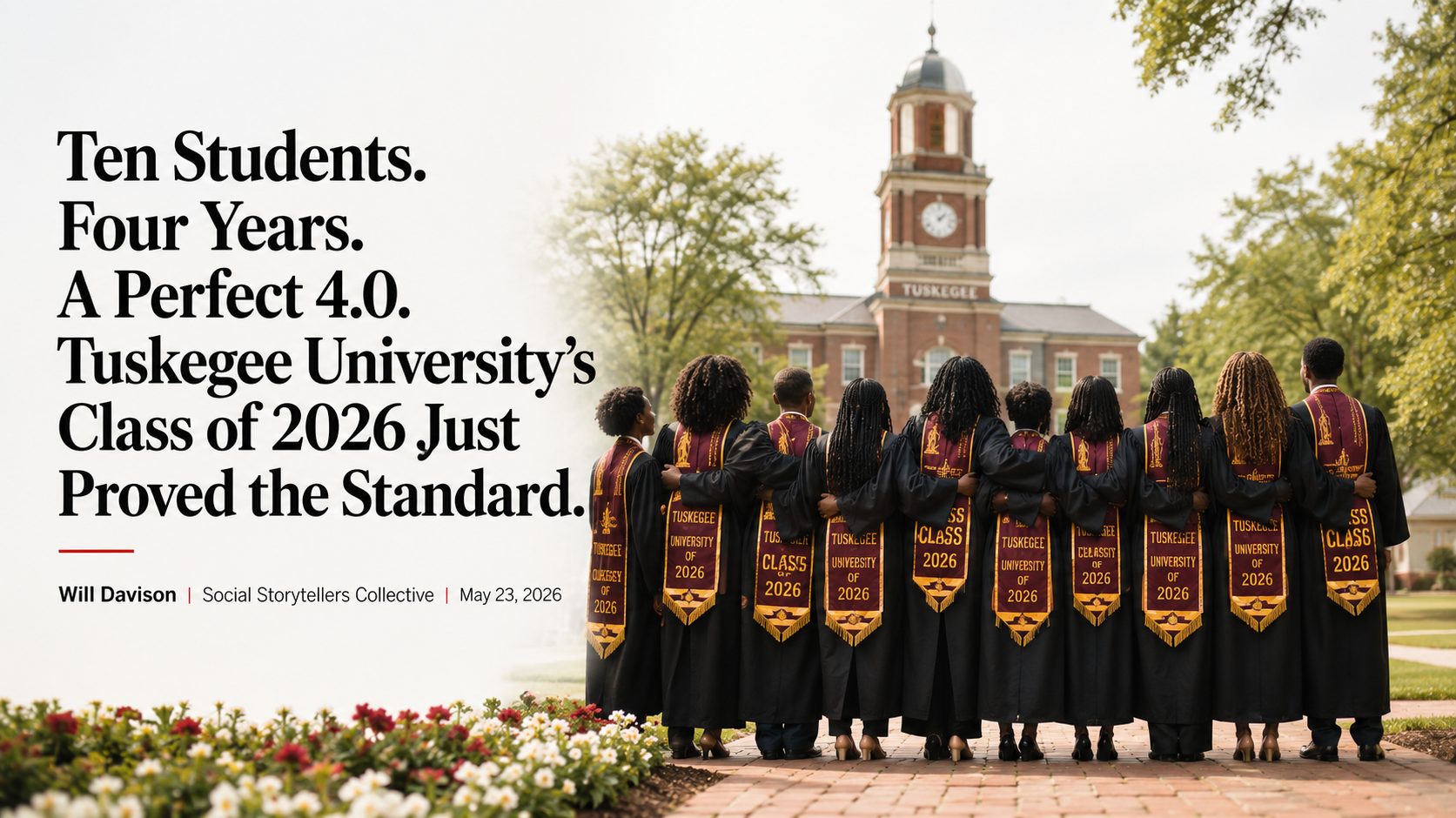
Not one semester. Not one standout year. All four.
When the Tuskegee University Class of 2026 walked across the stage on May 9th, ten of them did it with something most people spend an entire undergraduate career chasing and never catch — a perfect 4.0 GPA, held from orientation to commencement, without interruption.
Their names are: Joi Kayla Axem, Kerri Danielle Barnes, Nilajah Nyota Buchanan, Yasmin Aleksandria Davis, Alaynah Eldridge, Darren Raymond Hall, Keevion Hardamon, Charniece Elliana Jones, Brooklyn Monae Macklin, and Leah D. Saunders.
Say them again. All ten.
What Perfection Actually Costs
A 4.0 for a semester is an achievement. A 4.0 for a year is exceptional. A 4.0 for four consecutive years — across labs and clinicals, internships and late nights, through a pandemic’s aftermath, through whatever life dropped in the way — is something categorically different. It is a sustained act of will that most people, if they are honest with themselves, cannot fully imagine.
The ten members of Tuskegee’s Class of 2026 who did it didn’t just excel. They refused to slip. Not once, in any course, in any semester, across four years of undergraduate study at an institution that demands genuine rigor from its students.
Nearly 55 percent of the entire graduating class earned cum laude honors or above. That’s not a footnote — that’s a culture. And these ten students were at the top of it.
The Institution Behind the Achievement
Context matters here, and it matters a lot.
Tuskegee University was founded in 1881 by Booker T. Washington on a core principle that education exists not for its own sake, but to develop the “head, hand and heart” of a person — to shape scholars who can master their own fate and then make that life possible for others. That founding argument is still doing work, 145 years later, in every graduate who walks off that stage.
The school is ranked No. 1 in Social Mobility among regional universities in the South by U.S. News & World Report. It holds the Carnegie Foundation’s new Opportunity College designation, granted in 2025, which specifically measures how directly a school’s education translates into economic success for its graduates. More than 62 percent of first-year students receive need-based financial aid.
This is not a school where students arrive with every advantage already in place. Which is precisely what makes ten consecutive 4.0s more remarkable, not less.
The Class They Graduated With
The ten students didn’t cross the stage alone. They graduated alongside a class that, by any measure, delivered.
More than 300 undergraduates walked — and 40 percent of them stepped directly into full-time roles in their chosen fields. Combine those with graduates headed to graduate school or newly commissioned as military officers, and over 70 percent of the Class of 2026 had a clear next step already secured.
More than 75 percent completed at least one internship before graduating, with most completing two or more. Twenty graduates were commissioned as U.S. military officers the day before commencement — through the only ROTC program at an HBCU offering training in all five branches of the armed forces, including the Space Force.
Fifteen students graduated with private pilots’ licenses through a new aviation science program — a direct lineage from the Tuskegee Airmen, the legendary Black military aviators who proved, in the 1940s, what institutions and systems insisted couldn’t be done.
Seventy-two students graduated from the School of Nursing and Allied Health, entering a field facing a projected shortfall of as many as 14,000 nurses in Alabama alone by 2027. All 15 of Tuskegee’s newly licensed registered nurses either passed their licensure exam and are already working, or have confirmed job offers waiting.
Earvin “Magic” Johnson delivered the commencement address, challenging graduates to become owners — of businesses, of their futures — and to “bottle up these past four years” as a touchstone against the obstacles ahead.
Who Gets to Own the Narrative
Earlier this week, we wrote about what happens when academic excellence stops belonging to a single person. The Spelman Seven. Twenty-one valedictorians at a Long Island high school. Achievement at scale — and the very different ways the culture receives it depending on who’s doing the achieving.
We said the valedictorian is becoming a category. The question is who gets to inhabit it without their achievement being converted into someone else’s argument.
Tuskegee’s ten are the answer we keep needing to see.
HBCUs are under sustained political and financial pressure. The narrative around Black excellence in academic spaces is constantly being contested, diminished, or pulled into debates that have nothing to do with the students themselves. Against that backdrop, these ten young people held a 4.0 for four consecutive years at an institution built specifically for their flourishing — and graduated into a world that will, as Magic Johnson warned them, come with naysayers, obstacles, and unearned penalties.
They built something in those four years that no one can take back. A record. A standard. A proof.
The Spelman Seven were celebrated as collective triumph. The Jericho twenty-one were immediately filtered through demographic anxiety. The Tuskegee ten deserve the same clean celebration the Spelman Seven received — their achievement read on its own terms, not as a data point in someone else’s argument about merit, access, or who belongs in which room.
The standard is the standard.