
Drugmakers are asking the Supreme Court to intervene after a federal ruling cut off online access to the most widely used abortion medication—introducing immediate uncertainty into a system millions rely on.
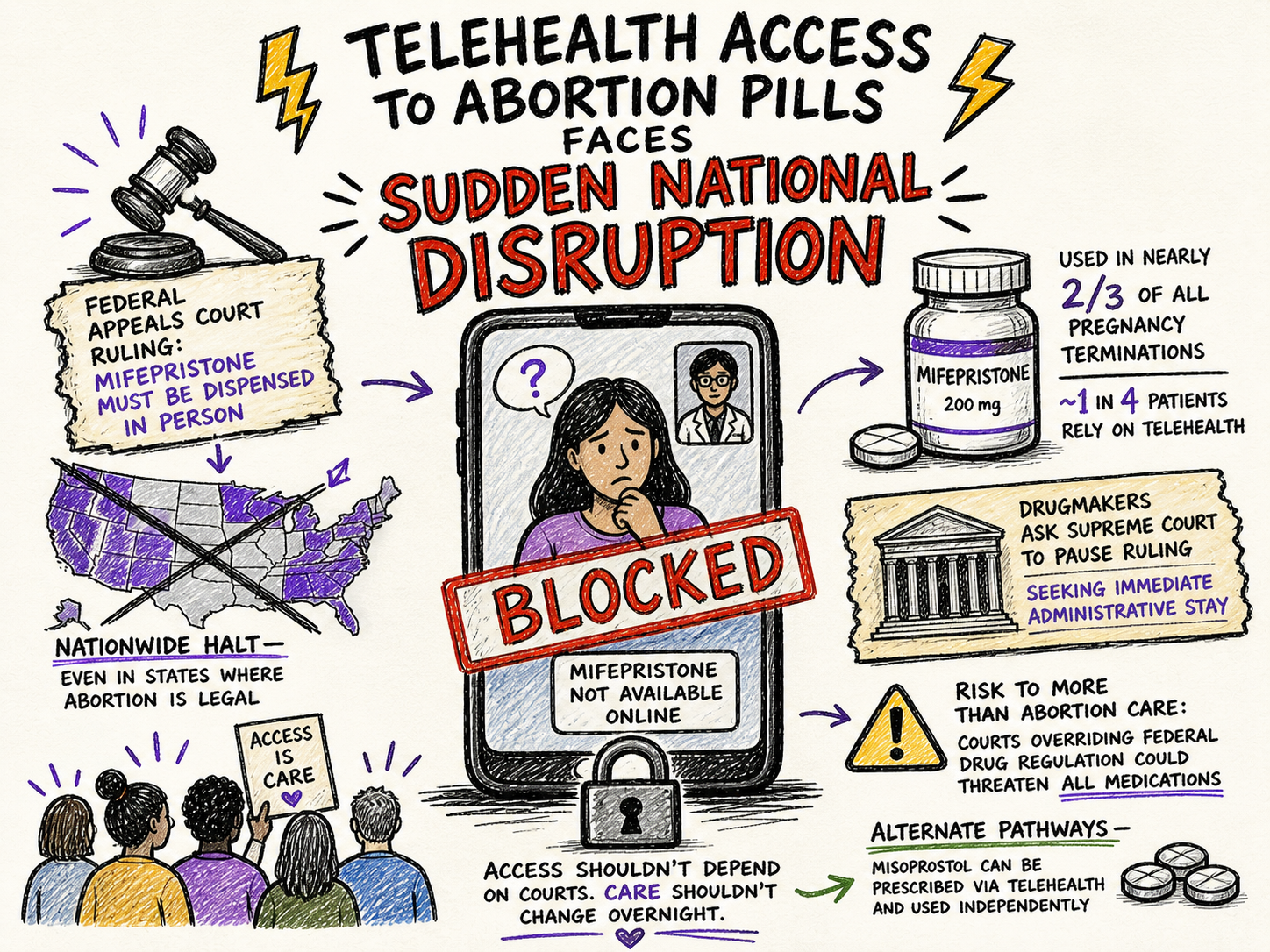
A federal appeals court ruling has abruptly halted telehealth access to mifepristone nationwide, including in states where abortion remains legal, triggering an emergency response from pharmaceutical companies and healthcare providers. The decision reinstates older regulations requiring the medication to be dispensed in person, effectively shutting down a distribution model that had become central to abortion access over the past several years. In response, drugmakers have asked the Supreme Court to pause the ruling, warning that the shift will create immediate disruption for patients and providers navigating an already fragmented care system.
The stakes are significant because of how central medication abortion has become to the broader healthcare landscape. Mifepristone is used in nearly two-thirds of all pregnancy terminations in the United States, and roughly a quarter of patients rely on telehealth to obtain it. The ruling doesn’t just affect abortion access—it also restricts telemedicine prescriptions for related uses, including miscarriage management, expanding its impact beyond a single category of care.
The legal argument underpinning the decision reflects a broader tension between federal regulatory authority and state-level policy enforcement. The appeals court sided with claims that expanded access policies posed safety concerns and infringed on state sovereignty, despite years of established use under federal guidelines. That tension is now being pushed to the Supreme Court, where drugmakers are seeking an immediate administrative stay to preserve what they describe as a long-standing regulatory status quo.
Beyond reproductive healthcare, the ruling is raising alarms across the pharmaceutical and biotech sectors. Industry leaders warn that allowing courts to override federal drug approval and distribution frameworks could introduce instability into the entire system, opening the door for challenges to other medications based on political or ideological opposition. That concern reframes the issue from a single policy dispute into a broader question about how medical access, regulation, and authority are determined—and who ultimately controls them.
In the short term, providers are pointing patients toward alternative pathways, including the use of misoprostol, a second medication that can be prescribed via telehealth and used independently. But that workaround underscores the larger reality: access is becoming more conditional, more complex, and more dependent on navigating a shifting legal landscape. What was once a standardized system is increasingly fragmented—reshaped not just by policy, but by how quickly that policy can change.