
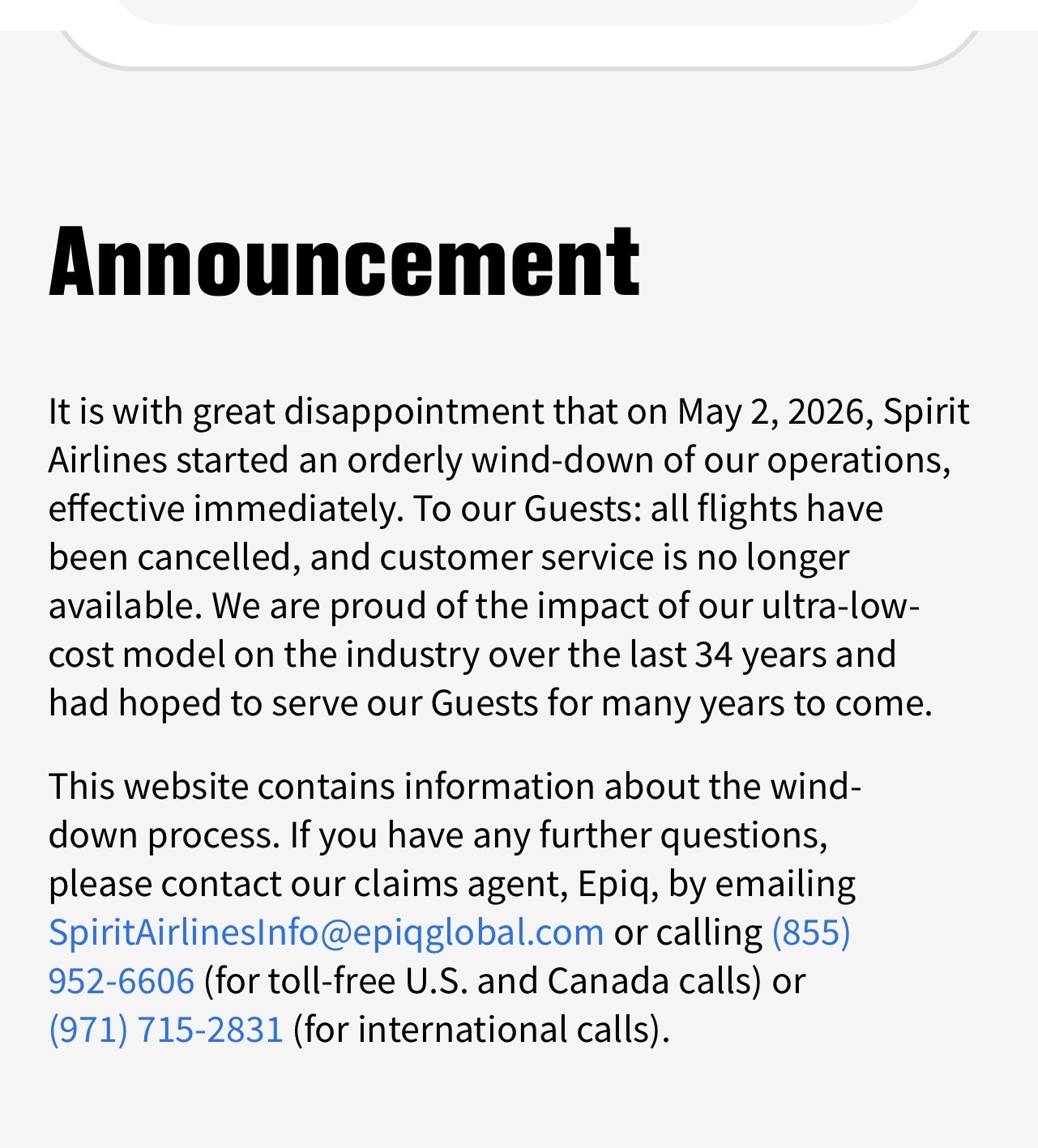
The message is direct, almost procedural. Spirit Airlines announced it is beginning an “orderly wind-down” of operations, effective immediately. All flights canceled. Customer service offline. The language is controlled, measured, and final. But inside that framing is something more revealing than the shutdown itself: a quiet acknowledgment that what’s ending is not just a company, but the model it represented.
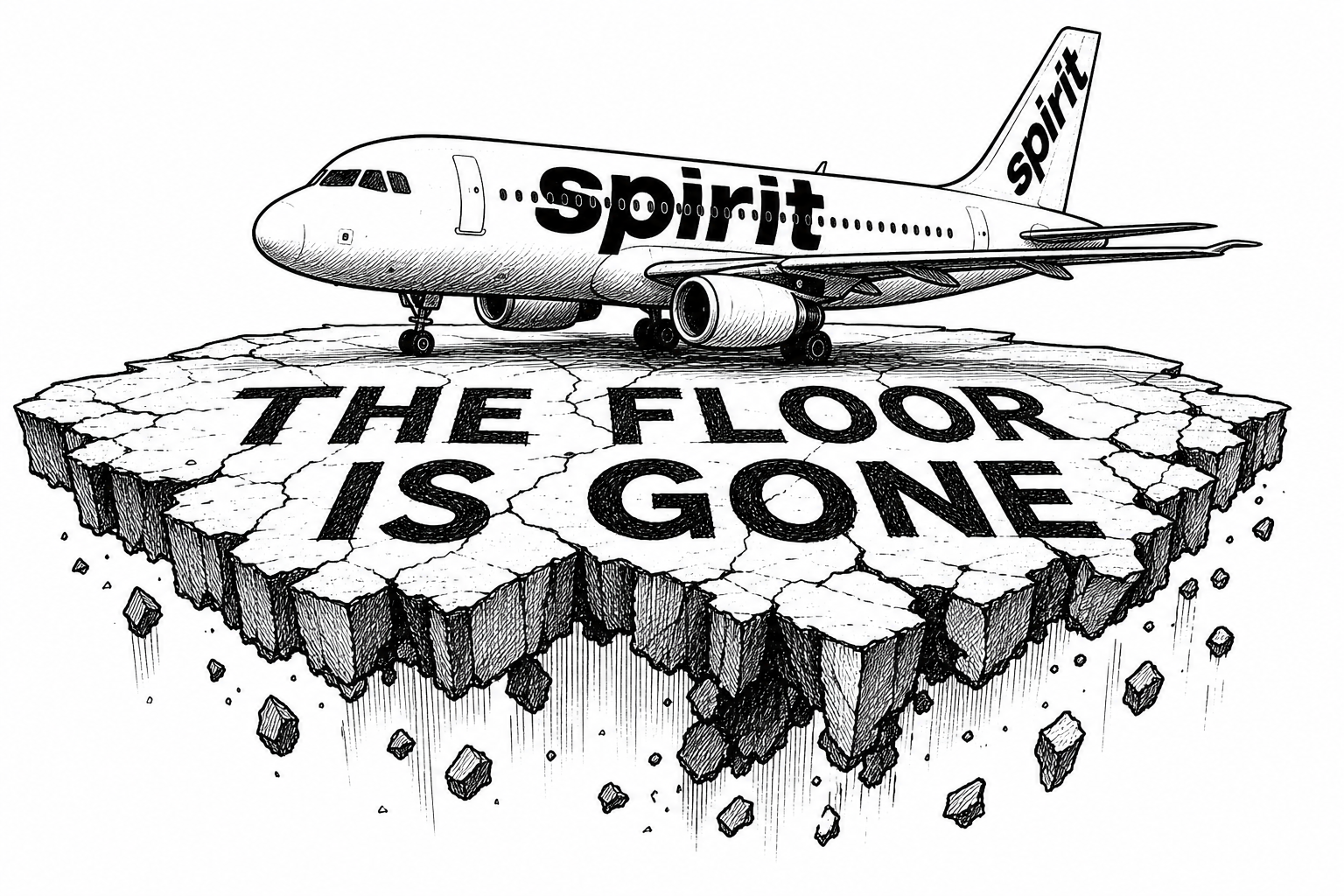
For 34 years, Spirit didn’t just operate flights — it operated as a structural force inside the airline industry. Its ultra-low-cost model established a baseline that shaped pricing far beyond its own routes. Even for travelers who never booked a Spirit flight, its presence influenced what other airlines could charge. It created a reference point. A constraint. A floor. That floor is now gone.
The company’s own statement reinforces what this actually is. It points to the “impact of our ultra-low-cost model on the industry” — a line that reads less like reflection and more like positioning. Spirit is not framing its closure as a failure of execution. It is framing it as the end of a model that could no longer hold under current conditions. That distinction matters, because it shifts the question from what the company did wrong to what the system no longer supports.
What changed is not one variable. It is the accumulation of pressure across multiple layers of the system simultaneously. Fuel costs increased. Operational expectations rose. Travelers began valuing reliability and flexibility in ways that conflict with stripped-down service models. Regulatory and competitive constraints limited the consolidation paths that might have stabilized the business. None of these forces are new. What’s new is that they are all being absorbed at the same time — and the ultra-low-cost model has no mechanism to absorb them.
It was always a high-efficiency model built on the removal of margin from nearly every part of the experience, redistributing cost through fees, volume, and utilization. That structure depends on stability elsewhere. When volatility increases — when delays compound, when input costs rise, when consumer expectations shift — the model doesn’t bend. It transfers pressure directly to the customer, or it fails. This time, it failed.
The implications extend well beyond one airline. Ultra-low-cost carriers function as anchors in the pricing ecosystem. They don’t just compete — they define the lower boundary of what travel can cost. Without that boundary, the rest of the market recalibrates upward. Other airlines will absorb Spirit’s routes and capacity, but they are not built to replicate its pricing structure at scale. The service continues. The constraint disappears.
What follows is not a sudden spike in airfare. It is something less visible and more durable: a gradual upward shift in baseline pricing. Fewer ultra-low options. Narrower margins for budget travel. More tradeoffs embedded into every booking decision — timing, flexibility, comfort, cost. The system still functions. It just functions differently, with more of the burden redistributed to the traveler who can least afford to absorb it.
That redistribution is already visible in how the shutdown itself is being handled. Customer service is offline. Claims are being routed through a third-party processor. The experience of the collapse mirrors the model that defined the company: minimal buffers, limited absorption, direct transfer of friction to the user. Even in ending, Spirit is operating exactly as designed.
What’s closing here is not just access to cheap flights. It is access to a certain version of mobility — one where price alone could determine participation. When that version disappears, travel does not stop. It becomes more selective, more conditional, and more dependent on the ability to absorb cost increases that don’t arrive all at once but accumulate quietly over time until the floor gives way.
The system still runs. Planes will still fly. Routes will still exist. The difference is that the mechanism that kept those routes accessible at the lowest end of the market is no longer there to hold the line.
Why It Matters
Spirit’s shutdown is being covered as a corporate collapse. It is also a mobility story. The travelers most affected are not the ones who can rebook on Delta. They are the ones for whom Spirit’s price point was the condition of participation — in work travel, family visits, and opportunities that require moving through the country at a cost the legacy carriers were never designed to support. When the floor disappears, the market doesn’t fill the gap. It prices around it.