
Snap announced on April 15 that it would cut approximately 1,000 employees — 16% of its full-time workforce — and close more than 300 open roles, citing rapid advancements in artificial intelligence as enabling smaller teams to move faster and reduce repetitive work. Snap’s stock jumped roughly 7% on the news. The market did not react to the layoffs as a sign of distress. It read them as a sign of discipline — and that reading is the more consequential story.
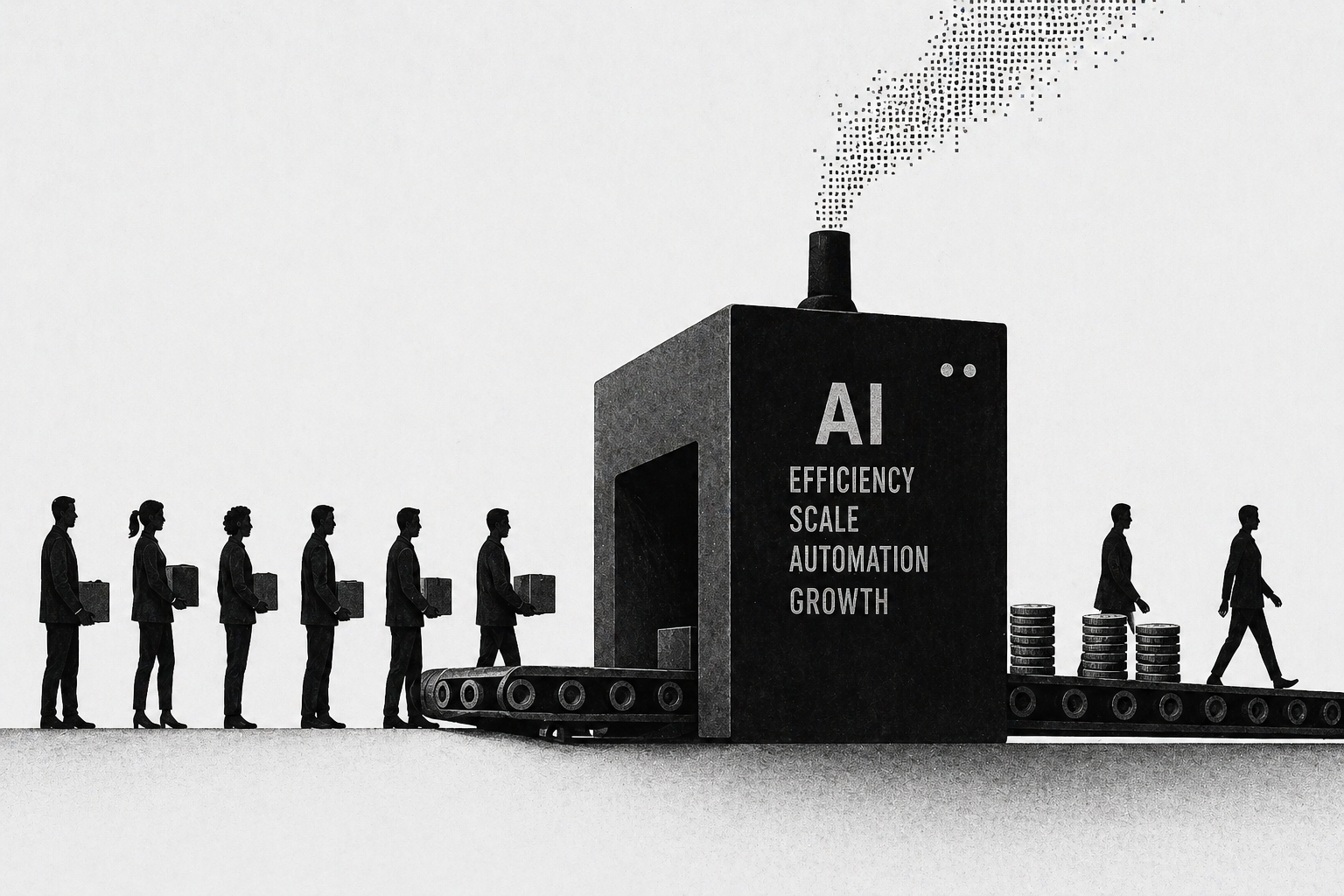
This is Snap’s fourth major layoff in four years. What was once described as a restructuring charge is now a recurring operational reality. The framing has shifted accordingly. CEO Evan Spiegel did not present the cuts as a response to financial pressure. He presented them as a strategic choice made possible by technology — specifically, the fact that more than 65% of Snap’s new code is now being generated by AI tools. When the majority of your code is being written by machines, the economic logic for the human workforce that once wrote it changes. The cuts follow from that logic directly.
The company expects to reduce its annualized cost base by more than $500 million by the second half of 2026, establishing what Spiegel called “a clearer path to net-income profitability.” That path runs directly through the roles being eliminated. The $500 million in savings is not abstract — it is the aggregate value the company has assigned to the work those 1,000 people were doing, now being reassigned to systems that do not require salaries, benefits, or equity. The pre-tax charges for severance and contract termination are estimated at $95 million to $130 million. The math is clean.
What makes Snap’s announcement worth examining beyond its own numbers is what it confirms about the broader pattern. Meta announced 8,000 cuts alongside a $135 billion AI capital spending projection. Microsoft structured buyouts targeting long-tenured employees. Google and Amazon have made similar moves across the past eighteen months. Each company frames its reductions differently — efficiency, strategic focus, AI transformation — but the underlying decision is the same: labor is being repriced relative to automated systems, and the repricing is happening faster than the workers inside these companies can adapt to.
The compression effect is already visible in how early careers are being structured. Entry-level roles — the positions that once provided training, access, and a pathway into professional life — are the first to disappear when AI handles the work that justified them. The remaining workforce is increasingly focused on architectural decisions and overseeing AI-generated output rather than manual production — a narrower set of roles requiring a higher baseline of technical fluency that the education system has not yet caught up to. Snap’s 1,000 layoffs are not an isolated event. They are a data point in a structural recalibration of who the labor market is built for.