
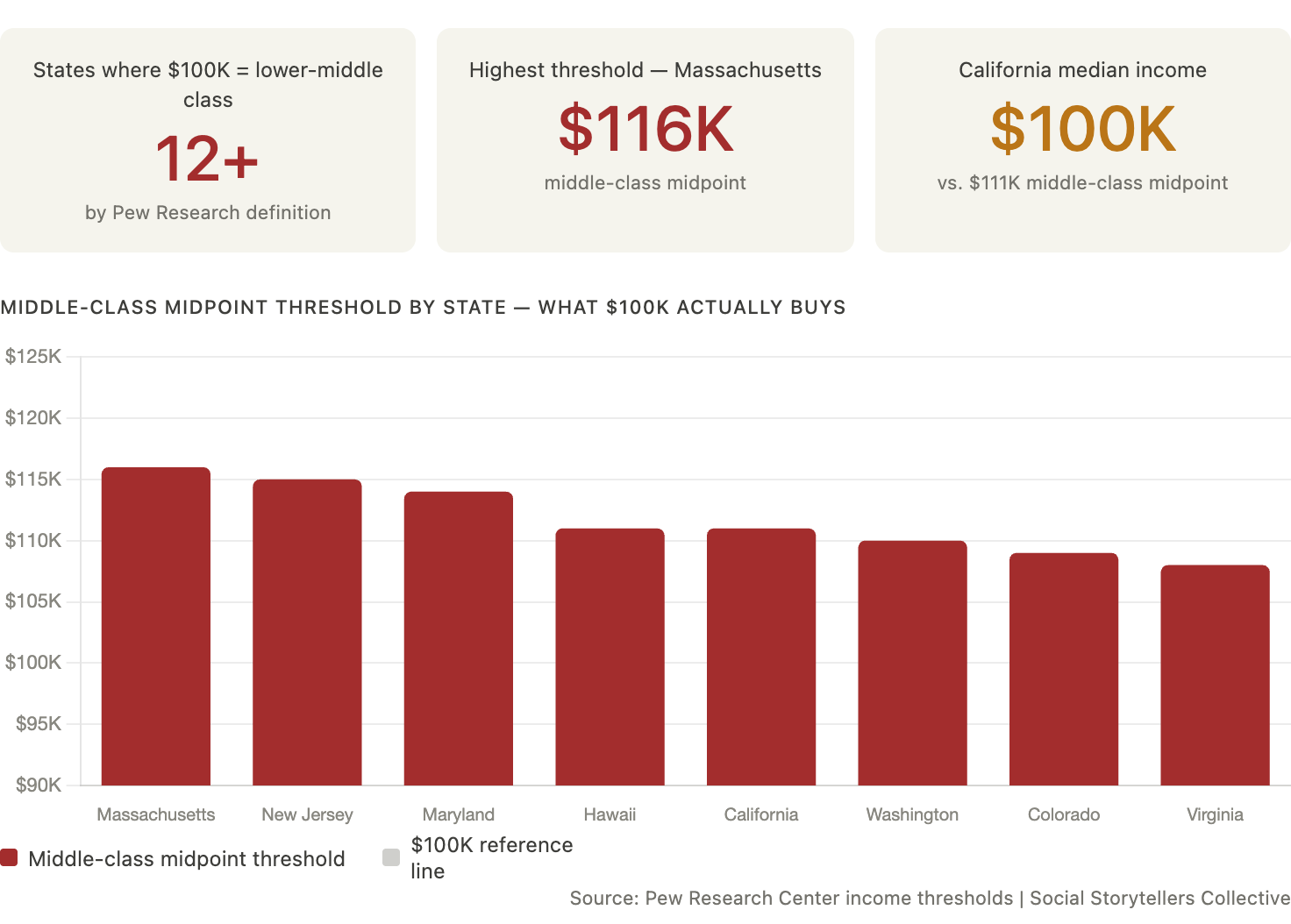
In at least 12 U.S. states, a $100,000 salary now places a household in the lower-middle class. Not by feel — by definition. Using Pew Research Center income thresholds, analysts have determined that California households need roughly $111,277 just to reach the midpoint of the middle-class range, despite a median income of about $100,149. Massachusetts sits at approximately $116,000. New Jersey at $115,000. Maryland at $114,000. Hawaii at $111,000. Washington, Colorado, and Virginia follow the same pattern. In each of these markets, the income that once signaled arrival is now positioned closer to the floor.
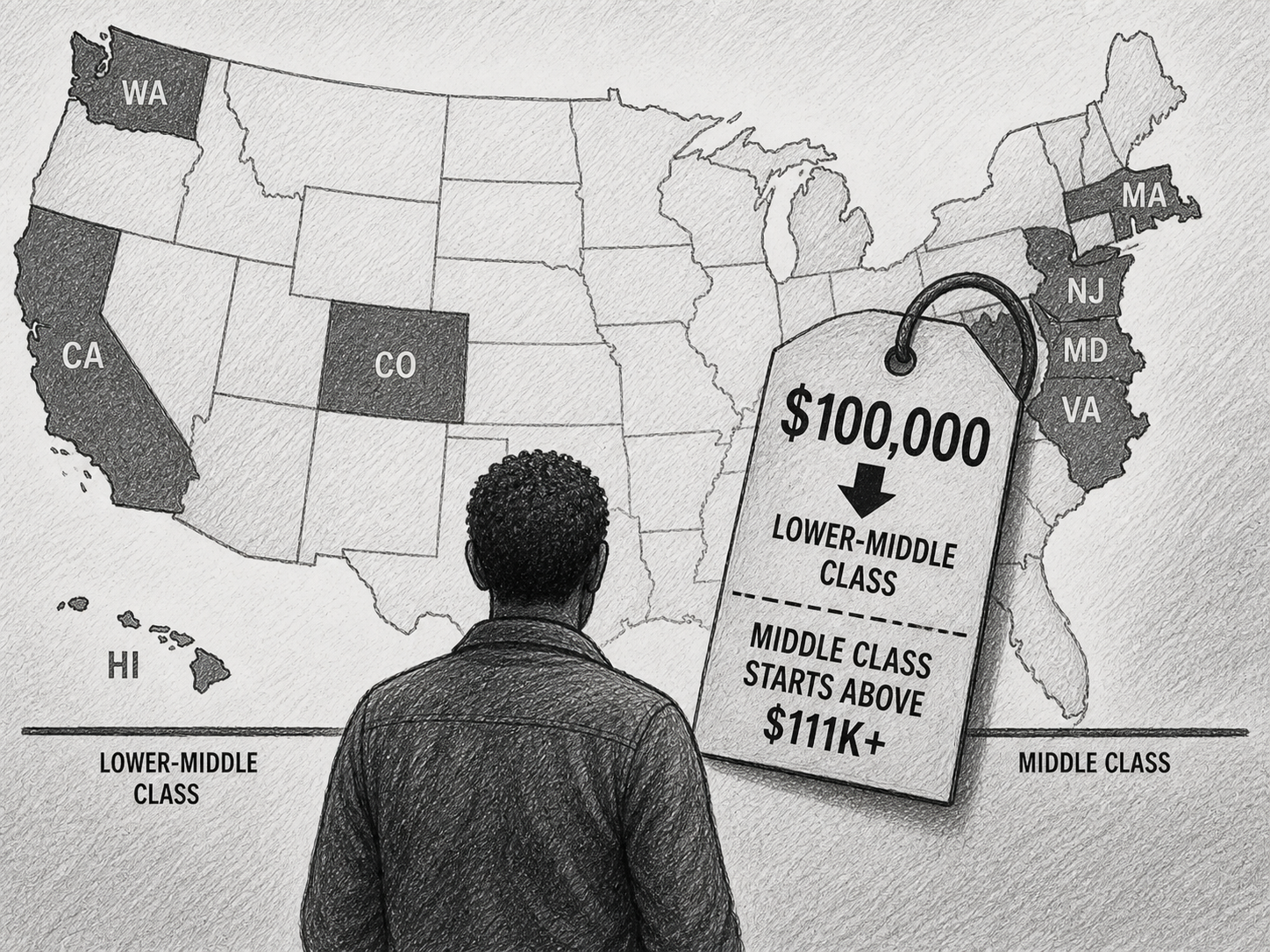
This is not a wage story. Wages in many of these states have risen. It is a cost structure story — and the distinction matters. Middle class is defined as a range, typically two-thirds to double the median income, which means as median incomes rise in high-cost states, the threshold for stability rises with them. Earning more does not move households forward. It allows them to maintain access to systems that have become more expensive to remain inside. That is a fundamentally different relationship between income and progress than the one the six-figure milestone was built to represent.
The populations absorbing the sharpest version of this reclassification are the ones who arrived at $100,000 most recently — workers who spent years building toward an income level that carried a specific cultural meaning and now find that meaning has shifted beneath them. As SSC has documented, the paycheck-to-paycheck condition is no longer limited to low-income households— it has migrated up the income distribution into households that, by any traditional measure, should be financially stable. The $100,000 reclassification is the next visible expression of that migration.
The geographic dimension is where the racial equity layer enters. The high-cost states where $100,000 no longer signals stability are also states with large Black and Latino professional populations — workers who entered these labor markets through education, credential accumulation, and career investment specifically because the income ceiling appeared high enough to justify the cost of entry. As SSC has reported on the NYC affordability crisis, the filtering effect of rising costs doesn’t move through the population neutrally — it concentrates on the households with the least accumulated wealth to absorb the gap between income and cost, which maps consistently onto race. A $100,000 salary landing on a thinner asset base in a higher-cost market produces a materially different lived experience than the same number landing on generational equity and inherited stability.
The reclassification is quiet by design. No policy changed. No threshold was officially moved. The cost structure simply reset around a new normal, and the definition of stability reset with it. The milestone didn’t disappear. It just stopped meaning what it used to.