
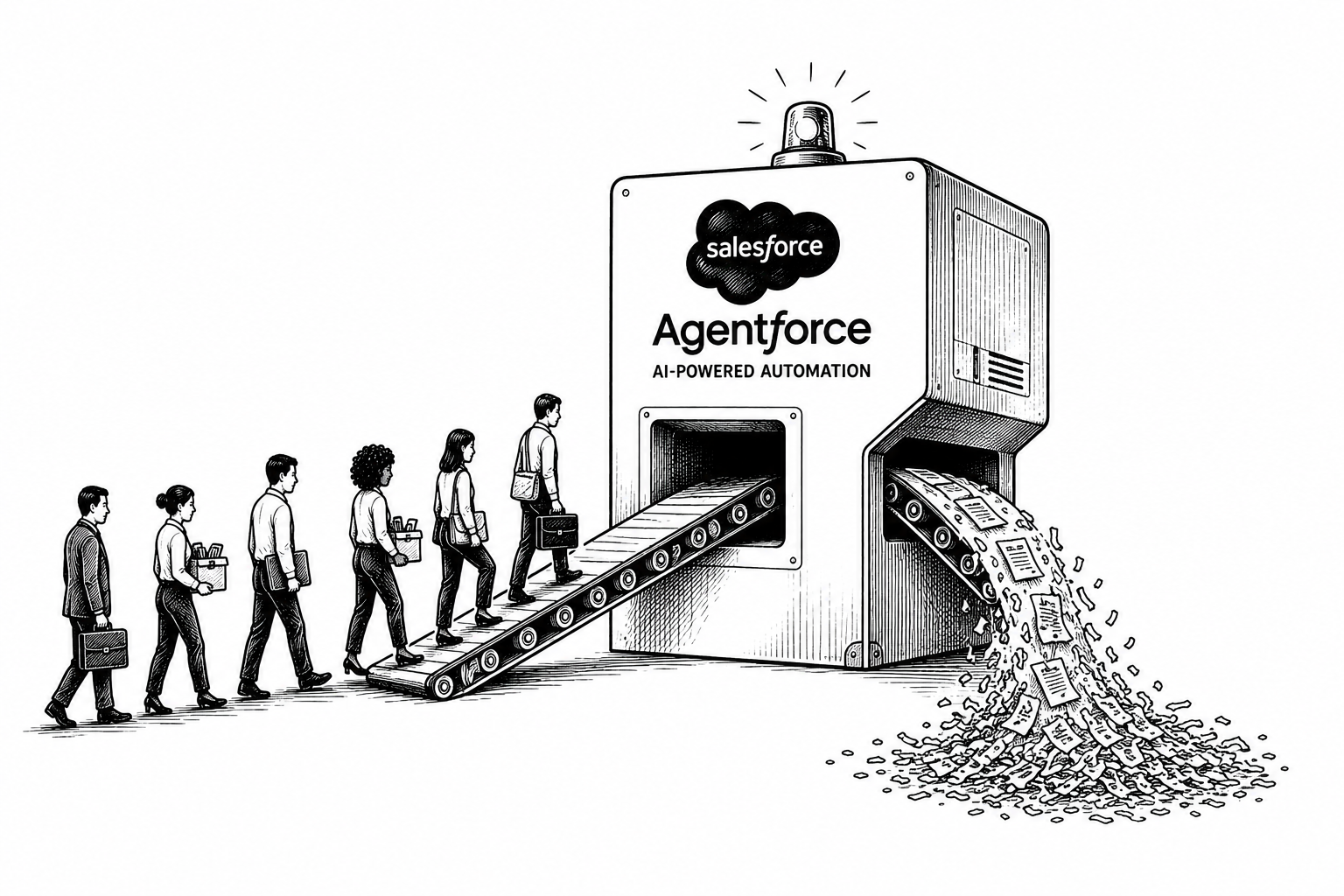
Salesforce cut jobs for the third time in nine months on June 10, 2026. A California WARN notice confirmed that 86 San Francisco-based positions were eliminated across technology and product, general administration, and sales. Additional cuts were made in Washington state and international offices. The affected teams include workers associated with Agentforce — Salesforce’s flagship AI product — as well as MuleSoft and Marketing Cloud. Workers affected remain on payroll through August 7.
This is the same Agentforce that crossed $1 billion in annualized revenue. The same platform posting 205% year-over-year growth. Salesforce is eliminating workers in the division generating its fastest growth while simultaneously describing that growth to investors as the company’s primary reason for optimism.
The apparent contradiction resolves when you understand what Agentforce actually does. Salesforce CEO Marc Benioff has described the shift plainly: enterprise customers are now more focused on agentic AI interfaces than traditional cloud infrastructure. Agentforce automates the tasks that previously required human customer service, sales support, content moderation, data analysis, and workflow management. The platform’s growth is not despite its displacement of human roles — it is because of it. Customers are paying for Agentforce precisely because it reduces their own headcount requirements. And Salesforce is reducing its own headcount as it builds the tool that reduces everyone else’s.
The pattern at Salesforce mirrors what is running across the technology sector. Salesforce stock is down more than 30% this year amid concerns that AI tools and agents could erode demand for traditional business software — including its core CRM products. The company’s response is to accelerate the transition: cut the roles that served the old model, invest in the platform built for the new one, and describe the displacement as strategic repositioning. Benioff told investors that engineering staffing levels had held steady at around 15,000 for approximately two years — even as the company’s AI revenue grew by more than 200% year over year. The company is producing significantly more AI-driven revenue from the same number of engineers.
Salesforce has cut jobs in September 2025, January 2026, and now June 2026. Each round has been described as restructuring. Each round has targeted the roles adjacent to the AI products growing fastest. The workers being eliminated are not the ones whose jobs will be safe after the transition — they are the ones whose functions are being handed to the platform their employer is selling.
The Salesforce pattern is the AI economy’s labor story in miniature: the company building the automation tool is using that tool to eliminate its own workers, while reporting record growth in the revenue generated by doing so. The workers absorbing the displacement are not failing to adapt. They are being displaced by the product their company bet its future on — and the displacement is being reported, accurately, as a business success.
— SSC News Desk | Social Storytellers Collective
Get SSC analysis delivered to your inbox every day. Subscribe free on Beehiiv: socialstorytellerscollective.beehiiv.com