
After more than two years of suspended flights, Haiti and the Dominican Republic are set to reopen shared airspace in May. The restoration of a key regional connection will allow commercial flights to resume between two countries that share a single island, a deeply intertwined economic history, and an asymmetry of conditions that the resumption of air service will facilitate but not address. Two years is a long suspension. Airspace closures between neighboring countries are not routine administrative decisions — they reflect conditions serious enough to make regular operations untenable, whether those conditions involve security, political instability, or the kind of bilateral tension that requires more than operational adjustment to resolve. The reopening signals that conditions have recalibrated sufficiently to permit movement. It does not signal that the underlying factors have been resolved.
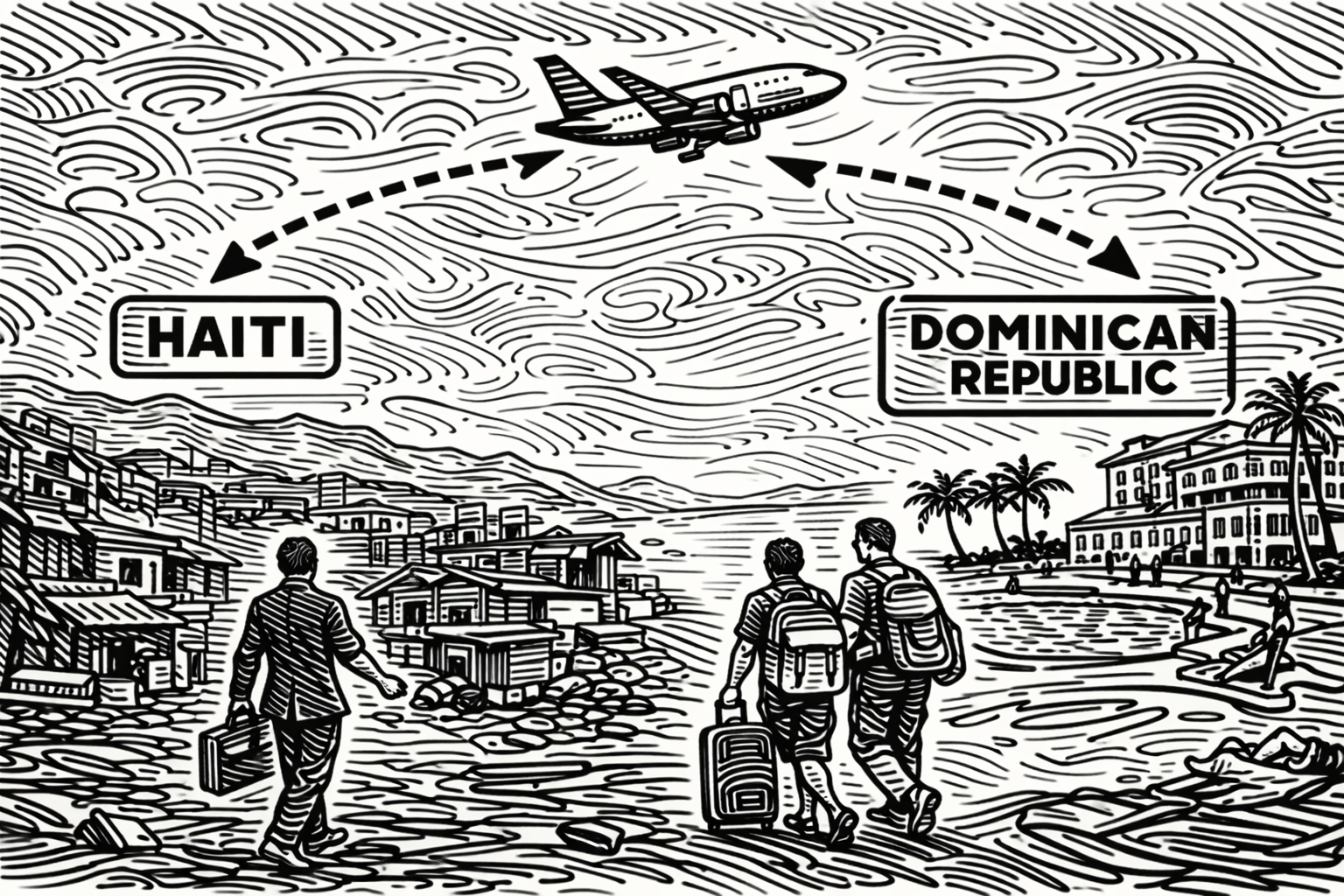
The duration of the suspension carries its own economic weight. Two years without direct air travel between Haiti and the Dominican Republic disrupted business relationships, family connections, and trade flows that depend on reliable transportation infrastructure — disruptions whose costs accumulated across the communities and enterprises that absorbed them, without any mechanism for recovery built into the reopening itself. The restoration of flights enables the resumption of those connections going forward. It does not compensate for what was lost during the suspension or address the conditions that made the suspension necessary in the first place. Infrastructure can reconnect faster than systems recover, and the reopening of airspace is a reminder that the presence of movement is not the same as the presence of stability.
The asymmetry between Haiti and the Dominican Republic is the structural context within which the reopening must be understood. The Dominican Republic operates under conditions of relative political and economic stability that allow it to benefit from restored air connections in ways that Haiti’s current environment makes more complicated. Haiti continues to face significant governance challenges, security concerns, and economic pressures that affect its capacity to participate in regional economic relationships on equal terms — meaning the resumption of flights restores access without restoring balance. Cross-border connectivity benefits both sides, but it does not benefit both sides equally when one side is operating from a position of significantly greater fragility. The same flight carries different weight depending on which direction it is going and what institutional infrastructure is waiting on the other end.
The broader Caribbean regional pattern matters here. Island economies across the Caribbean are deeply interconnected through transportation networks that serve as the backbone of trade, tourism, and labor mobility — networks whose disruption in one part of the system produces cascading effects across the region. The Haiti-Dominican Republic airspace closure was not an isolated bilateral event. It was a regional disruption whose resolution through reopening is genuinely important for the connectivity of the broader Caribbean economy. What the reopening cannot do, by itself, is resolve the political and economic conditions that made Haiti’s instability severe enough to close that airspace in the first place. Those conditions require a different order of intervention — diplomatic, economic, and humanitarian — that a flight schedule cannot substitute for and that the reopening announcement risks obscuring by providing a visible sign of normalization where normalization is still incomplete.