
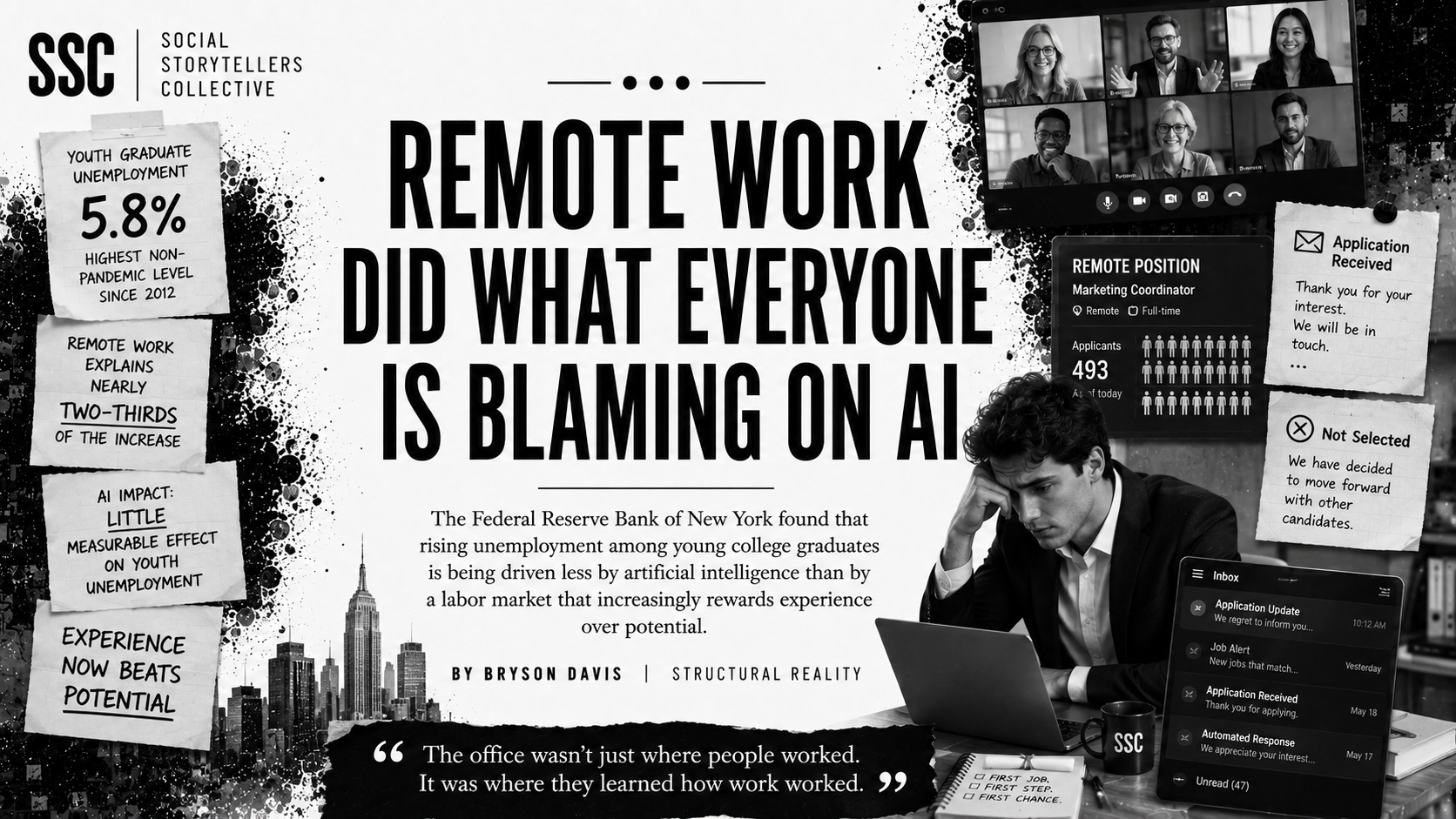
The unemployment rate for college graduates under 29 rose 20 percent from before the pandemic to an average of 3.7 percent between 2022 and 2025. For graduates between 22 and 27, unemployment reached 5.8 percent last year — the highest outside of the pandemic since 2012. Those numbers have generated significant commentary, most of it pointing in the same direction: artificial intelligence is displacing entry-level workers, automating the tasks that junior employees used to handle, and closing the door on the first rung of the professional ladder before young graduates can reach it.
A study released Monday by the Federal Reserve Bank of New York finds that explanation is largely wrong — or at minimum, significantly overstated. The research, led by New York Fed economist Natalia Emanuel, compared unemployment trends across occupations that can be performed remotely with those requiring in-person presence. The findings are direct: the unemployment rate among young college graduates in remotable occupations rose by approximately one percentage point from the 2017–2019 period to 2022–2024. Among older workers in those same fields — those 29 and over — the jobless rate declined slightly over the same period. In non-remotable occupations, the gap between younger and older college graduates is negligible. Remote work, the study concludes, is responsible for nearly two-thirds of the rise in unemployment among young college graduates since the pandemic. When the authors examined AI exposure across different occupations, they found that artificial intelligence had little measurable impact on youth unemployment. Read the full AP report on the New York Fed study.
The mechanism the study identifies is training and mentorship. Employers, the researchers argue, are reluctant to hire inexperienced workers onto distributed teams because it is harder to teach them the skills they need from a distance. The study includes detailed data from an unnamed Fortune 500 technology company whose hiring patterns mirror the broader national trends — when offices were closed and staff worked remotely, the firm hired fewer inexperienced workers and more experienced ones. Once offices reopened, hiring of younger workers resumed. But even after the reopening, the company continued to favor experienced workers for teams that included a remote component. The preference for experience over potential did not fully reverse when the physical space returned.
This is where the structural argument lives — and it goes beyond the labor market data. The office, for all of its dysfunction and inefficiency, was historically the primary mechanism through which entry-level workers built the professional knowledge, institutional relationships, and career capital that eventually made them valuable to employers. Watching how senior colleagues navigated difficult conversations, receiving informal feedback on work product before it reached a decision-maker, being visible to the people responsible for promotions and assignments — none of those things transferred cleanly to distributed work. Remote work did not simply change where people worked. It changed who could access the informal infrastructure that professional development was built on.
That infrastructure was never equally distributed even when offices were full. Workers who grew up in households with professional networks — who had parents, relatives, or family friends in white-collar fields — arrived at entry-level jobs with a map of how organizations actually work that their peers did not have. First-generation college graduates, Black and Brown workers entering predominantly white professional environments, and workers from lower-income backgrounds were already navigating those spaces with less informal support than their counterparts. Remote work did not create that disparity. It removed one of the few mechanisms — proximity, visibility, incidental relationship-building — that could partially compensate for it. The workers who most depended on the office to close the gap are the ones who lost the most when the office stopped being the default.
The AI misdiagnosis compounds this. When the dominant explanation for youth unemployment points at automation and technological displacement, the policy conversation follows. Retraining programs get funded. Credential initiatives get launched. Workforce development infrastructure gets oriented around helping workers adapt to a technological transition that the data suggests is not the primary driver of their unemployment. Meanwhile the actual mechanism — a hiring market that remote work made more hostile to inexperience — goes unaddressed. Employers quietly continue preferring candidates who need less mentorship. Young workers continue cycling through job searches that take longer and yield fewer offers. And the gap between the explanation that is politically and culturally convenient and the one the data supports keeps producing outcomes that nobody involved claims to want.
The New York Fed study lands during a spring when college graduates have been publicly booing references to AI during commencement speeches — a signal of how thoroughly the technological displacement narrative has saturated the conversation among the workers it is supposed to describe. Their frustration is real and legitimate. The labor market they are entering is genuinely more difficult than the one their predecessors navigated. But the study suggests the difficulty is less about the technology replacing their work and more about a structural shift in how employers have organized that work — a shift that disadvantages the workers with the least experience precisely at the moment when experience has become the primary hiring filter.
The credential they were told to get did not lie to them, exactly. The degree remains a sorting mechanism. The sort has simply become more aggressive — and remote work changed the terms of sorting in ways that have not been fully named, adequately measured, or honestly addressed by the institutions that told an entire generation that the degree was the answer.