
There is a growing shift in how people talk about going out, gathering, and being physically present with others. These moments are no longer treated as routine. They are framed as intentional, sometimes indulgent, occasionally aspirational — the kind of thing that gets scheduled in advance, budgeted for, and described afterward with a quality of gratitude that was once reserved for genuinely rare experiences. In a culture saturated by digital interaction, real-world presence is being repositioned as something closer to a luxury. That repositioning is partly cultural and partly economic. The two are now difficult to separate.
The demand data does not suggest people are opting out. Eventbrite data shows that 76 percent of consumers plan to maintain or increase their spending on live events, with younger audiences leading that trend. Nearly 80 percent of people aged 18 to 35 intend to attend more in-person events this year. The desire for physical presence is not declining. It is intensifying — precisely because digital saturation has made what used to be ordinary feel scarce. The experience of being in a room with other people, of encountering something unscripted and unrepeatable, has taken on a weight it did not carry when it was simply the default mode of social life.
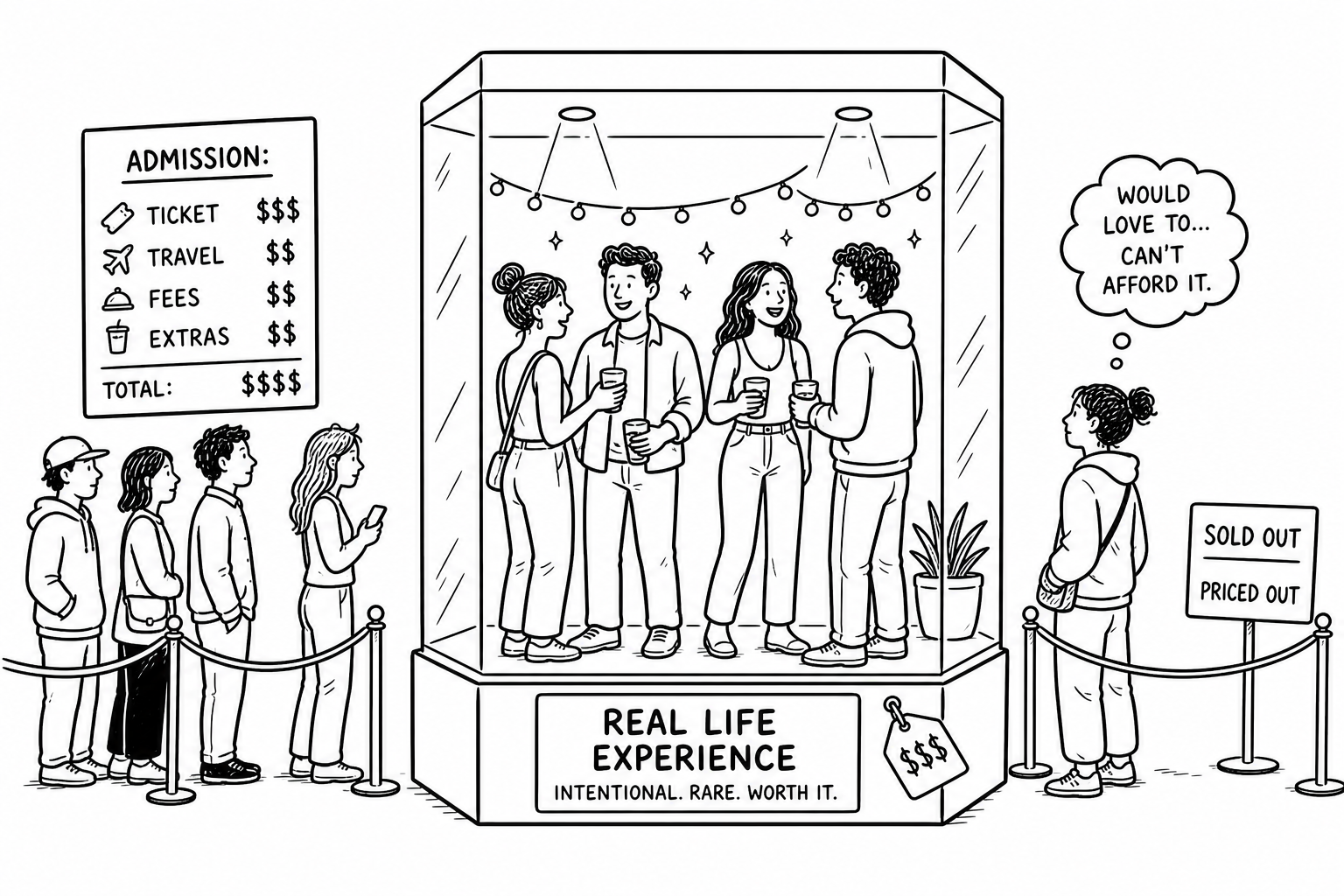
What is changing is the meaning attached to these experiences and, critically, the cost structure surrounding them. Live events are no longer just entertainment. They are being used as a counterbalance to digital fatigue, algorithmic repetition, and the flattening effect of mediated interaction. People are not just looking for something to do. They are looking for something that feels distinct, embodied, and difficult to replicate on a screen. That search is legitimate and the need behind it is real. What is also real is that access to these experiences is becoming more stratified at exactly the moment demand for them is rising. Ticket prices, travel costs, service fees, and the broader expense of participation are increasing across the live events industry in ways that SSC has documented in its touring economy coverage — a market that rewards the highest-spending consumer while pricing out the communities that have historically been at the center of the cultural production being consumed.
The tension this produces is specific and worth naming directly. Experiences that are positioned as humanizing, grounding, and authentic — as the antidote to the alienation of digital life — are increasingly functioning as status signals, shaped by who can afford to participate consistently and who cannot. The desire to be present is democratic. The ability to sustain that presence is not. And when physical gathering becomes something that must be budgeted, scheduled, and sometimes sacrificed, it stops being the social infrastructure it once was and starts being the premium product it is being sold as. The communities for whom real-life gathering was never optional — who built their social fabric around physical presence because they did not have the digital infrastructure to substitute it — are now being priced out of the upgraded version of what they already knew how to do.
What emerges is a redefinition of connection itself. Being present, offline, and engaged is no longer assumed. It is pursued. And in being pursued, it becomes something that must be earned, budgeted for, and sometimes foregone. Real life is not disappearing. It is being repriced. And the question that repricing raises — who can afford to show up, and what happens to the people who cannot — is the one that the cultural celebration of in-person experience consistently fails to ask.