
A proposed federal bill is resurfacing an old American tension: who gets to prove they belong, and what happens when the proof was never fully documented in the first place.
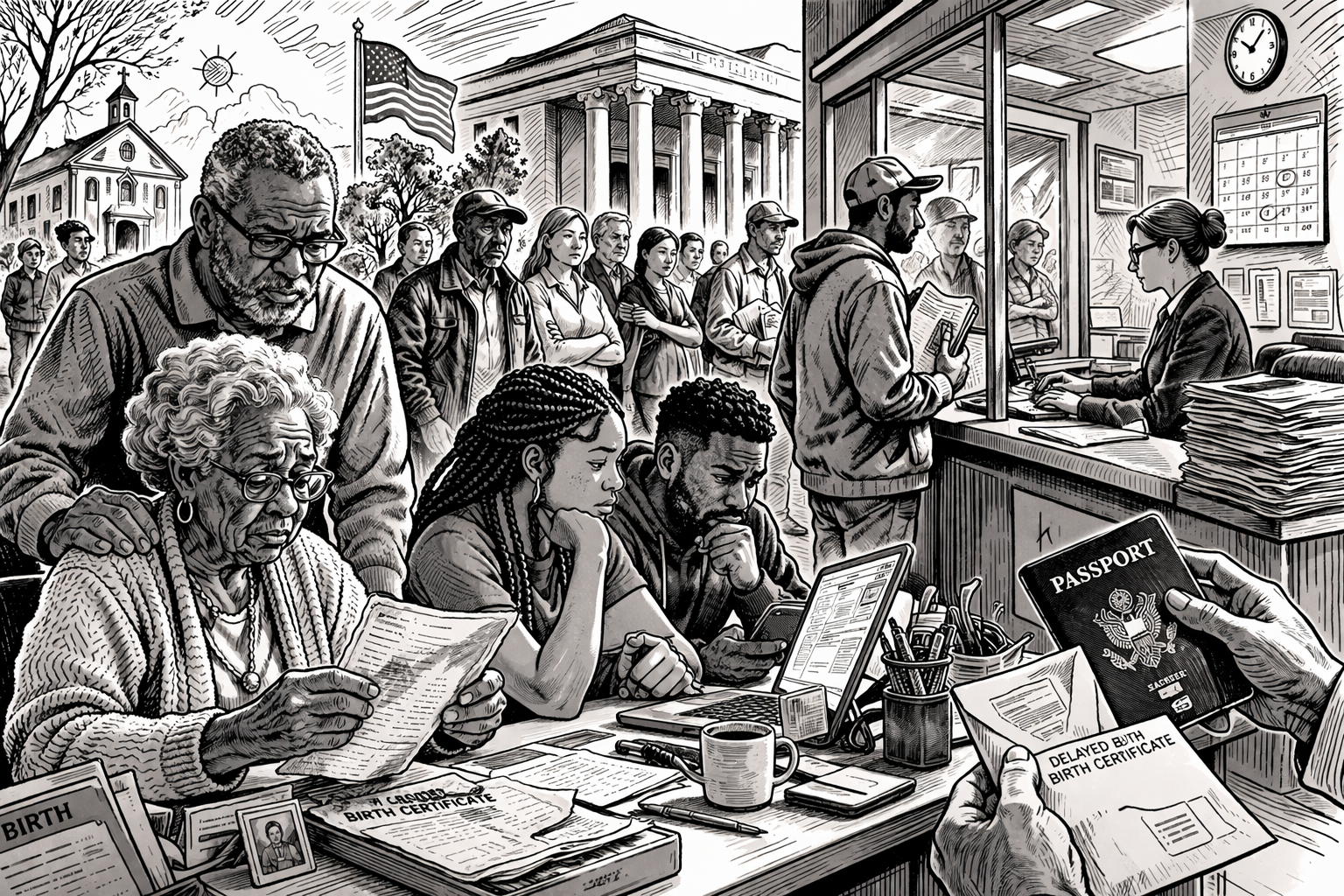
The Safeguard American Voter Eligibility Act — now reintroduced in the Senate as the SAVE America Act — would require individuals to provide documentary proof of citizenship in order to register to vote in federal elections. The House passed the bill on February 11, 2026, by a vote of 218 to 213. Senate debate began March 17, and as of late March, a final vote had not been scheduled, with Republicans lacking the 60 votes needed to overcome a Democratic filibuster. On paper, the requirement reads as a tightening of election security. In practice, it raises a more complicated question about documentation, history, and access — particularly for older Black Americans whose records were never formally established or preserved.
For most Americans, compliance would mean presenting a passport or certified birth certificate. Government-issued driver’s licenses — including REAL IDs — as well as military IDs do not satisfy the bill’s requirements on their own. That matters because only about one-third of Black Americans have passports, compared to roughly half of all American adults. For a subset of Black elders, especially those born in the Jim Crow South, the gap runs deeper than passport access. One-fifth of Black Americans born in 1939 and 1940 were never issued birth certificates at all, according to the Center on Budget and Policy Priorities.
This documentation gap is a direct result of a system that excluded Black families from hospitals and government record-keeping. Between 1900 and 1960, hospitals in many Southern towns refused to admit Black women, forcing families to rely on home births attended by lay midwives who lacked the legal standing to file official paperwork with the state. Even when birth registration became a national requirement in 1933, Southern states did not always prioritize the records of Black residents. What looks like a neutral requirement in 2026 intersects with a historical reality where documentation was never guaranteed.
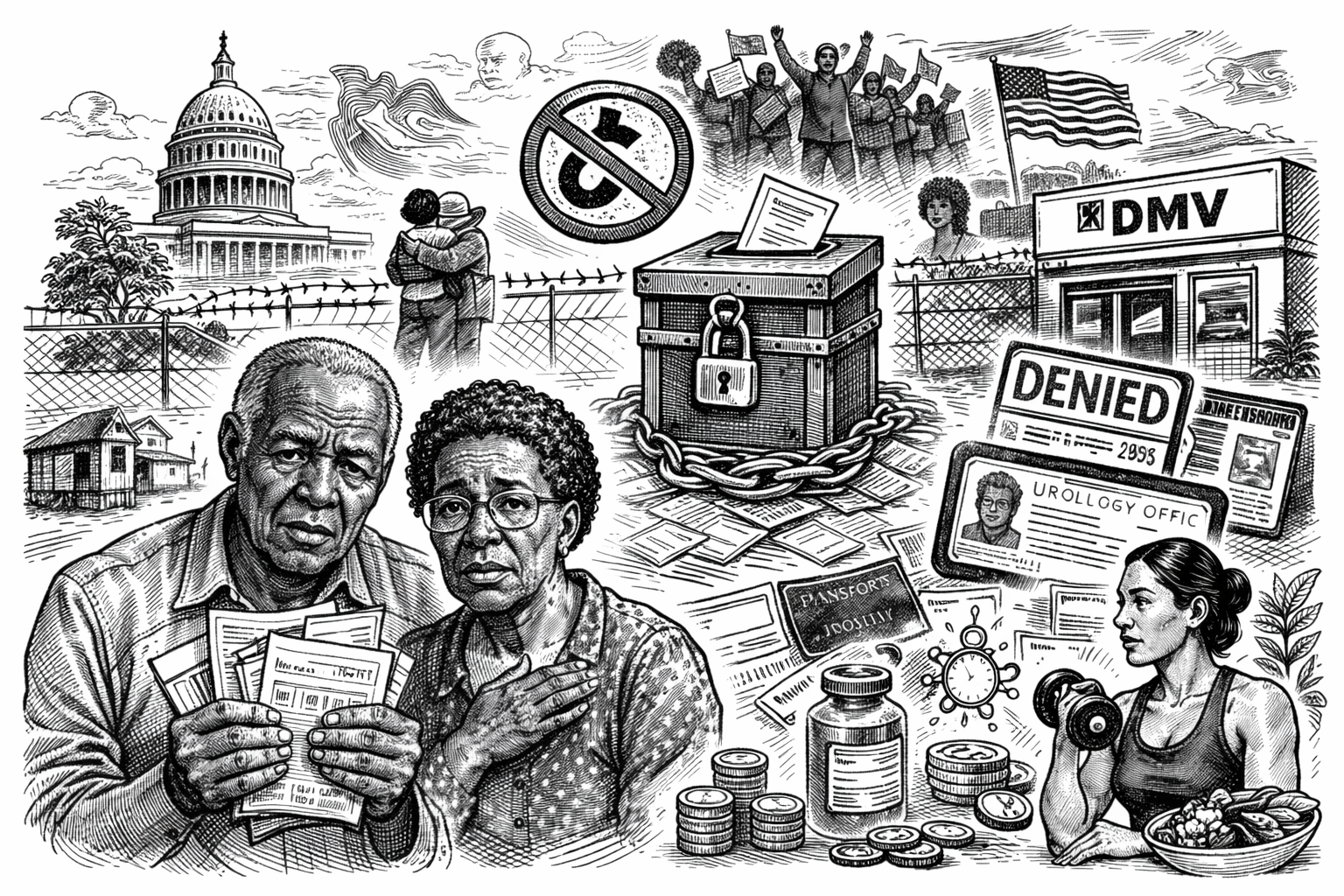
The implications are direct. According to the Brennan Center for Justice, more than 21 million voting-age Americans lack ready access to documentary proof of citizenship, with people of color disproportionately represented in that group. For those without records, the path forward is difficult by design. Obtaining a “Delayed Birth Certificate” typically requires presenting three different documents created within ten years of birth — school records, baptismal certificates, or census records. Many Black seniors who grew up in the rural South attended schools that did not keep formal records, and churches in Black communities were frequently targets of violence or fires that destroyed existing documentation. The process can become circular: to get a birth certificate, a person may need a government ID; to get that ID, they need a birth certificate.
The state-level record on these requirements is instructive. When Kansas implemented a similar documentary proof requirement, it blocked over 31,000 eligible citizens — roughly 12 percent of all applicants — from registering to vote. Kansas officials conceded in court that over 99 percent of those blocked were U.S. citizens, and a federal court struck the law down in 2018. Documented instances of noncitizen voting remain vanishingly rare — just 77 confirmed cases across 24 years, according to the Bipartisan Policy Center.
Supporters of the SAVE America Act argue that citizenship verification is necessary to maintain trust in elections. Opponents, including many Democratic lawmakers and civil rights advocates, argue the policy functions as a modern form of disenfranchisement. Demetria McCain, director of policy at the NAACP Legal Defense and Educational Fund, drew a direct line to history: “And guess what the poll tax was about? It was about money. All of that costs money” — referring to the fees, travel, and time required to secure documentation that many Black Americans were structurally denied decades ago. The disagreement is not just political. It is definitional. One side is focused on system integrity. The other is focused on equitable access within a system that has never been evenly built.
There is also a civic infrastructure question the bill largely sidesteps. For decades, voter registration has orbited around Black civic life: churches, historically Black fraternities and sororities, and community organizations that meet people where they are. But proving citizenship requires formal documentation verified in person. “And you can’t do that at a church registration drive,” McCain said. The bill would effectively eliminate online and mail voter registration — options that millions of Americans currently depend on.
This moment sits within a longer American pattern. Voting rights have often expanded and contracted through administrative mechanisms that appear procedural but carry real consequences. Literacy tests, poll taxes, and voter ID laws were all framed in neutral terms at different points in history. Their impact was anything but neutral. That pattern is already advancing at the state level: Florida enacted its own version of the SAVE Act in early April 2026, and South Dakota, Alaska, West Virginia, Kansas, and Arkansas have moved on similar citizenship verification measures ahead of the 2026 midterms.
What makes the current debate distinct is how it exposes the fragility of something assumed to be settled. Citizenship, in theory, is fixed. But the ability to prove it is mediated through documents — and documents are products of systems that have not treated all populations equally.
For Black elders without formal birth records, the question is not whether they are citizens. It is whether they can produce the kind of evidence the system now demands. That distinction is where policy becomes personal.
The outcome of the SAVE America Act will determine more than a procedural change. It will signal how the country chooses to reconcile documentation with history — and whether access to the ballot is defined by presence or by paperwork.