
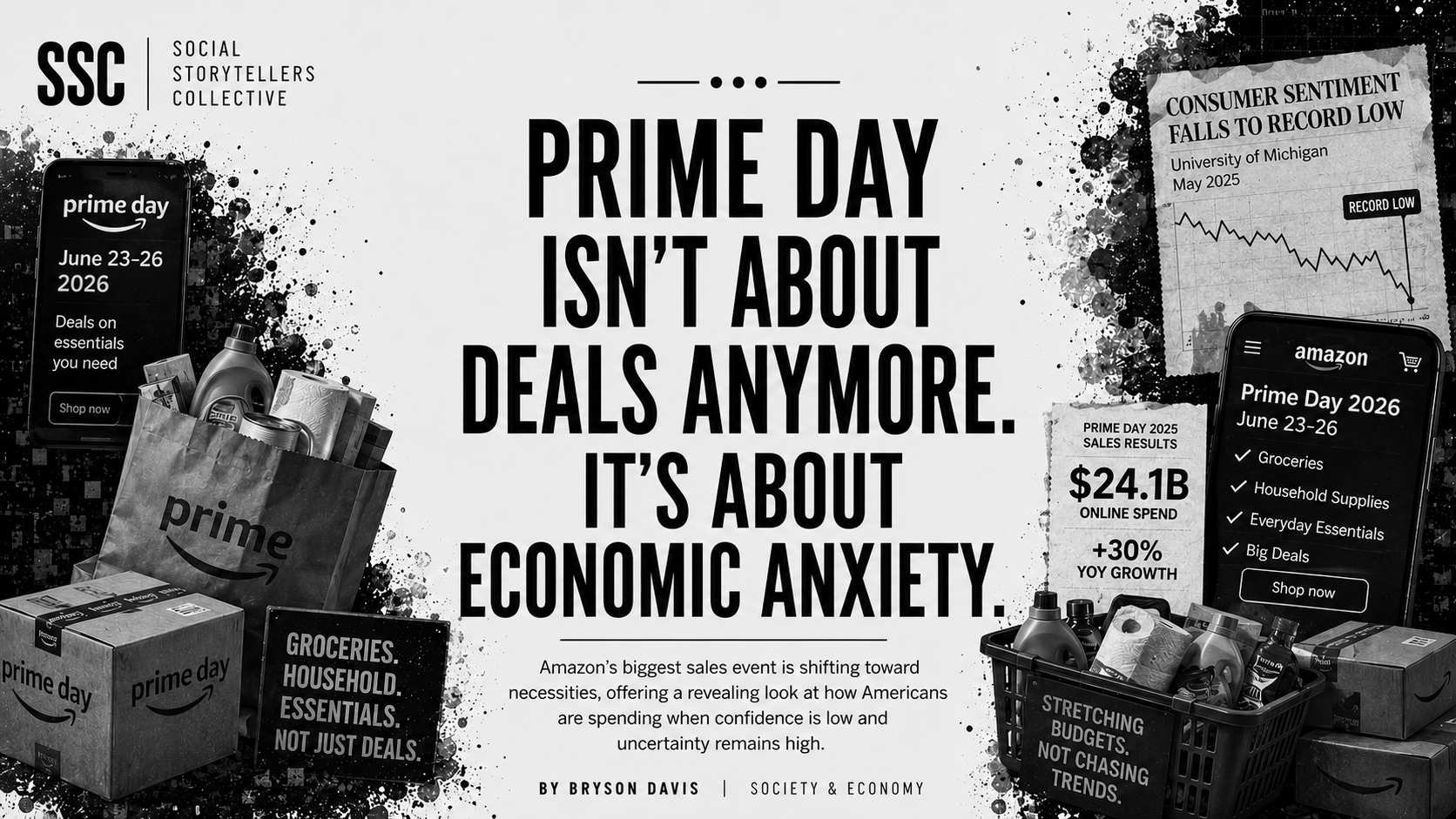
For years, Amazon Prime Day functioned as a celebration of discretionary spending. Consumers filled carts with televisions, smart home gadgets, kitchen appliances, and impulse purchases they didn’t necessarily need but could justify because the discounts felt too good to ignore. The event became a mid-summer ritual built around abundance. This year’s announcement signals something different. Amazon says Prime Day 2026, scheduled for June 23–26, will emphasize groceries, household supplies, and everyday essentials alongside traditional deals. On the surface that sounds like a merchandising decision. It may be a more honest reflection of where the economy actually is.
The timing is not accidental. Consumer sentiment fell to a record low in May, according to University of Michigan data. That matters because confidence influences spending as much as income does. When people feel uncertain about their financial future, they don’t necessarily stop spending — they become more deliberate about where their money goes. The shopping cart becomes less aspirational and more practical. A discounted television can wait. Laundry detergent cannot. Amazon is not creating that shift. It is responding to it.
What the pivot reveals is how Americans are navigating an economic environment that the headline numbers keep underselling. Inflation may have cooled from its peak, but millions of households are still absorbing elevated housing costs, insurance premiums, healthcare expenses, childcare, and grocery bills that have not returned to where they were. Economists sometimes call this a “vibecession” — the gap between what the macroeconomic indicators say and what households are actually experiencing at the register. In that environment, value is no longer measured by how much you save on something you wanted. It is measured by how much longer you can stretch a paycheck on something you need.
The broader retail implications are significant. Prime Day has become a barometer for the retail economy at large — last year’s event generated $24.1 billion in online spending, representing more than 30 percent year-over-year growth, and retailers across the country build competing sales events around it. If the market leader is signaling that essentials are the priority category, competitors will follow. The result could be a retail landscape increasingly organized around affordability rather than aspiration — which is a meaningful structural shift from where e-commerce positioned itself a decade ago.
That repositioning runs deeper than a single sales event. For most of the last decade, e-commerce companies led with convenience as the primary selling point — speed, selection, frictionless delivery. Affordability is now equally in the room. Consumers are not simply asking how fast an item can arrive. They are asking whether they should buy it at all. The companies that succeed in this environment may be the ones that position themselves less as lifestyle brands and more as economic partners — organizations that help households manage uncertainty rather than ones that profit from manufacturing desire.
When one of the world’s largest retailers chooses to lead its marquee sales event with groceries and household necessities, it is not making a statement about its product strategy. It is making a statement about its customers. The story is not that Americans have stopped spending. The story is that many are spending with a different calculus. In a period marked by economic unease, essentials have become the new indulgence — and that may be the most precise signal yet about where this economy is holding and where it is quietly coming apart.