
Thousands of graduate student workers at Harvard went on strike this week, disrupting research and academic operations across one of the most powerful universities in the world. The workers are demanding higher wages, improved benefits, and protections for international students facing deportation risks. The strike is not symbolic. It is operational. When graduate labor stops, the institution’s ability to produce research, teach courses, and maintain its academic output is immediately affected.
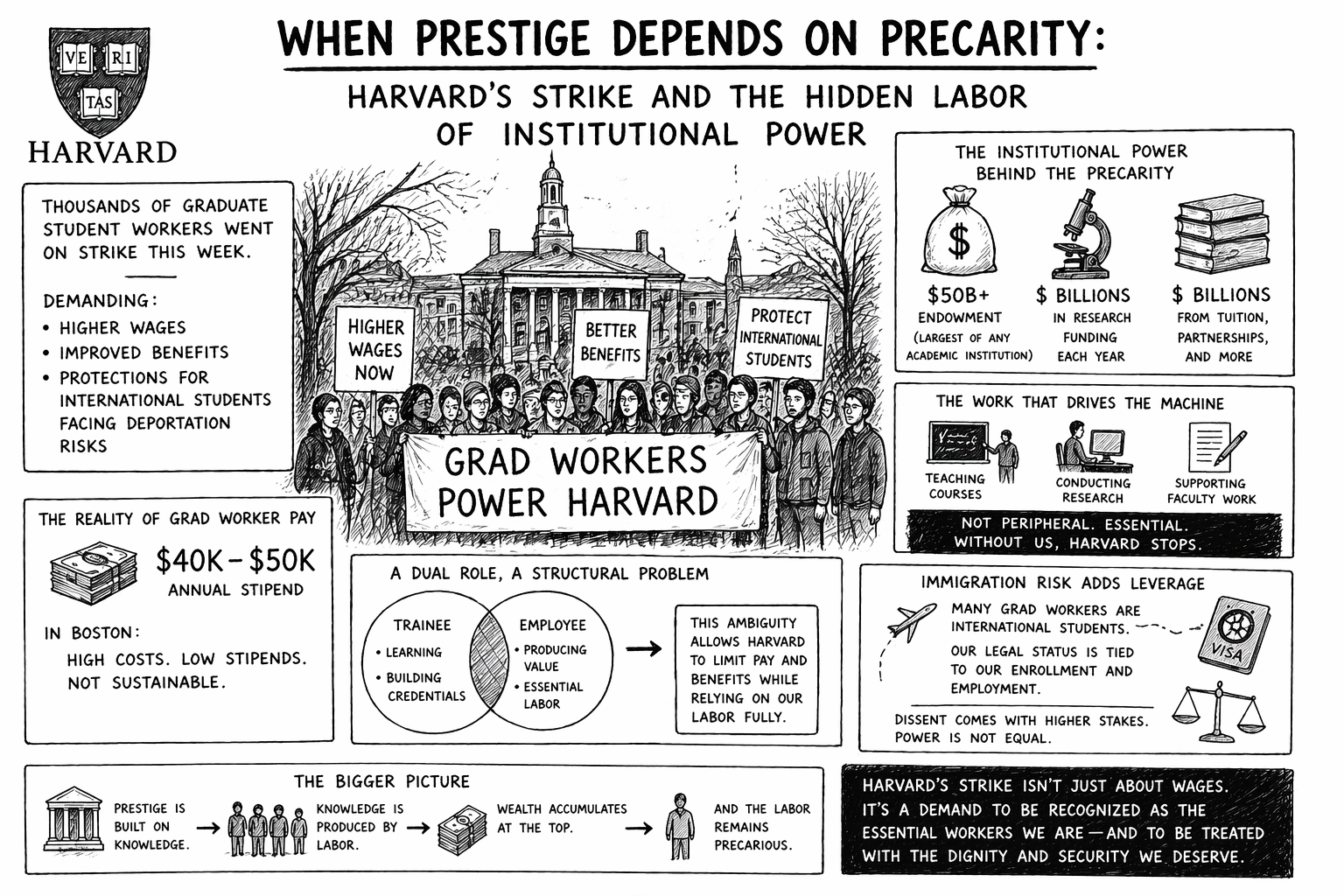
The scale of that dependency is often obscured by the university’s global reputation. Harvard operates with an endowment exceeding $50 billion, the largest of any academic institution, and generates billions annually through research funding, tuition, and partnerships. Yet the graduate workers driving much of that research are often paid stipends that range between $40,000 and $50,000, levels that struggle to keep pace with the cost of living in the Boston area. The tension is not between scarcity and demand. It is between institutional wealth and labor distribution.
That tension becomes more pronounced when viewed through the structure of academic labor. Graduate students occupy a dual role: they are both trainees and employees. This ambiguity allows institutions to classify them in ways that limit compensation and benefits while still relying on them for core operational functions. Teaching undergraduate courses, conducting research, and supporting faculty work are not peripheral tasks. They are central to the university’s output. The classification system, however, allows that labor to be compensated below market rates for comparable work in other sectors.
The strike also introduces a layer of immigration risk that is rarely foregrounded in discussions of academic labor. A significant portion of graduate workers are international students whose legal status is tied directly to their enrollment and employment conditions. The demand for deportation protections is not abstract. It reflects a system where participation in the workforce is contingent not only on performance, but on visa status. This creates a structural imbalance in bargaining power, where some workers face higher stakes for dissent than others.
This dynamic is not isolated to Harvard. Across elite universities, graduate labor has become an essential component of institutional growth, particularly as research funding has expanded. Federal grants, private partnerships, and industry collaborations have increased the scale of academic research, but the labor model supporting that expansion has remained relatively unchanged. The result is a system where output scales, revenue increases, and prestige grows, while the underlying labor conditions remain compressed.
There is also a broader comparison to be made with other knowledge industries. In sectors like technology and consulting, highly educated workers command salaries that reflect their contribution to organizational output. In academia, that same level of education and specialization is framed as part of a training process, even when the work being performed is functionally equivalent to professional labor. The distinction allows institutions to maintain lower labor costs while continuing to expand their research footprint.
What this moment reveals is a structural contradiction at the center of higher education. Universities position themselves as engines of knowledge, innovation, and opportunity, but the conditions under which that knowledge is produced are increasingly contested. The strike is not just about wages or benefits. It is about whether the model that has sustained academic prestige can continue to rely on labor that is both essential and undervalued. The question is not whether the system works. It is who it works for, and under what conditions that work is expected to continue.