
Part of Culture in Motion — an ongoing series examining who defines culture, how race is interpreted, and how both are reshaped over time.
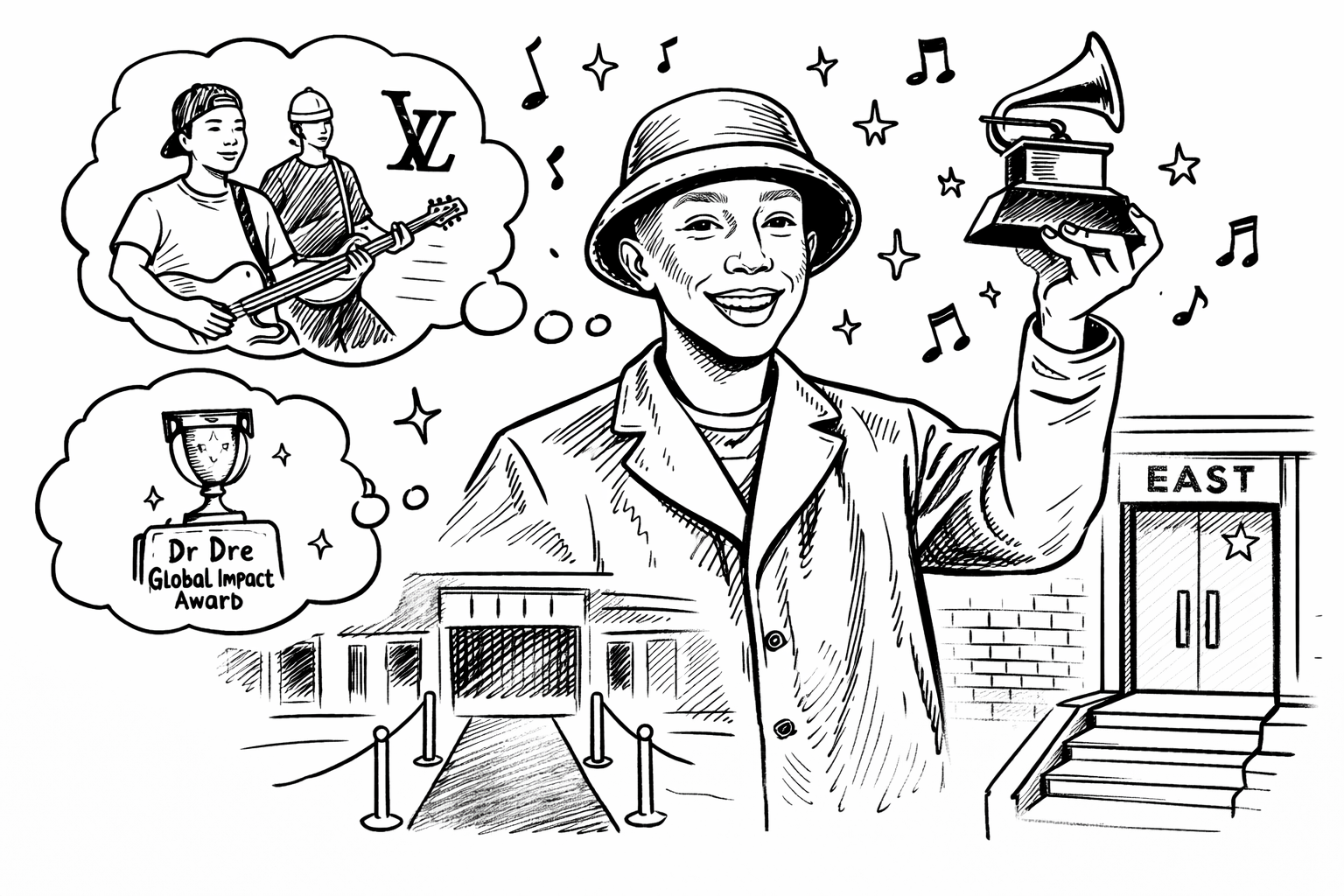
I think about the N.E.R.D. era when I think about Pharrell Williams. Specifically Fly or Die — the 2004 album that was raw, genre-defying, and the least industry-friendly thing he has ever made. Rock guitars, funk, hip-hop, existential restlessness — an album that didn’t ask permission and didn’t get the mainstream moment it deserved because it refused to be easily categorized. That version of Pharrell — the one who was making music that the industry didn’t quite know what to do with while simultaneously producing the records everyone else was chasing — is the one the Dr. Dre Global Impact Award is finally, belatedly, acknowledging in 2026.
Politics as usual.
The award arrived at the same ceremony where Kendrick Lamar swept rap and SZA dominated — which is fitting, because Pharrell’s fingerprints are on the lineage that produced both of them. His Neptunes production run in the late 1990s and early 2000s redefined the sound of pop, hip-hop, and R&B simultaneously. The snare, the space, the refusal to follow conventional arrangement logic — all of it became a template that the industry absorbed and replicated for decades. By the time “Happy” made him a global household name in 2013, he had already shaped the sonic DNA of a generation. The industry was just catching up then too.
The Louis Vuitton appointment in 2023 is where the politics get most visible. Pharrell as creative director of one of the world’s most powerful luxury institutions is an extraordinary achievement — and it would be easy to read it as pure recognition of his creative vision. But it is worth asking the harder question: how much of that appointment is genuine embrace, and how much is leverage? Black creatives at this level of influence rarely arrive at institutional power without a negotiation that the institution controls. The terms are set by the house. The creative director operates within them. And no matter how prominent the role, the oversight rarely disappears entirely — it simply becomes less visible.
That is not a cynical reading of Pharrell’s achievement. It is an honest one. He has built something genuinely rare — a career that has moved from music production to performance to fashion to cultural curation without losing credibility in any lane. As Jay-Z Adds Third Yankee Stadium Date examined, Jay-Z’s GQ interview described the next step as owning the building rather than occupying the highest floor. Pharrell is inside the building — and doing extraordinary work there. The question of who ultimately holds the deed is a different conversation.
What the Dr. Dre Global Impact Award represents, when you strip away the ceremony, is the industry’s habit of recognizing Black creative power only after it has become impossible to ignore — and then presenting that recognition as generosity rather than obligation. Pharrell earned this award sometime in the early 2000s. The Grammys are presenting it in 2026. The gap between those two dates is the story. The culture already knew. The industry just finally said it out loud.