
Part of Culture in Motion — examining who defines culture, how it moves, and what it reveals about the moment.
For much of the past decade, celebrity influence was defined by visibility. Speaking out was expected. The artist who stayed quiet during Ferguson was noted. The athlete who said nothing after a police killing was named. Silence was interpreted as a choice — and usually as the wrong one. That expectation shaped careers, brand relationships, and the terms under which cultural figures maintained their credibility with the communities that made them.
That expectation is shifting — and the shift is worth examining carefully, because it is being framed as evolution when it may be something more calculated.
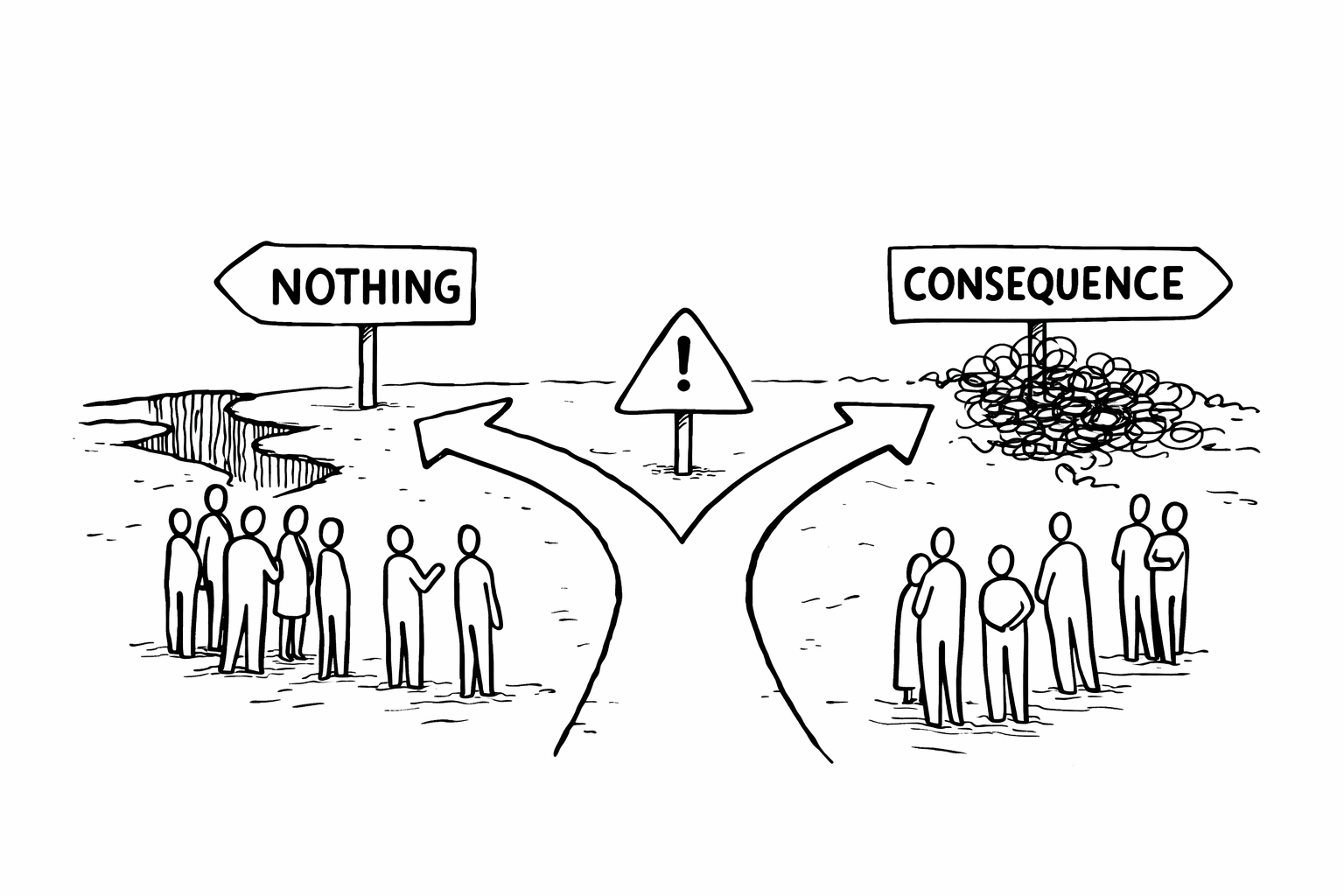
A growing number of public figures are choosing not to engage in political or cultural commentary — not because they lack opinions, but because the cost of expressing them has become increasingly difficult to manage. In a media environment shaped by constant amplification, a single statement can be reframed, redistributed, and contested across multiple audiences simultaneously. The artist who speaks on a political issue risks losing streaming listeners in markets where that issue is polarizing. The athlete who takes a position risks brand relationships that underwrite the infrastructure of their career. The calculation is not hypothetical. It is being run in real time, by management teams, publicists, and the figures themselves.
The result is not disengagement. It is recalibration — and the recalibration has a name even if it is rarely spoken plainly: selective engagement designed to preserve optionality. Engage where the upside is clear and the audience is aligned. Avoid statements that require long-term defense. Maintain visibility without committing to positions that close future doors. This is not a new instinct. It is a new system — built on analytics, audience segmentation, and the lesson that controversy travels faster than context.
The structural argument underneath all of this is real. Influence is no longer linear. It does not move from speaker to audience in a controlled way. It moves through networks — platforms, media coverage, community interpretation — each adding a layer of meaning that the original speaker cannot fully manage. A statement made in one context arrives in another as something different. That dynamic creates genuine risk that did not exist at the same scale a generation ago.
But the framing of strategic silence as neutral adaptation is worth questioning — because it is not neutral for the communities doing the listening. As SSC covered in the Jay-Z GQ analysis and When the Booking Doesn’t Match the Room, the relationship between Black cultural figures and Black audiences has always involved an implicit accountability that is not part of the brand calculation. The audience that made the career is not a market segment to be managed. It is a community that extended trust — and that trust carries an expectation of reciprocity that strategic silence systematically declines to honor.
Beyoncé’s long studied silences on political questions. Ye’s chaotic and destructive visibility. LeBron’s careful and deliberate engagement. Drake’s consistent avoidance of anything that would cost him a fanbase. Each of these is a different version of the same calculation — and each reveals something about what the figure has decided their influence is ultimately for. The answers are not always wrong. Reckless visibility can cause real harm. But the frame of self-protection that underlies most strategic silence does not ask what the silence costs — only what speech would cost. That asymmetry is the thing worth naming.
Because silence has costs too. When the most visible Black cultural figures choose not to speak during moments that directly affect Black communities — voting rights legislation, mass deportations, economic policy that targets the communities those figures came from — the silence is not received as neutral. It is received as a signal about whose interests the influence ultimately serves. That signal lands regardless of what the management team intended.
As SSC covered in Everyone Profits From the Narrative — Except the People Living It and Black Twitter Was Infrastructure, the infrastructure of Black cultural power — the audiences, the community amplification, the trust that made the visibility possible — is not simply a platform to be monetized. It is a relationship with obligations. Strategic silence is, in many cases, a decision to extract value from that relationship without honoring its terms.
Why This Matters
Silence is increasingly a form of control — a way of managing influence in a volatile environment rather than abandoning it. That framing is accurate as far as it goes. What it leaves out is the question of who absorbs the cost of that management. In a system where every statement can be amplified beyond its original intent, choosing not to speak is a legitimate strategic choice. It is also a choice about whose concerns are worth the risk. For the communities that built the platforms these figures stand on, that choice is never invisible — and it is never without consequence.