
Part of Society & Economy / The Access Shift — examining how access is being quietly reshaped across American life
Think about the last time you searched for something real. Not an official answer — a human one. A recommendation from someone who’d actually been there, tried the product, survived the situation. Chances are, you ended up on Reddit. So did the algorithm.
Reddit is now the fifth-most visited site in the United States and eighth globally, with daily active users climbing past 120 million. Advertising revenue has surged past $2 billion. And the platforms people use to find information — ChatGPT, Perplexity, Google’s AI search products — are increasingly pulling from Reddit threads to generate their answers. That last part is the one worth sitting with.
Because Reddit doesn’t produce polished content. It produces perspective. It captures how people actually talk, ask questions, and work through problems in real time. In an AI-driven ecosystem, that raw, continuously updated input isn’t just useful — it’s valuable in ways the people generating it rarely see a return on. The conversations feel organic. The extraction is systematic.
Reddit’s internal data is now being packaged into products like Community Intelligence, allowing marketers to pull patterns from millions of posts. What users experience as a forum thread, a company experiences as a focus group. What feels like a community, a platform experiences as inventory — and the gap between those two realities is exactly where the money is made.
That asymmetry runs deeper when you consider who populates these communities. Black and Brown users have long built some of the most engaged, culturally specific corners of the internet — from early Black Twitter to niche Reddit communities organized around identity, experience, and mutual aid. Those spaces generate enormous signal. The platforms monetizing that signal rarely direct resources back into those communities, and the AI systems trained on them rarely acknowledge where the cultural intelligence originated.
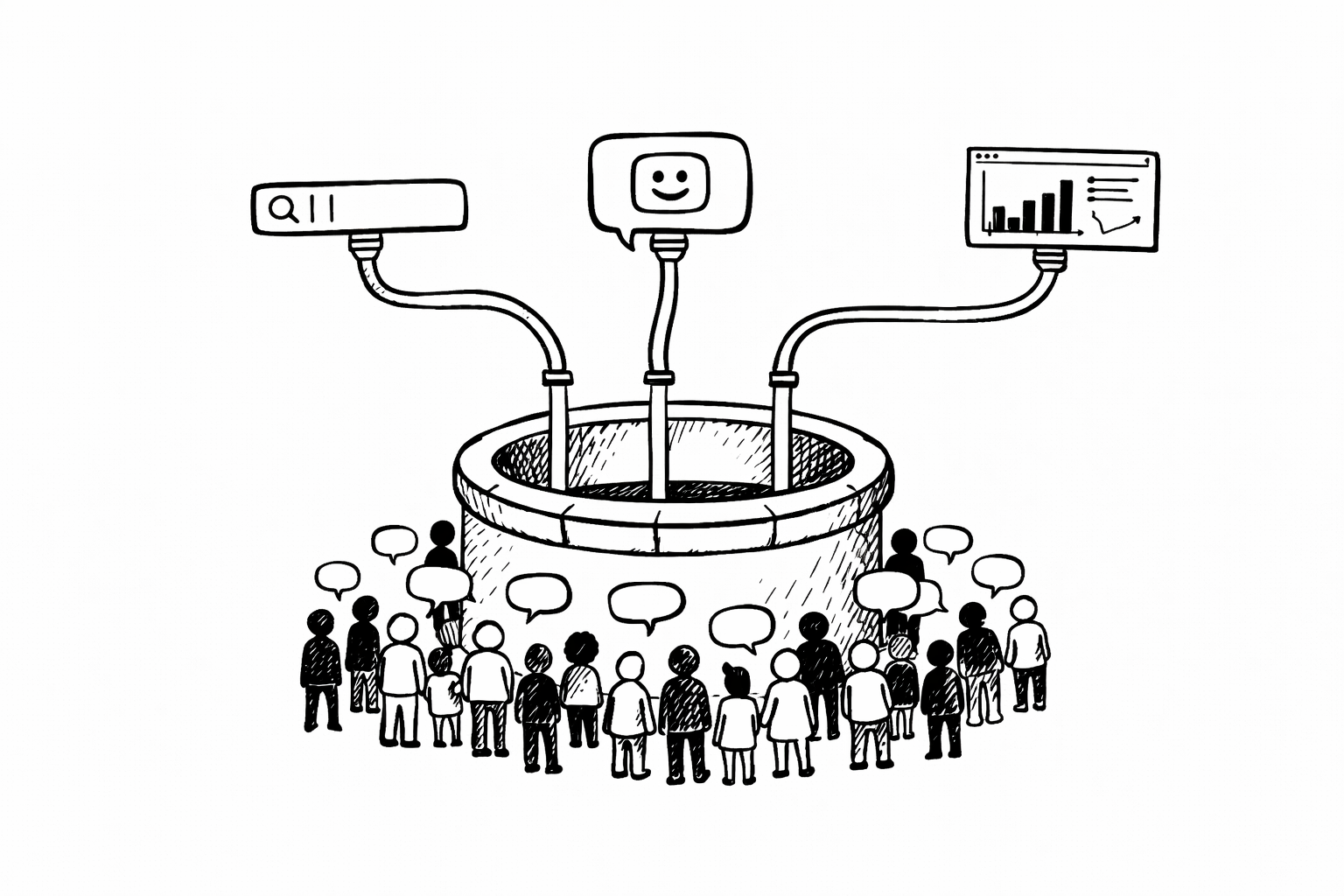
Reddit isn’t just where people go to talk anymore — it’s where systems go to learn. That repositioning changes everything. Once a platform becomes infrastructure, once other systems depend on it to function, its influence expands far beyond its own interface. It stops being a destination and starts being a layer. Search runs through it. AI learns from it. Brands embed themselves inside it, no longer just advertising but trying to exist within it, treating community as continuous market research. The line between participation and extraction keeps getting thinner, and the people doing the participating almost never set the terms.
This is what infrastructure looks like in the modern internet. Not a platform that hosts content, but one that feeds other systems — shaping search, influencing recommendations, and informing decisions well beyond what any single user can see. The shift is quiet, but it compounds.
Why This Matters
This isn’t just about Reddit’s growth. It’s about where authority is shifting. Information used to flow from institutions — media outlets, experts, official sources. Now it’s increasingly being pulled from aggregated human behavior: what people ask, what they upvote, what they respond to. Platforms like Reddit are turning that activity into a signal, and AI systems are amplifying it at a scale that changes how knowledge is formed.
It also changes who benefits. The value of these platforms isn’t just in their audience size — it’s in the data they generate. Conversations become inputs. Inputs become products. Those products drive revenue, often entirely disconnected from the people who created the original content in the first place.
The bigger shift is structural. Reddit isn’t competing with social platforms anymore — it’s becoming part of the foundation other platforms rely on. And in that role, it doesn’t just reflect the internet. It helps shape it, including which communities get amplified, which perspectives become “knowledge,” and which voices get extracted without credit.
The takeaway: The most powerful platforms today aren’t just the ones people use. They’re the ones other systems depend on.