
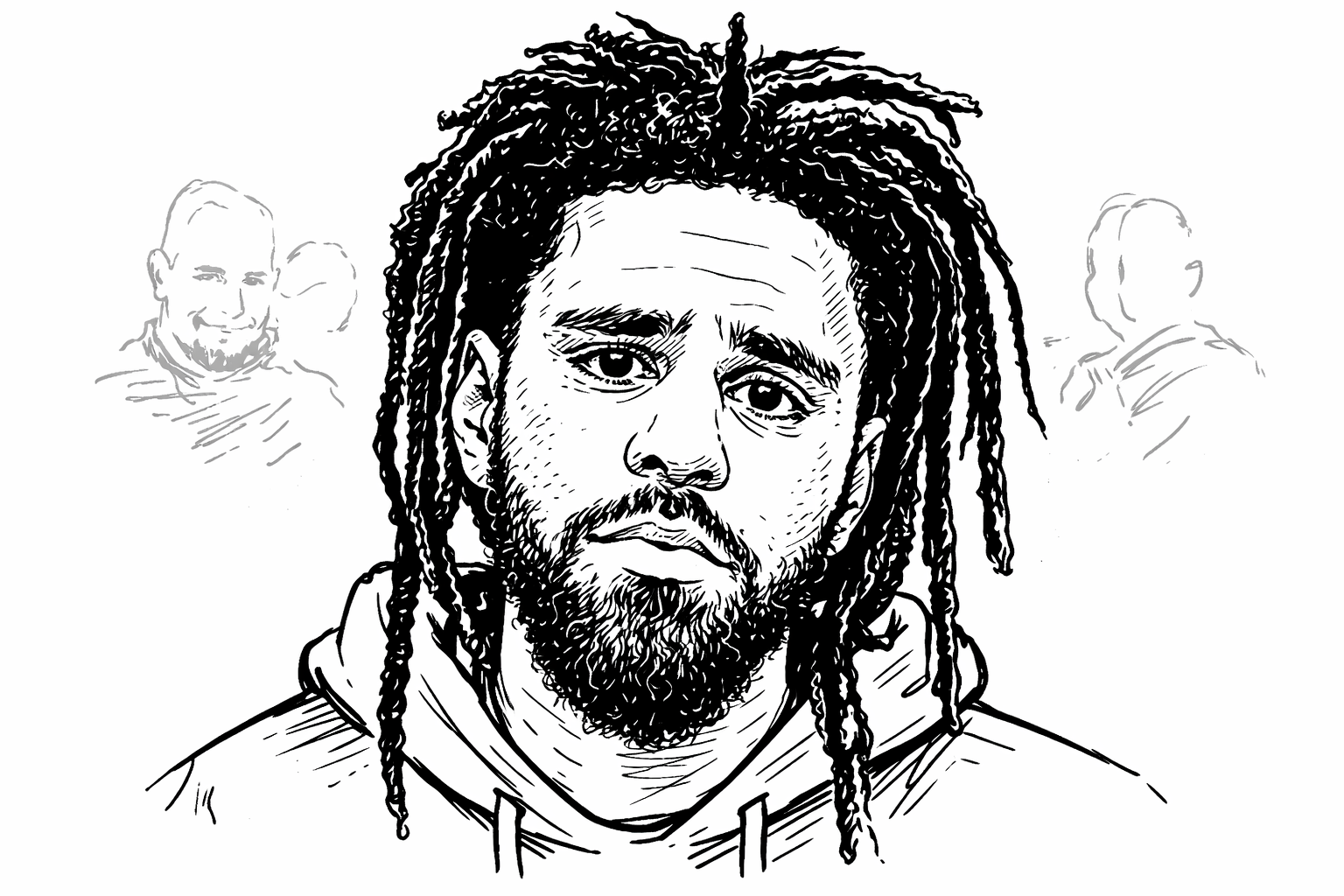
Part of Culture in Motion — an ongoing series examining who defines culture, how it’s interpreted, and how it shifts over time.
When Kendrick Lamar fired his opening shot on Future’s “Like That” — dismissing the idea of rap’s “Big Three” with the line “motherf*ck the big three, it’s just big me” — J. Cole felt tested for the first time. His response, “7 Minute Drill,” arrived two days later and took aim at Kendrick’s catalog. Then, almost immediately, Cole took the stage at Dreamville Festival and told the crowd he hadn’t been sleeping since the release, called the record the “lamest and goofiest shit” he’d ever done, and announced he was pulling it from streaming. The apology happened in real time, in public, in front of a live audience — at the exact moment the culture expected him to stand firm.
What made the moment more revealing came later. In a recent Apple Music interview, Cole shared that his wife Melissa Heholt was the only person he confided in before making the apology public. When he told her what he was planning to do, she cried — not from disappointment, but because she had watched the toll the situation was taking on him for days. Cole described it plainly: “She knows how I feel about him. She saw how it was weighing on me the two, three days before that. She could see in my whole energy.” That private moment — a wife’s tears before a public act of accountability — reframes what the apology was. Not a calculated move. The resolution of a tension that had already been present before he ever walked onstage.
Rap has always made space for vulnerability, but within limits shaped by performance. Pain can be expressed — but it tends to be framed through struggle, loss, or resilience, emotions that can be shaped into something clean enough for public consumption. What remains harder to articulate is the kind of conflict Cole was describing: ego in direct tension with integrity, pride pulling against internal alignment. That tension doesn’t resolve into a triumphant arc. It just sits there, visible and uncomfortable, which is exactly why it disrupts.
Cole was explicit about the source of the pressure: “The world wanna see blood. I don’t know if y’all can feel that, but the world wanna see blood. That shit disrupts my fucking peace.” That line matters because it names the external force clearly — not just the competitive logic of rap, but the audience’s appetite for conflict, which functions as its own kind of demand. Diss records are both strategy and spectacle, and within that system, escalation signals credibility while pulling back reads as failure regardless of the internal reality behind the decision.
Cole stepped outside of that system at the moment it most demanded adherence. And it cost him. He later admitted that the widespread backlash hit his confidence in ways he had to actively process: “Although the lightness that I felt made it easier to deal with, over time I had to sit with fears that ‘it’s over’ — that brought up emotions and fears I had to fight.” The vulnerability didn’t end with the apology. It extended into the aftermath, which is where most of the emotional labor actually lives and where it is almost never discussed publicly.
This connects to something SSC has examined in The Inner Work and Learning to Stand Where My Brother Stood — the specific weight Black men carry in navigating the gap between what they feel and what the culture permits them to express. Rap amplifies those expectations, turning them into performance, currency, and identity all at once. The hypermasculinity embedded in the genre is not created in isolation. It reflects broader cultural demands placed on Black men, where emotional control is equated with strength and vulnerability is policed both internally and externally. What Cole made visible was that reckoning — not after it was processed and packaged, but while it was still active and unresolved.
There is a long lineage of vulnerability within hip-hop, but it is almost always retrospective. The distance of time softens the impact, makes the emotion legible as wisdom rather than weakness. What made this moment different was its immediacy — the conflict visible in real time, without the buffer that usually makes it safer to share. That immediacy is precisely what challenged the genre’s expectations, because it refused to wait for resolution before becoming public.
Cole’s decision does not dismantle the system. But it introduces a disruption worth sitting with: that strength is not always the ability to persist at all costs, and that the willingness to step back when something no longer aligns is its own form of courage — one that carries real risk, tied less to losing and more to being perceived differently in a culture that watches closely and forgets slowly.
Why This Matters
The question this moment raises is not whether rap allows vulnerability. It’s under what conditions vulnerability is permitted to exist — and what it costs when it shows up unfiltered, in real time, without being softened first. When a Black man in one of the culture’s most competitive spaces chooses alignment over image, publicly and at personal cost, it forces a reconsideration of the rules. And underneath that: whether those rules still reflect the full range of what it means to be human within the culture, or whether they’ve simply been performing that range for so long that the performance has been mistaken for the thing itself.