
NATIONAL | ANALYSIS
Emotional intelligence has a professional definition: self-awareness, self-management, social awareness, relationship management. That framing positions it as a growth skill — something you develop to become more effective. For Black workers navigating environments not built to hold their full experience, it functions as something more specific. It is the work of surviving a system that requires constant adjustment without offering resolution.
The data from the HHS Office of Minority Health provides the backdrop. Black adults are 36% less likely than the overall U.S. population to receive mental health treatment, yet more likely to report persistent symptoms of emotional distress. The gap is not only about access. It reflects a system where what is experienced is not consistently met with care, coverage, or clinicians equipped to recognize what they’re seeing.
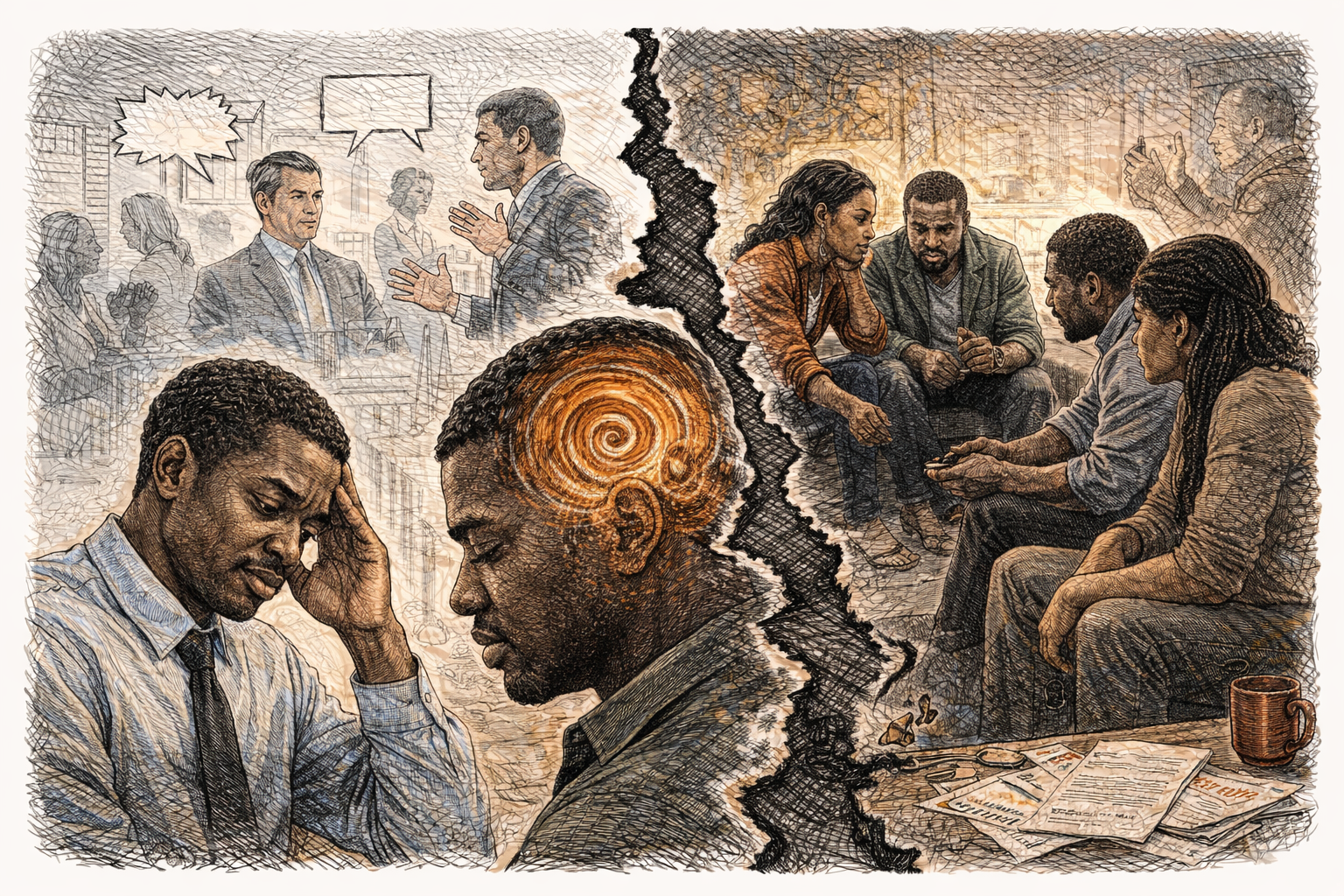
That gap does not remain empty. It gets carried and redistributed. In the workplace, emotional intelligence becomes the mechanism for holding what cannot be safely expressed — regulating tone, managing reactions, reading risk in real time. The skill is visible. The labor behind it is not.
As The Body You Can’t Talk About examined, the behaviors the culture rewards and the behaviors that signal something is wrong have become increasingly difficult to tell apart. Performing composure is not the same as feeling it. But in workplaces where Black professionals are already being evaluated against an invisible standard, the performance is not optional.
Outside of work, that pressure moves through the body and through community. Stress that cannot be named professionally accumulates — tension, fatigue, emotional strain without a clear outlet. In personal relationships, it gets processed collectively, through conversations, check-ins, and quiet recalibrations inside trusted spaces. As The Friend Group Audit Nobody Asked For documented, those spaces are harder to maintain than they used to be — which means the places where weight can finally be released are shrinking at the same time the weight is growing.
This is what reframes the skill. Emotional intelligence is not just about navigating others. It is about continuously managing what the environment does not resolve — deciding what to say, what to hold, and where it is finally safe to put it down.
The language of emotional intelligence promises development. What the data describes is endurance. The two are not the same, and the difference matters for how workplaces are designed, how mental health is resourced, and what gets counted as labor in the first place.