
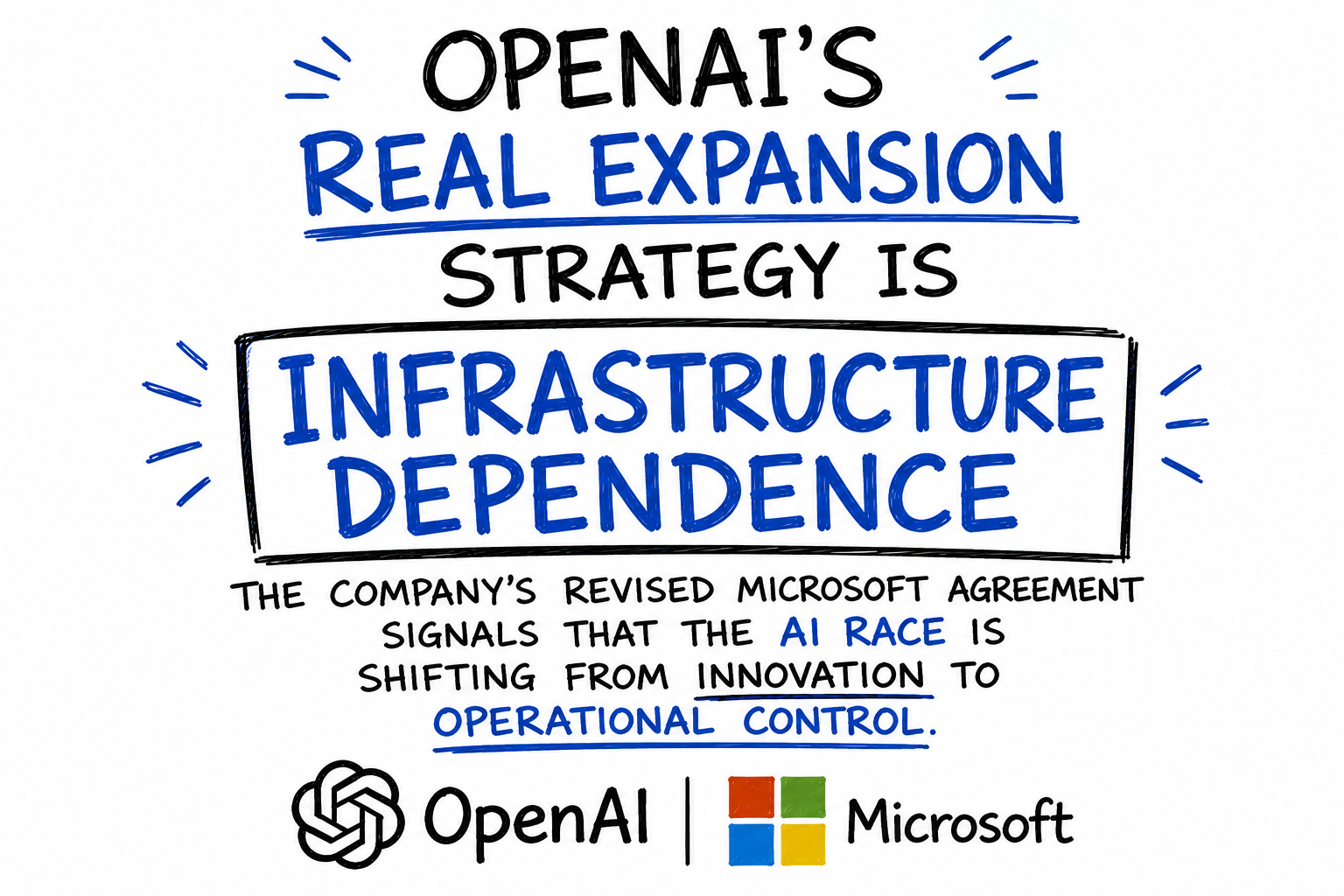
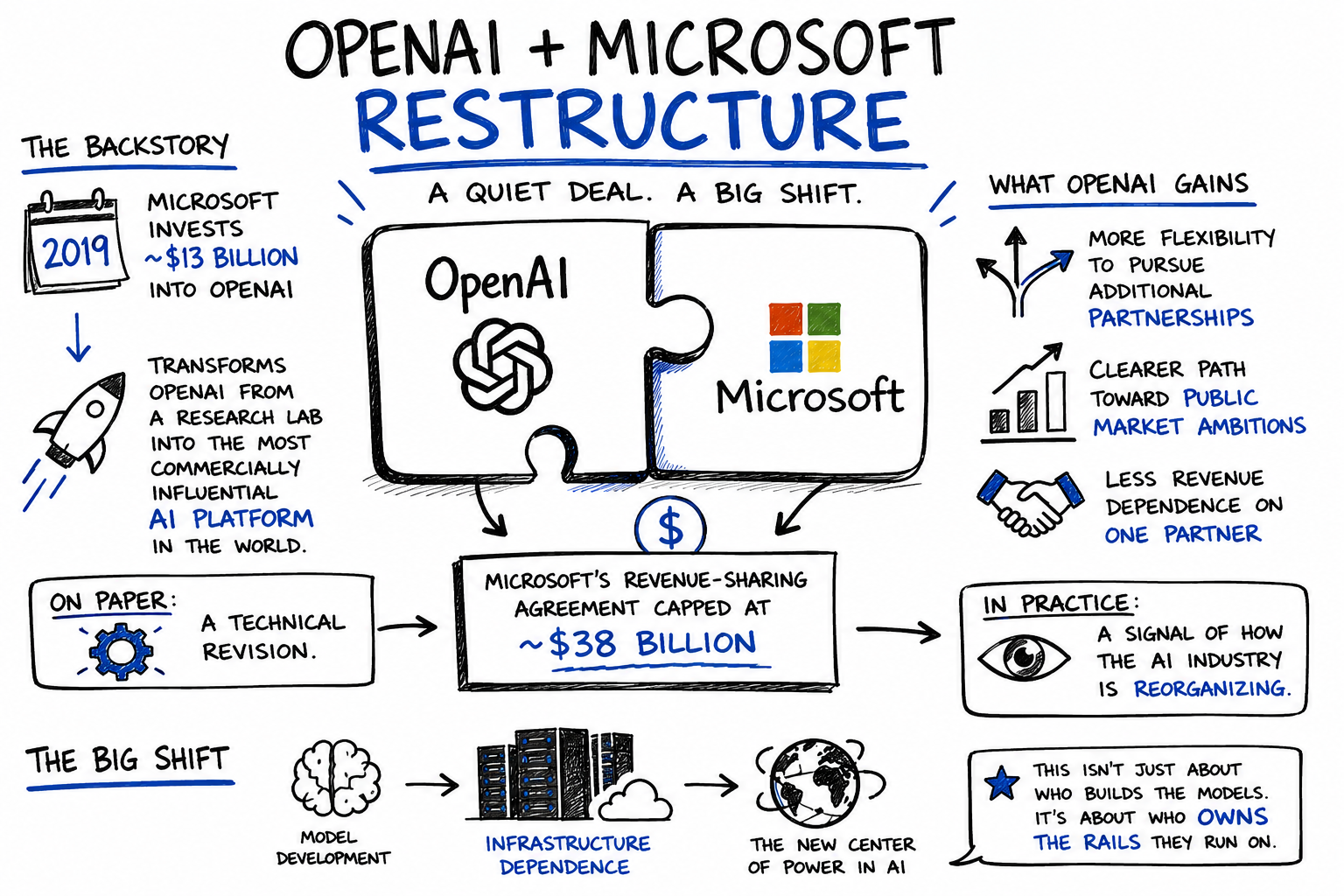
OpenAI and Microsoft quietly restructured one of the most consequential financial relationships in the technology industry this week, capping Microsoft’s revenue-sharing agreement with OpenAI at approximately $38 billion while giving the artificial intelligence company more flexibility to pursue additional partnerships and eventual public market ambitions. The adjustment arrives after Microsoft invested roughly $13 billion into OpenAI since 2019, helping transform the company from a research-focused organization into the most commercially influential AI platform in the world. On paper, the revision appears technical. In practice, it reveals how the AI industry is reorganizing around infrastructure dependence rather than simply model development.
For most of the past two years, public conversation around artificial intelligence has centered on who possesses the strongest model, the fastest innovation cycle, or the most advanced capabilities. That framing increasingly obscures where the real competition is moving. Building advanced AI systems is becoming only one layer of the market. The larger strategic fight now revolves around deployment, integration, and operational indispensability. OpenAI’s efforts to reduce exclusivity with Microsoft while maintaining access to Azure infrastructure reflects a broader industry realization: the company that becomes embedded deepest inside enterprise workflows may ultimately hold more durable power than the company with the single best model.
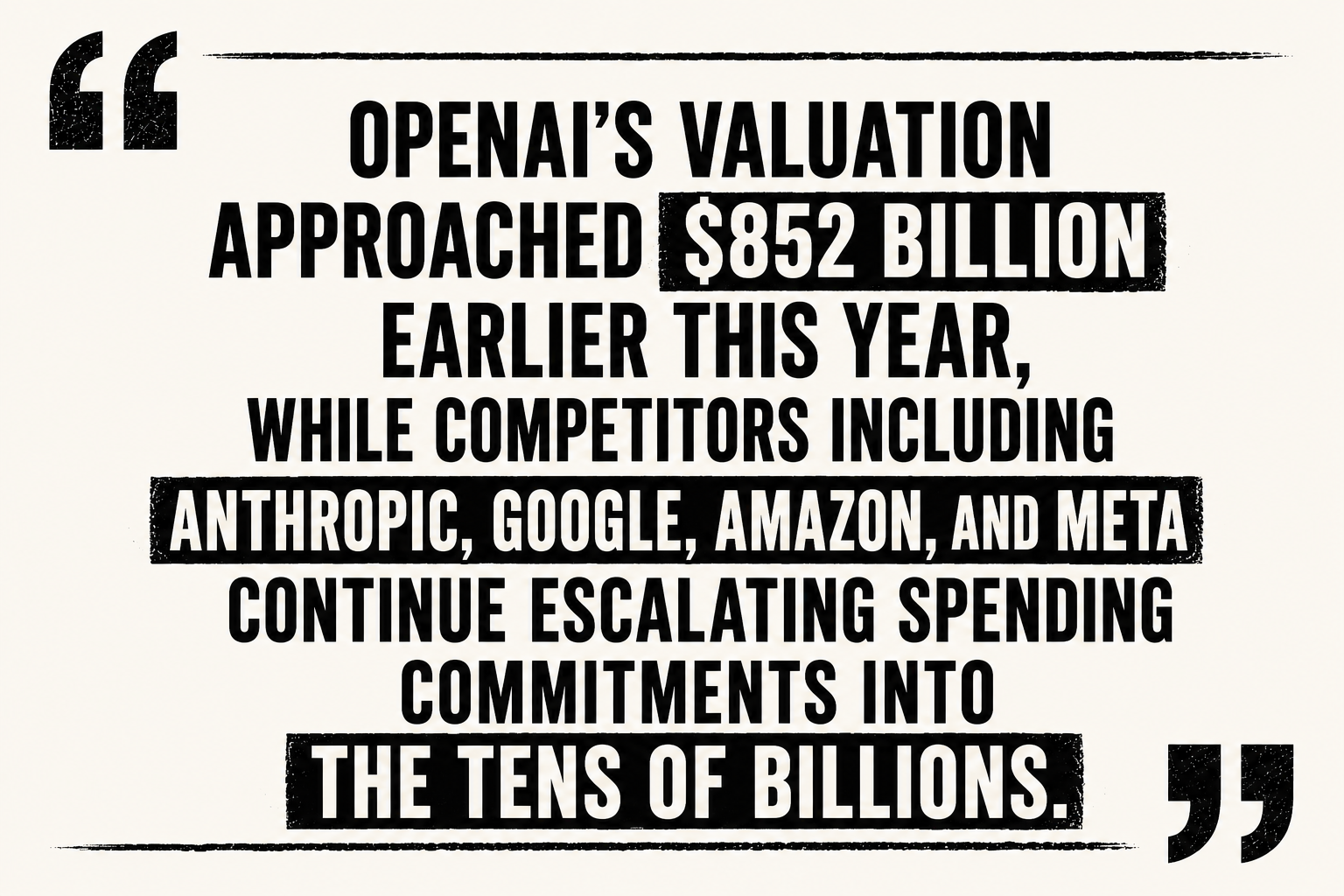
That distinction matters because the economics of AI are already evolving beyond the startup phase. OpenAI’s valuation approached $852 billion earlier this year, while competitors including Anthropic, Google, Amazon, and Meta continue escalating spending commitments into the tens of billions. Yet none of these companies operate in isolation. Their models rely on cloud providers, data center expansion, semiconductor supply chains, licensing agreements, and enterprise adoption relationships that increasingly resemble utility infrastructure more than traditional software competition. The industry is rapidly transitioning from experimental technology into institutional dependency.
The Microsoft relationship demonstrates the tension clearly. Microsoft helped accelerate OpenAI’s commercial scale by integrating its systems across Azure, Copilot products, and enterprise offerings. But dependence creates vulnerability in both directions. OpenAI needs compute power and enterprise reach. Microsoft needs AI products capable of justifying its extraordinary infrastructure spending. By capping the revenue-sharing agreement, OpenAI appears to be signaling that it cannot fully mature as a public-market company while remaining structurally tethered to a single corporate patron. The move resembles less a breakup than a recalibration of leverage.
The broader enterprise market helps explain why this matters now. Companies across finance, health care, education, media, logistics, and government are rapidly integrating generative AI systems into workflows tied to hiring, customer service, analytics, compliance, productivity, and internal communication. Enterprise research increasingly shows that organizations are prioritizing operational implementation over experimentation, with many executives now treating AI integration as a competitive necessity rather than an innovation project. That shift changes the incentives entirely. The goal is no longer merely to build powerful tools. It is to become impossible for institutions to remove once those tools are operationally embedded.
This transition also reframes the labor implications surrounding AI. Much public anxiety focuses on eventual automation outcomes, but the more immediate transformation involves organizational restructuring around AI-assisted efficiency. Companies do not need fully autonomous systems to justify workforce reductions or operational redesign. They only need enough functional integration to reorganize expectations around productivity.
Mainstream coverage often treats OpenAI’s valuation, partnerships, and fundraising activity as evidence of a rapidly accelerating innovation race. The more consequential reality is that the industry is beginning to resemble previous infrastructure consolidations that reshaped communications, transportation, and cloud computing itself. AI is increasingly less about isolated software products and more about becoming foundational to institutional operations. OpenAI’s revised Microsoft agreement matters because it signals that the companies building the models have already understood where the real long-term power sits. Infrastructure changes behavior before replacement fully arrives.