
The question is not only who owed money. It is what landlords owe when housing fails before tenants do.
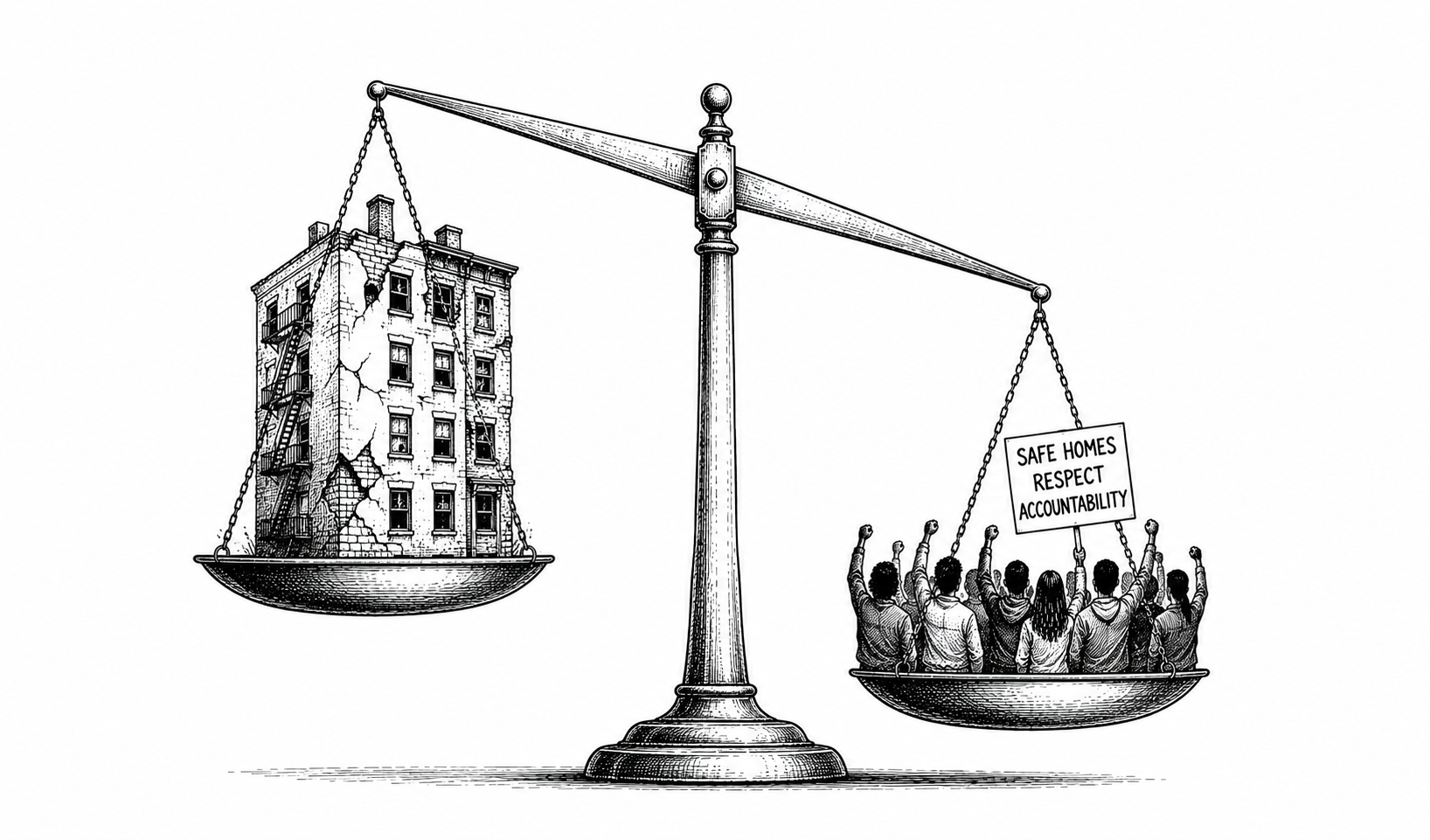
Thousands of tenants across New York City will no longer be required to repay years of unpaid rent after the new owner of a 93-building portfolio agreed not to pursue arrears for residents who stay current going forward. The agreement covers more than 5,000 mostly rent-stabilized apartments acquired by Summit Properties from the bankrupt Pinnacle Group in March 2026. Summit has not finalized the exact number of tenants affected, but a company spokesperson estimated the forgiven debt totals millions of dollars. The agreement followed years of organizing by the Union of Pinnacle Tenants.
That framing matters. This was not a landlord charity story. It was a tenant-power story.
Residents had described unsafe conditions across the portfolio, including collapsed ceilings, heat outages, dark hallways, broken basic systems, and common areas affected by unpaid utility bills. Tenant advocates said many residents fell behind after enduring those conditions, while others were already under financial strain. Vivian Kuo, a Union of Pinnacle Tenants representative in Harlem’s Hamilton Heights neighborhood, described the agreement as direct monetary redress for what residents had lived through.
The back rent was treated like tenant debt. The buildings’ conditions tell a different story.
Housing policy often separates rent collection from habitability, as if the monthly bill exists apart from the condition of the home. But tenants are not buying an abstract unit on a spreadsheet. They are paying for heat, safety, functioning ceilings, secure doors, lit hallways, working fire escapes, and a basic standard of shelter. When those conditions collapse, the economics of rent become harder to describe as a simple debt obligation.
That is the structural issue underneath this agreement.
The Pinnacle portfolio had already become part of a larger municipal fight. City officials sought to intervene in the bankruptcy process, citing nearly $13 million in unpaid taxes and fines owed by Pinnacle. A federal judge rejected the city’s attempt to delay the sale, allowing Summit to complete its $451 million purchase in March 2026. As part of the bankruptcy-related commitments, Summit CEO Zohar Levy pledged $30 million in building improvements over five years and agreed to address thousands of housing code violations. Company officials said about 3,500 violations had been corrected by June 1.
Those numbers show why the rent forgiveness matters beyond the individual tenants affected.
The portfolio moved through bankruptcy, debt, fines, violations, public pressure, and sale. Tenants were not the only people with unpaid obligations in the story. The former owner owed the city. The buildings carried unresolved code violations. Residents carried arrears. The question was which debts would be enforced and which failures would be treated as part of doing business.
For tenants, organizing changed that calculation.
Without collective pressure, unpaid rent likely remains a tenant liability. With organizing, the arrears became evidence in a larger argument about the cost of neglect. The agreement does not erase the years residents spent living with unsafe conditions, and it does not automatically repair every remaining violation — tenant organizer Jesse Ryan said residents still expect Summit to address thousands of additional issues identified during city inspections this spring. But the agreement does create a public acknowledgment that tenants should not be the only party asked to absorb the financial consequences of broken housing.
That is the piece other cities should notice.
Across the country, the affordable housing conversation often focuses on supply, zoning, rent levels, and subsidies. Those are real issues. But this case points to another part of the system: enforcement. A rent-stabilized apartment is not affordable if the building is unsafe. A housing portfolio is not functioning if unpaid fines, code violations, and deteriorating conditions are allowed to accumulate until the only numbers treated as urgent are the ones attached to tenants.
The New York agreement shifts the frame. It says unpaid rent cannot be discussed honestly without also asking what was unpaid to tenants: repairs, safety, services, stability, and years of habitable housing. Tenant debt is not always a clean ledger. Sometimes it is the final line item in a much larger system of deferred responsibility.
The next test is whether this remains an exception or becomes a model. If Summit completes the repairs, corrects remaining violations, and keeps residents housed, this agreement could become a case study in how tenant organizing, bankruptcy pressure, and municipal scrutiny can force a housing reset. If not, the arrears forgiveness will be remembered as a one-time concession inside a deeper pattern.
Either way, the lesson is already visible. The tenants did not win because the system worked automatically. They won because they organized long enough to make the system account for what it had ignored.
— SSC News Desk | Social Storytellers Collective
Related SSC Analysis: The Community Land Trust Model Is Working. It Just Isn’t Scaling. — A different mechanism for the same argument: what happens when housing infrastructure is held accountable to residents rather than market return.
Get SSC analysis delivered to your inbox every day. Subscribe free on Beehiiv: socialstorytellerscollective.beehiiv.com