
“It was standard practice in my community for a person to get their paycheck, cash it at the local liquor store and be happy,” Kier Gaines told EBONY. “I wasn’t necessarily opposed to banks. I just didn’t have an example of what to do.”
That sentence contains the entire argument.
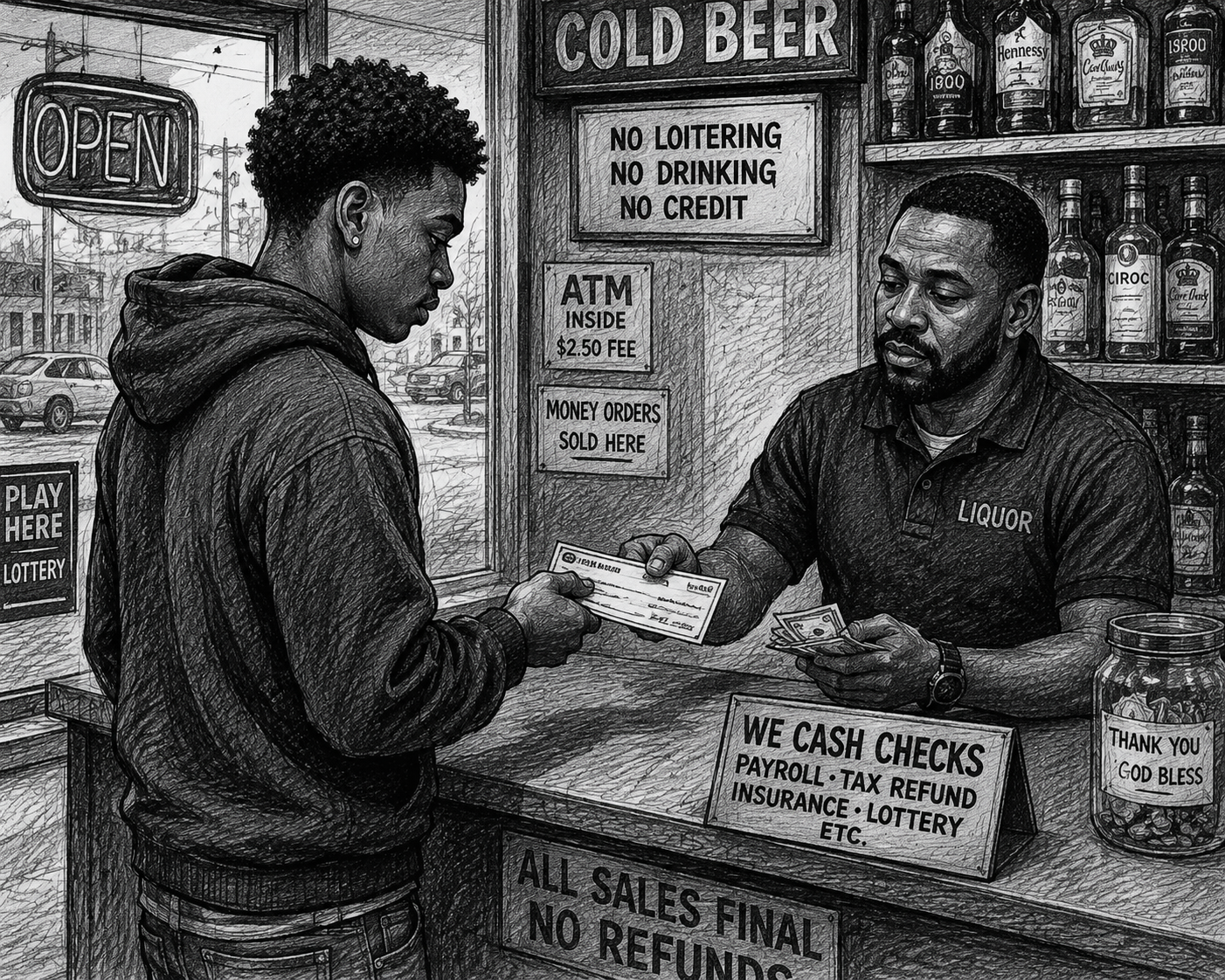
Gaines — therapist, mental health advocate, and one of the most widely followed voices on financial wellness for Black men — is not describing ignorance. He is describing inheritance. The absence of a banking relationship in his community was not a personal failure. It was a practiced, reasonable adaptation to a financial system that had spent decades demonstrating, through redlining, discriminatory lending, and branch desertification in Black neighborhoods, that it was not built for everyone equally. You cash your check where the check gets cashed. You do what you were shown. Nobody taught you what they were never shown.
Eight years at the same number
A recent study from the Global Financial Literacy Excellence Center found that financial literacy in the United States has hovered at exactly 50% for eight consecutive years. Half the country. The same half. For nearly a decade.
That flatline is not a measurement of individual capacity. It is a structural indictment. Financial literacy does not exist in a vacuum — it is shaped by whether you grew up watching adults around you navigate bank accounts, investment vehicles, credit-building strategies, and homeownership decisions. It is shaped by whether your school had a personal finance curriculum. It is shaped by whether the bank branch in your neighborhood closed when you were twelve, whether your family used payday lenders because the overdraft fees at the traditional bank were too unpredictable, whether the financial products marketed in your community were designed to extract rather than build.
According to FDIC data, 5.9 million US households currently have no bank accounts. The reliance on high-cost alternatives — check cashing services, payday loans, money orders — costs the average unbanked family an estimated $40,000 in lifetime fees, representing a potential loss of $360,000 in generational wealth over time. That is not a literacy problem. That is an access and design problem that produces a literacy gap as one of its symptoms.
What the Wells Fargo initiative promises
Into this gap steps Wells Fargo’s Banking Inclusion Initiative — a 10-year commitment launched in 2021 to expand banking access for unbanked and underbanked consumers, with a specific focus on Black, Hispanic, and Native American communities. The initiative includes Clear Access Banking, a low-cost account with no overdraft fees. It includes more than 30 HOPE Inside financial coaching centers embedded in Wells Fargo branches, with a commitment to expand to 50 centers by 2026. It includes 100-plus community connection branches specifically designed to serve low-to-moderate-income neighborhoods, representing nearly 30% of Wells Fargo’s total branch footprint.
“So many families want to build financial stability, yet they just need the right access and support,” Nadia van de Walle, Business Executive Director of Consumer Banking and Lending at Wells Fargo, told EBONY. “The Banking Inclusion Initiative is our 10-year commitment to expanding that access and providing the support people need to move forward with confidence.”
The framing is right. The structural logic — that access precedes literacy, that you cannot teach someone to use a system they cannot reach — is correct. The initiative is real, the products exist, and the coaching centers are operating.
But the institution delivering it carries a history that the initiative cannot simply sidestep.
The credibility gap
Wells Fargo is one of the most documented examples of predatory banking targeting Black and Latino communities in American financial history. In 2012, the bank settled a landmark $175 million Department of Justice lawsuit — at the time the largest fair lending settlement in DOJ history — after it was found to have systematically steered Black and Latino borrowers into subprime mortgages with higher fees and interest rates than white borrowers with identical credit profiles. Internal documents showed loan officers referring to subprime products as “ghetto loans” and describing Black borrowers as targets. In 2016, the bank was fined $185 million after it was revealed that employees had opened 3.5 million unauthorized accounts — a scandal that disproportionately harmed lower-income customers who were least equipped to identify and dispute the fraudulent charges.
The same communities Wells Fargo is now committing to include are communities that experienced its exclusion firsthand, in some cases within the last decade.
That tension does not make the Banking Inclusion Initiative worthless. It makes it complicated in a way that deserves honest acknowledgment rather than institutional marketing language. Kristy Fercho, Wells Fargo’s Senior Executive Vice President and Head of Diverse Segments, Representation and Inclusion, told EBONY that the bank’s efforts “were never performative but positioned for the long haul.” That claim will be measured against a decade of outcomes, not a press release.
What genuine financial inclusion actually requires
Kier Gaines is right that access is the entry point. Before literacy comes exposure — the lived experience of watching someone you trust navigate a financial system successfully and showing you how to do the same. The HOPE Inside coaching model, embedded in branches rather than requiring a separate trip to a separate institution, is an attempt at exactly that kind of proximate support. The no-overdraft-fee account is an attempt to remove the specific product feature that most frequently pushes lower-income customers out of traditional banking entirely.
But the 50% financial literacy flatline tells you that access alone is not sufficient. Access without trust does not produce engagement. Access without community-level credibility — which is built through demonstrated behavior over time, not initiative announcements — produces sign-ups that don’t stick and accounts that don’t get used.
Genuine financial inclusion requires institutions to reckon with why people adapted to alternatives in the first place. Kier Gaines cashed his check at the liquor store not because he was financially illiterate. He did it because that was the example he was given — and because the example he was given reflected a rational response to institutions that had not, historically, shown up for communities like his.
That is the problem an initiative needs to solve. Whether Wells Fargo’s 10-year commitment is long enough, structural enough, and honest enough about its own history to solve it is the question the next decade will answer.