
Nigeria’s federal government approved sweeping reductions in import tariffs across 127 product categories under the 2026 Fiscal Policy Measures, citing inflationary pressure and the need to stimulate economic activity. The import duty on rice was reduced from 70% to 47.5%, with broken rice now attracting 30%. Tariffs on fully built vehicles dropped from 70% to 40%. Refined salt, stationery, and a range of household and industrial goods received similar reductions.
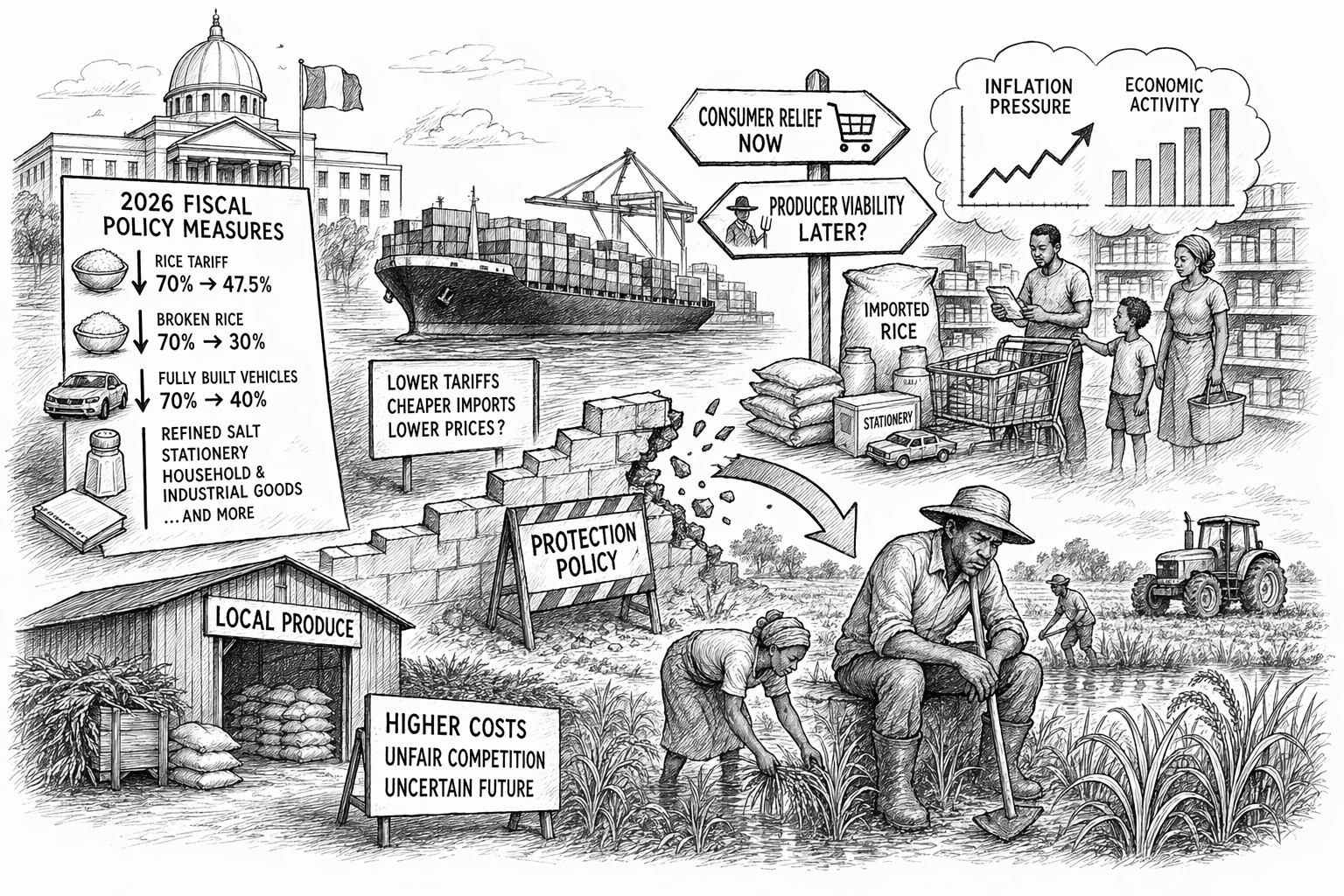
The framing is economic pragmatism. The reality is a policy reversal that the government has not characterized as one. For years, successive Nigerian administrations built an agricultural development framework around high import tariffs and border controls designed to shield domestic producers while local capacity developed. The rice self-sufficiency push was the most visible element of that strategy. The 2026 FPM now quietly dismantles the protective structure that strategy depended on — without a public accounting of why the prior approach fell short or what replaces it.
The sudden tariff cuts raise a question the government has not answered: is this a pragmatic response to conditions the prior policy could not resolve, or a concession that the import substitution strategy failed? Both answers carry consequences for Nigerian farmers who made production decisions based on the tariff protection that is now being removed. The zero-duty provision on imported machinery — also included in the FPM — points toward a different logic, one that incentivizes production capacity. But that provision cannot offset the competitive damage to agricultural producers facing subsidized imports at the moment their own resilience is most fragile.
This connects directly to the tralac analysis SSC is tracking in this cycle, which found that U.S. tariff architecture against Africa was shaped by U.S. domestic political economy rather than any coherent Africa trade strategy — with energy and mineral exports carved out while agricultural and industrial goods absorbed the highest tariff exposure. Nigeria sits at the intersection of both pressures: facing external tariff regimes it did not design, while simultaneously retreating from the domestic protection policy it built in response to those same external vulnerabilities.
West Africa is projected to expand by 4.4% in 2026. Food price inflation remains above 10% in many countries across the region. The distance between those two numbers is where the Nigerian farmer lives — between aggregate growth figures that signal stability and household economic realities that signal the opposite.
What the FPM represents, at its core, is a government choosing between two constituencies it cannot simultaneously protect: consumers who need cheaper food now, and producers who need policy stability to build for the future. The choice was made quietly, without a framework for what follows.
Structural Reality | Society & Economy | Africa Beat | News Desk