
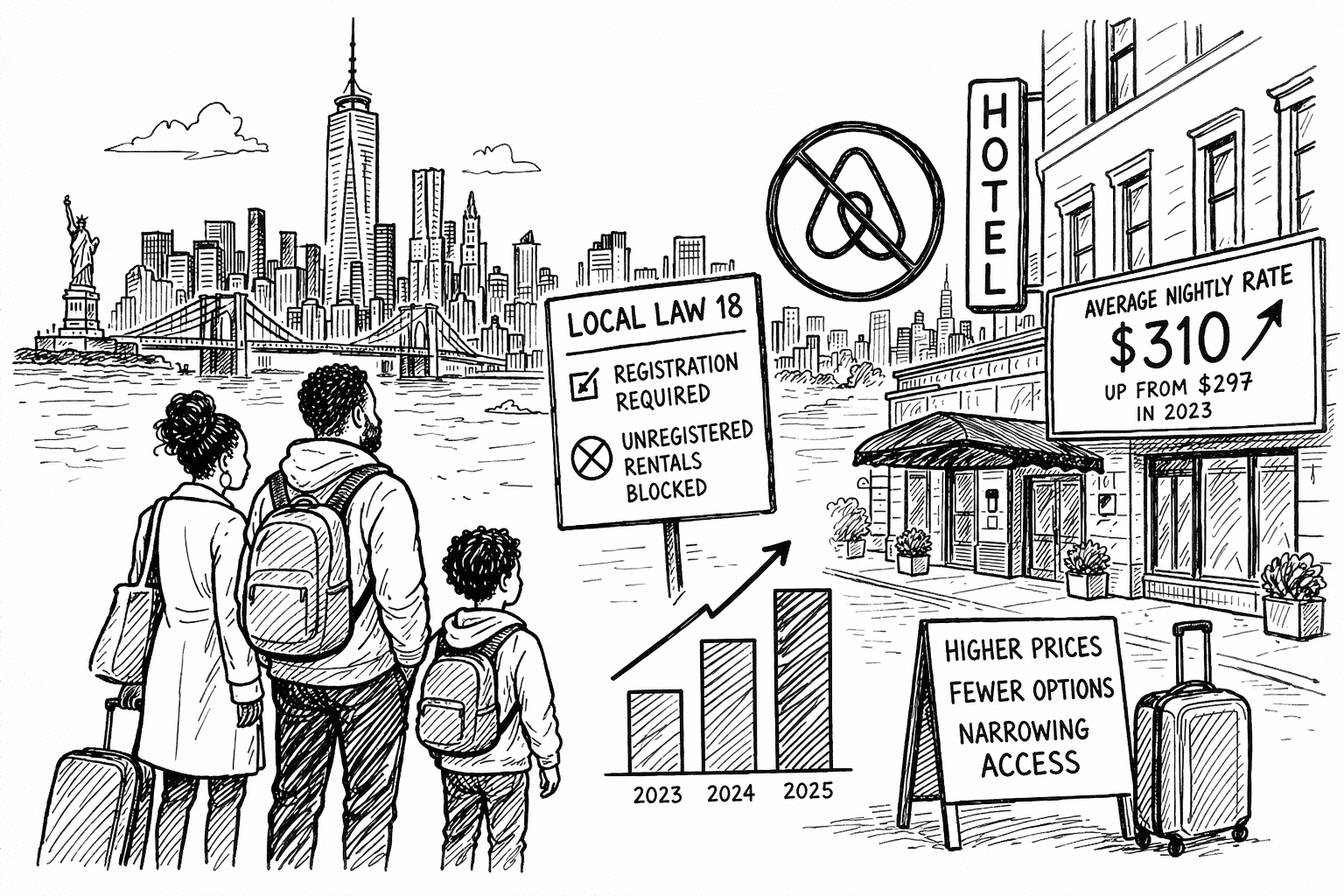
New York’s short-term rental crackdown is regularly framed as a housing policy win. The fuller story is more complicated — and for many travelers, considerably more expensive.
Local Law 18 requires hosts to register with the city and bars booking platforms from processing transactions for unregistered short-term rentals. The intent was to return investor-held units to the long-term rental market and ease pressure on a housing stock that was already stretched thin. Whether it has meaningfully moved that needle is still being measured. What is already visible is what happened to the tourism economy around it. In January 2026, citywide hotel occupancy averaged roughly 73%, slightly above January 2020 levels, and hotel revenue per available room was estimated to be up 6% year over year. New York’s own budget documents show average hotel room rates running from $297 in 2023 to $298 through October 2024, with a forecast of $310 for the full year — a trajectory that has not reversed.
That trajectory matters because lodging is not a neutral variable. When lower-cost and group-friendly alternatives contract, the floor on what it costs to enter the city rises with them. Airbnb and platforms like it were imperfect, and their concentration in certain neighborhoods carried real displacement consequences. But they also functioned as a price tier that made New York accessible to visitors and family groups who could not absorb $310 per night multiplied across multiple rooms and multiple nights. That tier has been significantly compressed. The tier that replaced it has not been made more affordable.
The economic stakes of that shift extend well beyond individual travel budgets. In a city where tourism spending supports an estimated 60 to 65 percent of local jobs in arts and entertainment and 30 to 35 percent of jobs in restaurants and bars, lodging policy does not stay contained to housing. It shapes who can afford to show up, who benefits from those visitors once they arrive, and which neighborhoods remain part of the city’s active hospitality economy. By spring 2025, the comptroller’s office reported that hotel occupancy and room rates were holding steady while Broadway attendance and revenue were running ahead of pre-pandemic levels — a signal that the premium tourism market has recovered and is performing well. The question is what that recovery looks like for the tourism economy below the premium line, and for the communities whose economic participation depends on volume, not margin.
The deeper issue is not whether short-term rentals deserved to be regulated. Many of them did. It is what happens when a city restricts one form of access without creating a viable, affordable alternative — and without asking who absorbs the cost of that gap. For Black and Brown travelers, for working-class families planning a trip to visit relatives, for diaspora communities returning to neighborhoods that have already been reshaped by rising rents, the answer is increasingly the same: New York is available, but not at every price point, and the range of price points continues to narrow. Policy does not have to be designed as exclusion to function that way. Sometimes the mechanism is simpler. You remove a rung, you raise the floor, and you call it housing reform.