
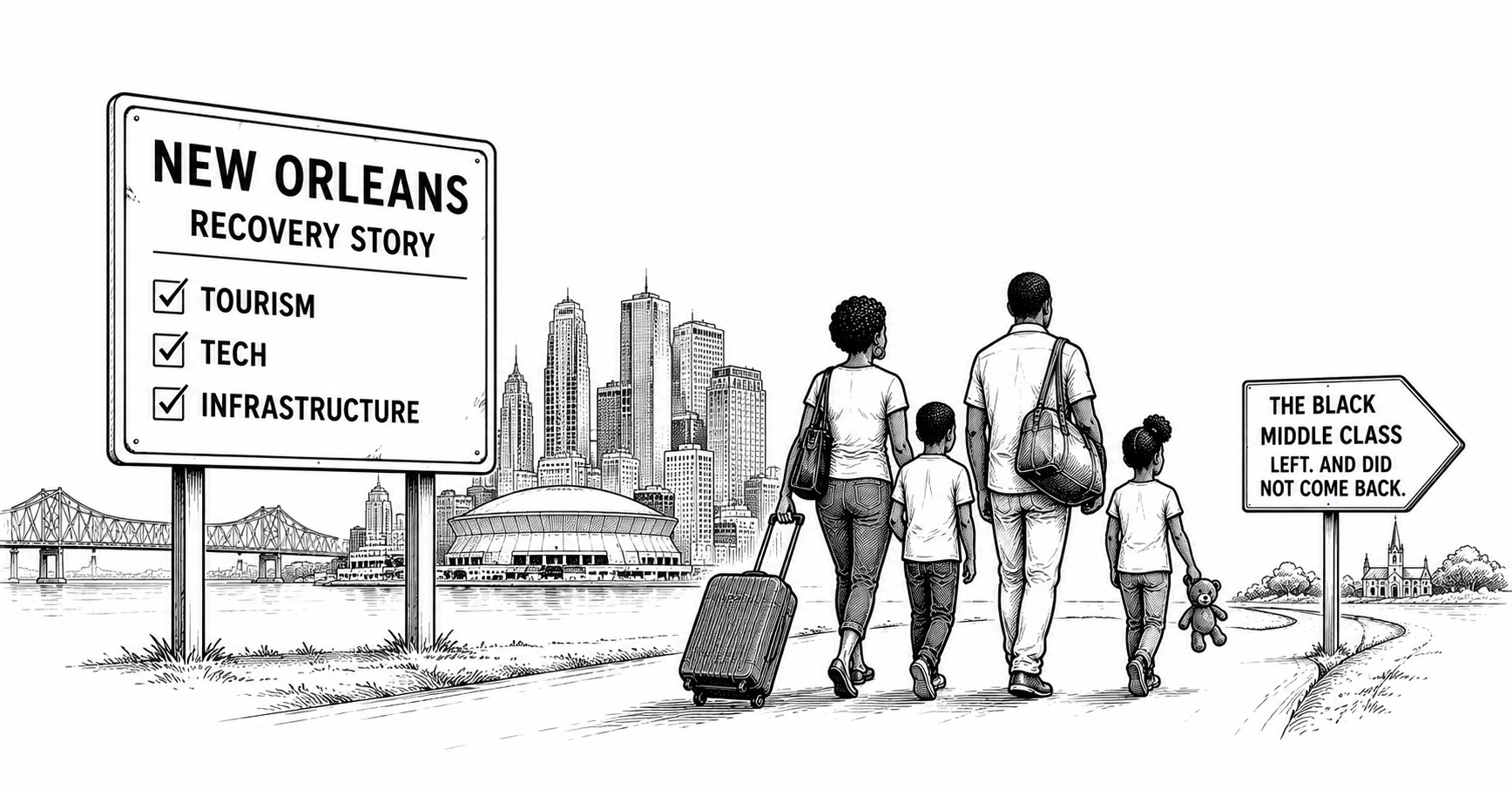
Twenty years after Hurricane Katrina, New Orleans is regularly described as a recovery story. The tourism economy is functional. A tech sector has emerged. Aerospace and clean energy have diversified the employment base. Greater New Orleans Inc. points to a more resilient city than the one the levees failed in 2005.
Before Katrina, New Orleans was about 67% Black. Today that number is closer to 57%. The city has lost more than 121,000 Black residents. The recovery is real. The question it refuses to answer is who it was for.
The Black middle class did not simply leave during the storm. It left and did not come back — and the conditions that would bring it back have not been built. Gregory Price, a professor of economics at the University of New Orleans, told Smart Cities Dive that local household median income rose 12% between 2000 and 2020 — but “Black households in New Orleans saw no rise in median income” during that period. The city’s aggregate income figure improved. The Black share of that improvement was zero.
The labor market structure explains why. New Orleans has shed a lot of the jobs that were staples of the Black middle class. After Katrina, the state took over nearly all public schools — eliminating one of the largest stable employment pipelines for Black professionals in the city. The hospitality and tourism economy that drives New Orleans’s recovery narrative depends heavily on low-wage service labor. Louisiana’s minimum wage has remained at $7.25 since 2009 — the federal floor, with no state supplement. The jobs that came back are not the jobs that left. The people who held the jobs that left have largely not come back either.
Housing is the structural lock that holds everything else in place. To afford a modest two-bedroom apartment at fair market rent in New Orleans, a full-time worker needs to earn $22.73 an hour. At the federal minimum wage of $7.25, that same worker would need to work 126 hours a week just to avoid being rent-burdened. As of 2025, the average rent for a one-bedroom apartment in New Orleans runs approximately $1,308 per month. A city that cannot house its working class at its own wage floor is not experiencing a housing shortage. It is experiencing a policy choice — and the people absorbing that choice are the ones with the least leverage to negotiate around it.
Policies and practices in New Orleans that impede affordable housing have significantly contributed to racial segregation — for decades, Black residents looking for housing have been forced to rent or buy in neighborhoods consistently underserved and under-resourced due in part to a long history of redlining. Post-Katrina reconstruction did not interrupt that pattern. In several neighborhoods, it accelerated it.
New Orleans is one of the weakest employment markets in the country. More residents are leaving the city for opportunities elsewhere. Louisiana’s total sales tax rate exceeds 10% in some areas — a regressive structure that extracts a disproportionate share of income from the households least able to pay it.
The recovery narrative New Orleans projects outward — diversified economy, rebuilt infrastructure, cultural vitality — is accurate as far as it goes. What it does not account for is the population that was present before Katrina, contributed to the city’s cultural and economic identity, and has not been given the conditions to return. The result is a reshaped city: whiter, wealthier, and more gentrified. Those are not incidental outcomes of a natural disaster. They are the outcomes of twenty years of policy decisions about who the rebuilt city was designed to serve.
When a city’s recovery metrics improve while its Black middle class continues to leave, the metrics are answering a different question than the one worth asking.
Get SSC analysis delivered to your inbox every day. Subscribe free on Beehiiv: socialstorytellerscollective.beehiiv.com