
A proposed federal rule could place as many as 3.7 million people at risk of losing rental assistance by introducing stricter time limits on how long households can receive support. The analysis, from the Center on Budget and Policy Priorities, warns that the change would significantly reduce access to housing subsidies for low-income renters, many of whom already face rising rents and limited alternatives. The proposal would shift assistance programs away from long-term stabilization and toward fixed-duration support.
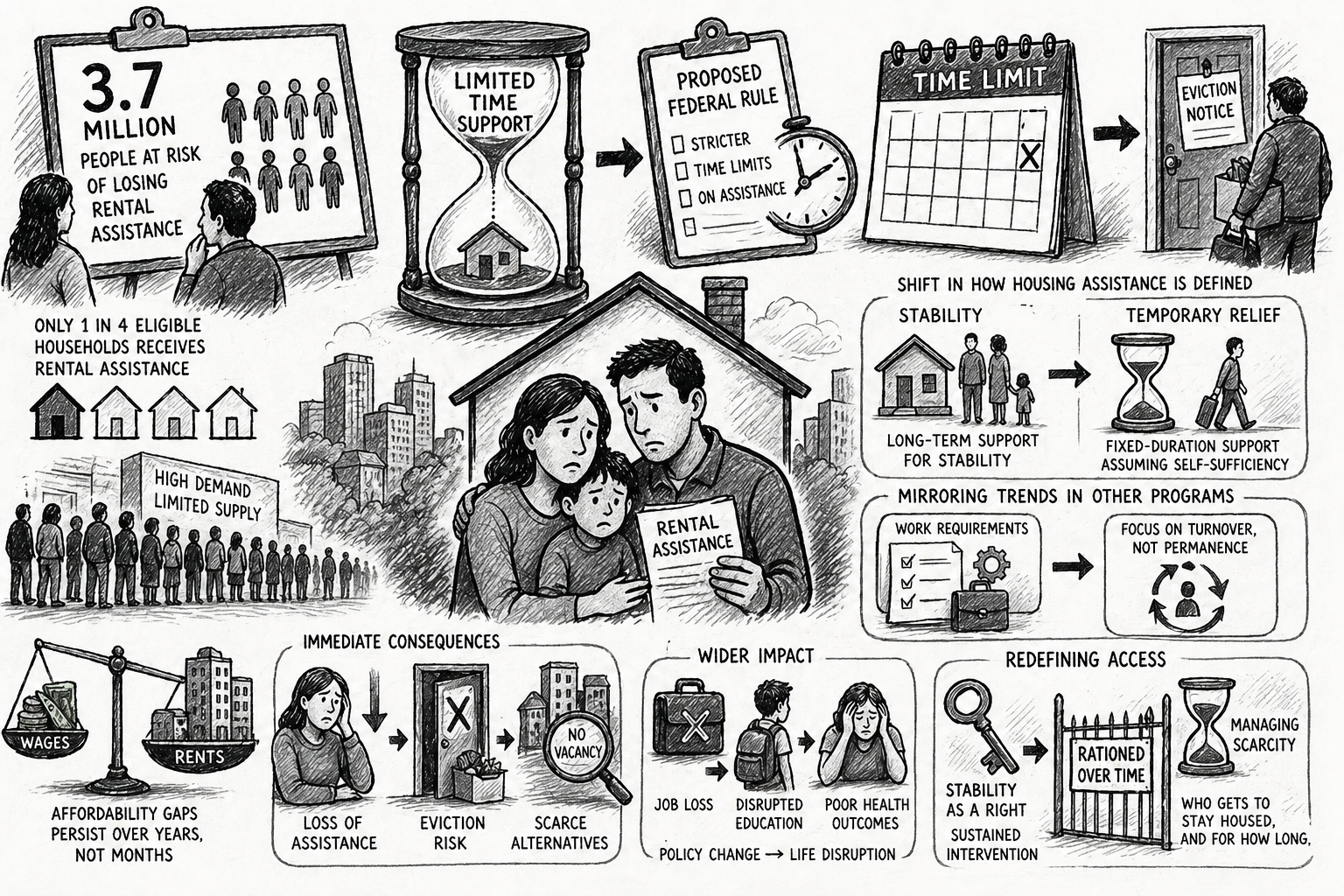
The timing reflects broader pressures on federal housing programs, where demand has consistently outpaced supply. Only about one in four eligible low-income households currently receives federal rental assistance, leaving millions already outside the system before any cuts take effect. Introducing time limits does not reduce need. It redistributes access within a constrained pool, effectively cycling households through support rather than expanding coverage.
The structural shift is in how housing assistance is being defined. Programs like vouchers were originally designed to provide stability in a market where rents exceed what low-income households can afford. Time limits reframe that support as transitional, implying that recipients will move into self-sufficiency within a fixed period. That assumption does not align with wage growth or housing costs, particularly in high-rent cities where affordability gaps persist over decades, not years.
This approach mirrors policy trends in other areas of social support, where benefits are increasingly conditioned on duration rather than need. Work requirements in public assistance programs operate on a similar logic, emphasizing turnover over permanence. In housing, that logic introduces a new risk: that assistance expires before stability is achieved, pushing households back into the very conditions the program was designed to prevent.
The real-world implications are immediate for renters already operating on thin margins. Losing assistance does not simply mean adjusting a budget. It often means facing eviction in markets where vacancy rates are low and alternative housing is scarce. For families, that instability can cascade into disruptions in employment, education, and health, turning a policy change into a broader life disruption.
What is emerging is a redefinition of access itself. Housing support is no longer being positioned as a sustained intervention in a structurally unaffordable market. It is being treated as a limited resource to be rationed over time. That shift moves the system away from guaranteeing stability and toward managing scarcity, reshaping who gets to remain housed and for how long.